We use Google Analytics to understand how visitors use this site. Analytics cookies are only activated with your consent. For details, read our Privacy Policy.
Profile lensThe same player, read from a different angle.
Athletic84
Acceleration
86
Pace
83
Agility
85
Strength
77
Balance
78
Jumping
85
Stamina
86
Fitness
90
Technical85
Dribbling
83
Short Passing
86
Long Passing
85
Finishing
69
Shot Accuracy
78
Shot Power
83
Shooting Technique
79
Heading
83
Tackling
90
Crossing
76
Free Kick
70
Penalties
72
First Touch
86
Mental91
Composure
95
Aggression
77
Consistency
92
Creativity
78
Leadership
89
Work Rate
88
Tactical90
Vision
86
Off the Ball
78
Defensive Positioning
96
Teamwork
95
Anticipation
92
Marking
89
Player Traits
Attacking77
Crossing
76
Finishing
69
Heading Accuracy
83
Shot Accuracy
78
Off the Ball
78
Technique82
Dribbling
83
Free Kick
70
Short Passing
86
Long Passing
85
First Touch
86
Shot Technique
79
Movement83
Acceleration
86
Pace
83
Agility
85
Balance
78
Physicality84
Shot Power
83
Jumping
85
Stamina
86
Strength
77
Fitness
90
Defending92
Marking
89
Tackling
90
Def. Positioning
96
Mentality & Game Reading86
Aggression
77
Composure
95
Penalties
72
Vision
86
Leadership
89
Work Rate
88
Teamwork
95
Anticipation
92
Consistency
92
Creativity
78
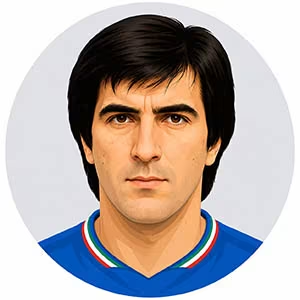
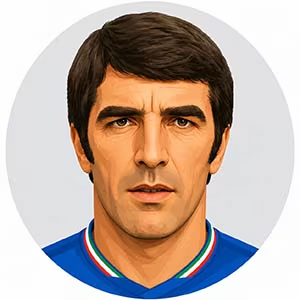
Italy - SweeperScirea, Gaetano
At the Santiago Bernabéu on 11 July 1982, Italy were leading West Germany 2–0 in the World Cup final when Gaetano Scirea advanced from the defensive line into the right side of the penalty area. Rather than forcing a shot, he exchanged possession, remained involved and eventually received the ball again near the byline before cutting it backwards for Alessandro Altobelli to score the third. The sequence began with Italy protecting a lead in a World Cup final and ended with their libero operating inside the opposing penalty area. It captured Scirea’s interpretation of defensive responsibility: security did not necessarily mean retreat. Once he had read that the structure behind him remained protected, he could become an additional midfielder and then an attacker. His authority over the game came less from imposing himself on every confrontation than from recognising when the confrontation could be bypassed entirely.
Scirea began as a midfielder before becoming a libero, and the origins remained visible throughout his career. He defended primarily through anticipation, cover and control of distance rather than through repeated direct marking. At Juventus, more aggressive defenders could engage the centre-forward while Scirea operated behind and around them, reading the second movement and deciding whether to intercept, cover or advance after possession changed. Once the ball was recovered, he could carry into midfield and distribute with the technical security of a player comfortable outside the defensive line. His passing was progressive without being reckless, and his timing allowed him to join attacks selectively rather than leaving defensive space through constant forward movement. Juventus won every major UEFA club competition during his career as well as seven Serie A titles, while Scirea accumulated 78 appearances for Italy and became a central figure in the 1982 World Cup-winning side. His effectiveness therefore came from connecting phases: defensive reading became possession, possession became progression and, when the structure permitted it, progression could become direct attacking contribution.
There were nevertheless clear limitations. Scirea was not a dominant specialist man-marker and benefited from defensive structures containing teammates more naturally suited to sustained physical confrontation. Asking him to remain permanently attached to a powerful centre-forward would reduce the spatial perspective from which his anticipation worked best. Nor was his avoidance of unnecessary fouling evidence that he could solve every duel without contact. His comparative advantage depended on seeing the attack develop early enough to choose the cleaner solution; once isolated late in an action, the range of available responses narrowed like it did for any defender. His forward movement likewise depended on collective coverage. A structure unable to protect the space he vacated would turn one of his greatest strengths into risk. As he aged, reduced mobility made advance-and-recover sequences more demanding, increasing the importance of positioning. Scirea’s elegance should therefore not be confused with defensive omnipotence: his football was most effective when the surrounding system allowed intelligence to replace unnecessary confrontation.
Psychologically, Scirea is best defined by **de-escalatory authority through solution replacement**. His disciplinary record is extraordinary—he was never sent off in senior football—but the important point is not moral purity. It is how he avoided situations that required escalation. Accounts from teammates consistently describe a player who communicated, corrected positioning and exercised authority without needing confrontation to establish hierarchy. When defensive danger could be resolved through anticipation, interception or redistribution, Scirea selected those actions rather than increasing physical or emotional intensity for its own sake. This distinguishes low aggression from passive avoidance: he remained willing to enter decisive situations and assumed increasing leadership responsibility for Juventus and Italy. His relationship with more confrontational teammates is especially useful. Scirea could operate alongside defenders whose methods were physically and verbally harsher without needing either to imitate them or publicly oppose them; the defensive structure allowed different forms of aggression to coexist. There is insufficient evidence to assign distinctive reactions to referee decisions, individual provocation or teammates’ mistakes beyond the consistently low disciplinary escalation documented across his career. Nor should later recollections of his kindness be converted automatically into competitive softness. The stronger signal is behavioural: **Scirea repeatedly exercised control by reducing the number of conflicts the team needed to fight, using anticipation, positioning and communication to replace escalation with a more efficient solution whenever one existed**.