We use Google Analytics to understand how visitors use this site. Analytics cookies are only activated with your consent. For details, read our Privacy Policy.
Profile lensThe same player, read from a different angle.
Athletic84
Acceleration
82
Pace
80
Agility
78
Strength
87
Balance
85
Jumping
92
Stamina
84
Fitness
86
Technical83
Dribbling
80
Short Passing
84
Long Passing
77
Finishing
67
Shot Accuracy
65
Shot Power
84
Shooting Technique
75
Heading
88
Tackling
94
Crossing
72
Free Kick
70
Penalties
65
First Touch
82
Mental89
Composure
93
Aggression
83
Consistency
86
Creativity
68
Leadership
92
Work Rate
85
Tactical88
Vision
80
Off the Ball
65
Defensive Positioning
95
Teamwork
85
Anticipation
91
Marking
93
Player Traits
Attacking 71
Crossing
72
Finishing
67
Heading Accuracy
88
Shot Accuracy
65
Off the Ball
65
Technique 78
Dribbling
80
Free Kick
70
Short Passing
84
Long Passing
77
First Touch
82
Shot Technique
75
Movement 81
Acceleration
82
Pace
80
Agility
78
Balance
85
Physicality 87
Shot Power
84
Jumping
92
Stamina
84
Strength
87
Fitness
86
Defending 94
Marking
93
Tackling
94
Def. Positioning
95
Mentality & Game Reading 83
Aggression
83
Composure
93
Penalties
65
Vision
80
Leadership
92
Work Rate
85
Teamwork
85
Anticipation
91
Consistency
86
Creativity
68
Curated interpretation
Signature Moves
Role-defining patterns—not attributes, traits or Inner Game measures. Three ways Elías Figueroa changes the meaning of the role around him.
01
The Box Is Mine
He treats the penalty area as personal territory, dominating it through positioning, anticipation and authority rather than emergency defending.
02
Three Crowns
Three countries, three coronations: he reaches dominant status in Chile, Uruguay and Brazil without losing his superiority across different football cultures.
03
Always Upright
He defends on his feet, preferring reading and positioning to desperate intervention—a defender exceptionally difficult to unbalance, technically or metaphorically.
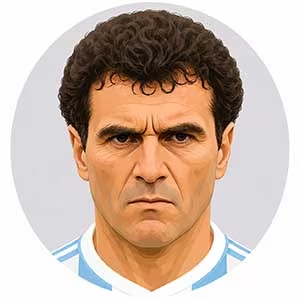
Chile - Centre-backFigueroa, Elías
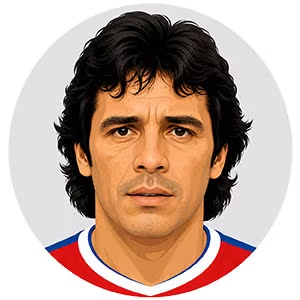
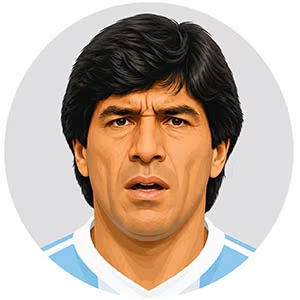
Porto Alegre, 1970s: a striker breaks into the box, and a tall Chilean defender arrives at his shoulder without appearing to accelerate, takes the ball cleanly, and walks it out. Elías Figueroa summarised his own method in a sentence that Brazilian football never stopped repeating — the penalty area is my house, and you enter only with my permission. He said it without aggression. That was the point: he was the rare great defender who dominated without ever seeming to fight anyone.
Born in Valparaíso in 1946, having survived a childhood bout of polio that doctors expected to leave him unable to walk properly, Figueroa became the finest defender South America has produced. He was the prototype of the modern centre-back: 1.85m, powerful, genuinely quick, unbeatable in the air, and technically secure enough to build play himself — not with long diagonals but with low, incisive passes threaded through the midfield line. His positioning was close to flawless, he read sequences early enough to intervene without contact, and he scored important goals from set pieces throughout his career. After emerging at Santiago Wanderers he joined Peñarol, winning three Uruguayan championships in the late 1960s, then moved to Internacional in Brazil, where he became a national figure: three consecutive Campeonato Brasileiro titles between 1975 and 1976 and a run of individual awards unprecedented for a defender and extraordinary for a foreigner — South American Footballer of the Year three times, the Bola de Ouro twice, and four Bola de Prata. He later returned to Chile with Palestino, winning a domestic title, and played briefly in the NASL. For Chile he won 47 caps and appeared at three World Cups, in 1966, 1974 and 1982, and was named in the team of the tournament in 1974.
The limitation was circumstantial rather than technical, and it defined how he is remembered. Figueroa never played in Europe despite offers, which meant the world saw him only in World Cups with a Chile side well below his own level — three tournaments in which his team won a single match. He also carried, through no fault of his own, an association with the darkest period of Chilean history: he played in the era of the dictatorship, including the notorious 1973 World Cup qualifier played at the Estadio Nacional against an absent Soviet Union, and he consistently declined to discuss politics then or afterwards, a silence that some in Chile have never fully accepted. On the pitch, his measured style meant he rarely used the tactical foul as insurance, so a forward who genuinely beat him in the first movement was not going to be stopped illegally.
He led through a quiet, regal authority and a mastery of psychological dominance, remaining unruffled in the highest-friction environments Brazilian and Copa Libertadores football could produce. His leadership in the dressing room was serene, dignified and inclusive, earning total respect without theatrical gestures or raised voices. Towards opponents, officials and journalists he maintained an impeccably polite posture, treating the game with a gentlemanly professionalism that never descended into gamesmanship or dissent. He relied on spatial timing, clean positioning and physical strength rather than cynical fouls or harassment, and his disciplinary record across two decades was exceptionally clean for a defender of his usage. Provocation found no purchase on him: forwards who tried to unsettle him verbally or physically received courtesy and nothing else, and he was never drawn into the escalations that South American football offered constantly. He carried a deep pride in his Chilean identity and strong emotional bonds to Internacional and Peñarol, approached training and physical preparation with uncompromising discipline, and absorbed pressure with a stoic self-assurance that made him the calmest man in any stadium he occupied. Away from the pitch he was private, religious, conventional and entirely without controversy across a fifty-year public life. Composed, commanding and constitutionally incapable of losing his temper, Figueroa dominated a continent by making the hardest position on the pitch look like a matter of good manners.