We use Google Analytics to understand how visitors use this site. Analytics cookies are only activated with your consent. For details, read our Privacy Policy.
Profile lensThe same player, read from a different angle.
Athletic82
Acceleration
75
Pace
80
Agility
74
Strength
87
Balance
77
Jumping
92
Stamina
85
Fitness
86
Technical80
Dribbling
75
Short Passing
76
Long Passing
75
Finishing
66
Shot Accuracy
70
Shot Power
77
Shooting Technique
67
Heading
93
Tackling
93
Crossing
67
Free Kick
65
Penalties
66
First Touch
76
Mental88
Composure
87
Aggression
90
Consistency
88
Creativity
70
Leadership
90
Work Rate
91
Tactical84
Vision
73
Off the Ball
65
Defensive Positioning
92
Teamwork
75
Anticipation
86
Marking
92
Player Traits
Attacking72
Crossing
67
Finishing
66
Heading Accuracy
93
Shot Accuracy
70
Off the Ball
65
Technique72
Dribbling
75
Free Kick
65
Short Passing
76
Long Passing
75
First Touch
76
Shot Technique
67
Movement77
Acceleration
75
Pace
80
Agility
74
Balance
77
Physicality85
Shot Power
77
Jumping
92
Stamina
85
Strength
87
Fitness
86
Defending92
Marking
92
Tackling
93
Def. Positioning
92
Mentality & Game Reading82
Aggression
90
Composure
87
Penalties
66
Vision
73
Leadership
90
Work Rate
91
Teamwork
75
Anticipation
86
Consistency
88
Creativity
70
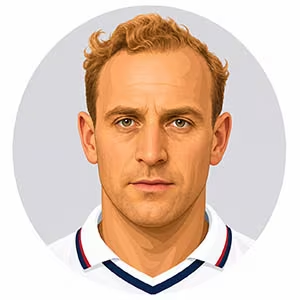
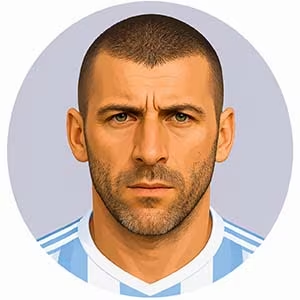
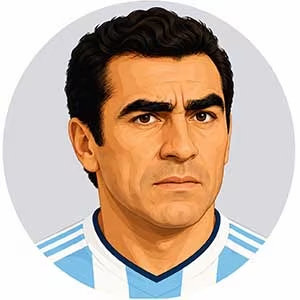
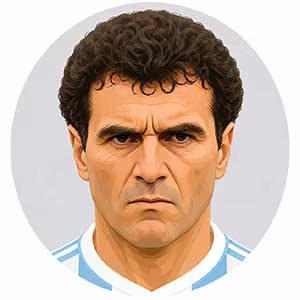
Argentina - Centre-backRuggeri, Oscar
A menacing glare and a set of studs raking down the back of an opponent’s calf announced the presence of El Cabezón (Big Head) across the brutal battlegrounds of South American and European football throughout the 1980s and 1990s. Oscar Alfredo Ruggeri was the uncompromising defensive general and psychological enforcer of Carlos Bilardo’s tactical blueprint. Stationed as an aggressive, man-marking central stopper or sweeping sweeper, Ruggeri paired an imposing aerial leap with ruthless tackling mechanics, suffocating elite center-forwards through relentless physical friction and gamesmanship. His club career achieved near-mythic completeness: winning the Argentine Primera División, the 1986 Copa Libertadores, and the 1986 Intercontinental Cup with River Plate (after an explosive cross-town switch from Boca Juniors), before capturing La Liga with Real Madrid in 1989–90 and later lifting the 1995 Copa CONMEBOL with Rosario Central. For Argentina, across 97 caps and seven goals, he stands as an immortal pillar: anchoring the defense to lift the 1986 World Cup in Mexico, reaching the 1990 final in Rome, and captaining La Albiceleste to back-to-back Copa América titles in 1991 and 1993.
Ruggeri’s destructive style, however, operated on the razor edge of disaster. He was not a delicate, cultured ball-playing defender capable of stepping through midfield lines with subtle dribbles; his passing was strictly pragmatic clearances or low-risk recycling. In open transitions, if drawn into 40-yard footraces against nimble, low-center-of-gravity forwards without an auxiliary sweeper behind him, his turning circle was slow and heavy, forcing him into cynical tactical fouls that routinely brought him into conflict with disciplinary panels.
Feral, vociferous, and possessing an unyielding street-fighter ethos, Ruggeri treated the penalty box as sovereign territory that had to be defended at all costs. He thrived on hostility: barking non-stop psychological barbs at opposing strikers, organizing his defensive partners with sharp screams, and throwing his body into flying boots to block shots. Inside the locker rooms of River, Madrid, and Argentina, he was Diego Maradona’s indispensable right-hand man and the squad's enforcer, setting a brutal physical standard that nobody dared challenge. Opposing forwards universally dreaded the bruising war of facing him over ninety minutes, cementing an eternal legacy as the definitive, hard-bitten Argentine defensive warrior of his generation.


 All Time ArgentinaNT