We use Google Analytics to understand how visitors use this site. Analytics cookies are only activated with your consent. For details, read our Privacy Policy.
Profile lensThe same player, read from a different angle.
Athletic78
Acceleration
66
Pace
71
Agility
70
Strength
86
Balance
73
Jumping
91
Stamina
81
Fitness
88
Technical79
Dribbling
72
Short Passing
76
Long Passing
72
Finishing
68
Shot Accuracy
63
Shot Power
71
Shooting Technique
67
Heading
92
Tackling
92
Crossing
67
Free Kick
65
Penalties
58
First Touch
77
Mental87
Composure
83
Aggression
92
Consistency
92
Creativity
61
Leadership
88
Work Rate
92
Tactical85
Vision
71
Off the Ball
65
Defensive Positioning
93
Teamwork
85
Anticipation
86
Marking
93
Player Traits
Attacking71
Crossing
67
Finishing
68
Heading Accuracy
92
Shot Accuracy
63
Off the Ball
65
Technique72
Dribbling
72
Free Kick
65
Short Passing
76
Long Passing
72
First Touch
77
Shot Technique
67
Movement70
Acceleration
66
Pace
71
Agility
70
Balance
73
Physicality83
Shot Power
71
Jumping
91
Stamina
81
Strength
86
Fitness
88
Defending93
Marking
93
Tackling
92
Def. Positioning
93
Mentality & Game Reading81
Aggression
92
Composure
83
Penalties
58
Vision
71
Leadership
88
Work Rate
92
Teamwork
85
Anticipation
86
Consistency
92
Creativity
61
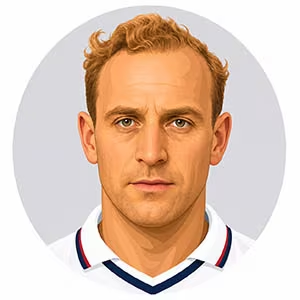
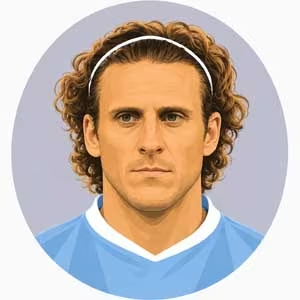
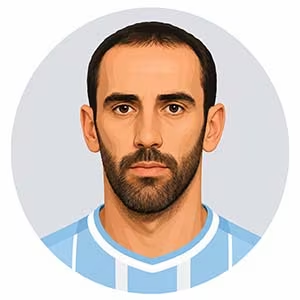
Uruguay - Centre-backGodín, Diego
The header arrived in the eighty-sixth minute at the Camp Nou, on the final day of the season, with a league title hanging on it and Atlético Madrid trailing. Diego Godín rose above a crowded six-yard box, met a corner with his forehead, and the ball looped over Pinto and in. He did not celebrate wildly. He turned, jogged back, and started shouting positional instructions at his defenders, because there were still four minutes left and the job was not finished. That single sequence explains him better than any statistic: the goal was incidental, the four minutes were the point.
Born in 1986 in Rosario, a small town in the Uruguayan department of Colonia, into a rural working-class family, Godín became the most decorated Uruguayan defender of the modern era and the spine of one of Europe's most disciplined teams. At 1.85m he was neither tall for a centre-back nor quick, and he built his defending on anticipation, positional courage and an aerial game bordering on the violent — he attacked crosses with his eyes closed to consequence, won headers against taller men through timing and neck strength, and threw his body in front of shots as a first instinct rather than a last resort. His passing was functional and short-range rather than expansive, which suited a system built on compactness. After Cerro and Nacional he moved to Villarreal in 2007, then to Atlético Madrid in 2010, where nine seasons under Diego Simeone produced the 2013–14 La Liga title, the 2013 Copa del Rey — he scored in the final against Real Madrid — two Europa Leagues, two UEFA Super Cups, and two Champions League finals in three years. He opened the scoring in the 2014 final in Lisbon and watched Sergio Ramos equalize in the ninety-third minute, a wound that shaped everything that followed. Later spells at Inter, Cagliari, Atlético Mineiro and Vélez Sarsfield closed a career that included 161 caps for Uruguay, more than any player in the country's history, the 2011 Copa América, fourth place at the 2010 World Cup and four tournaments in total.
His lack of pace was a permanent structural constraint. Godín defended brilliantly inside a deep, compact block and struggled badly when asked to hold a high line, since quick forwards running into space behind him exposed him repeatedly — a mismatch that made his season at Inter under Antonio Conte visibly uncomfortable. He also offered little in build-up, and in possession-dominant systems that required a centre-back to break lines with passing, his limitations became a bottleneck rather than an inconvenience.
He compensated with a temperament that made him a captain almost by default. Godín organized his defensive line verbally throughout the ninety minutes — short commands, constant repositioning, a hand on a teammate's shoulder rather than a public reprimand — and led through visible, uncomplaining sacrifice: playing through injuries, taking blows to the face without protest, absorbing physical damage as though it were a professional courtesy. He treated suffering as a virtue in the specific Uruguayan sense of garra, and the word appeared in almost every interview he ever gave. Confrontation held no appeal for him; he rarely argued with referees, never simulated contact, and responded to provocation by walking away, which made his fouls tactical rather than emotional. Defeat, however, cut deep and stayed: he wept openly in Lisbon in 2014 and again in Milan in 2016, and spoke for years afterwards about finals he could not let go. Away from the pitch he was the quietest kind of professional — softly spoken, deeply attached to his family and to his hometown, where he funded local projects without publicity, and entirely absent from any scandal. Humble in manner and merciless in the box, Godín was proof that a dressing room can be led by a man who never raises his voice in it.

 All Time UruguayNT