We use Google Analytics to understand how visitors use this site. Analytics cookies are only activated with your consent. For details, read our Privacy Policy.
Profile lensThe same player, read from a different angle.
Athletic83
Acceleration
87
Pace
85
Agility
86
Strength
75
Balance
77
Jumping
85
Stamina
94
Fitness
77
Technical80
Dribbling
83
Short Passing
78
Long Passing
86
Finishing
75
Shot Accuracy
73
Shot Power
87
Shooting Technique
77
Heading
65
Tackling
68
Crossing
86
Free Kick
83
Penalties
78
First Touch
83
Mental81
Composure
83
Aggression
87
Consistency
78
Creativity
81
Leadership
84
Work Rate
78
Tactical78
Vision
85
Off the Ball
83
Defensive Positioning
64
Teamwork
85
Anticipation
78
Marking
70
Player Traits
Attacking76
Crossing
86
Finishing
75
Heading Accuracy
65
Shot Accuracy
73
Off the Ball
83
Technique82
Dribbling
83
Free Kick
83
Short Passing
78
Long Passing
86
First Touch
83
Shot Technique
77
Movement84
Acceleration
87
Pace
85
Agility
86
Balance
77
Physicality84
Shot Power
87
Jumping
85
Stamina
94
Strength
75
Fitness
77
Defending67
Marking
70
Tackling
68
Def. Positioning
64
Mentality & Game Reading82
Aggression
87
Composure
83
Penalties
78
Vision
85
Leadership
84
Work Rate
78
Teamwork
85
Anticipation
78
Consistency
78
Creativity
81
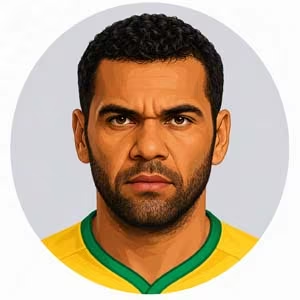
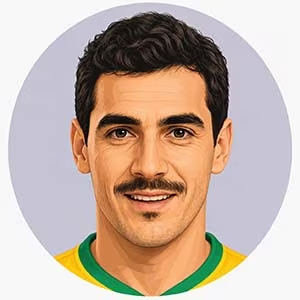
Brazil - Right BackDani Alves
To categorize Daniel Alves da Silva merely as a right-back is to fundamentally misunderstand the tactical revolution that swept European football in the late 2000s; he was, in truth, an entire right-sided attacking system packaged into a five-foot-eight dynamo of perpetual kinetic energy. Bursting onto the European scene with Sevilla—where he claimed back-to-back UEFA Cups—before establishing himself as the most decorated player in the history of the sport across legendary spells at Barcelona, Juventus, PSG, São Paulo, and the Brazilian national team, Alves completely erased the flank boundary. Technically, his telepathic associative interplay on Barcelona’s right wing alongside Lionel Messi became the defining structural cheat-code of Pep Guardiola’s tiki-taka era: sharp, one-touch wall passes, explosive diagonal underlaps into the half-spaces, razor-precise whipped crosses to the far post, and a lung-busting recovery capacity that allowed him to press high up the pitch and sprint back sixty meters without dipping in cardiovascular output. Over a glittering career laden with over forty major trophies, including three UEFA Champions League titles and multiple domestic leagues across four countries, he set an untouchable benchmark for the playmaking wing-back.
Mentally, Alves was an electric vortex of uncontainable joy, hyper-expressive theatricality, and unshakeable competitive arrogance. He viewed matchday not with anxiety, but as an expansive carnival stage where his technical supremacy was meant to be celebrated, often dancing, laughing, and bantering through high-friction moments that would paralyze lesser athletes. Inside the locker room, he was a chaotic, magnetic cultural hub—bringing samba rhythms, high-volume dressing room music, and an infectious, fearless bravado that actively relieved tension across superstar-laden squads, while simultaneously maintaining a relentless, almost maniacal standard during daily physical conditioning. Under the brightest continental spotlights, his psychological pulse remained entirely fearless; he welcomed hostile away atmospheres with open arms, famously defusing overt racial abuse at Villarreal by casually picking up and eating a thrown banana before taking a corner kick with cold-blooded calm. Against match officials and opposition full-backs, Alves operated with a mischievous, sharp-edged gamesmanship: constantly exaggerating contact, initiating heated tactical dialogues, and exploiting every millimeter of psychological advantage, yet backing up every bit of theatrics with world-class, game-defining technical execution.