We use Google Analytics to understand how visitors use this site. Analytics cookies are only activated with your consent. For details, read our Privacy Policy.
Profile lensThe same player, read from a different angle.
Athletic82
Acceleration
82
Pace
83
Agility
76
Strength
83
Balance
82
Jumping
74
Stamina
90
Fitness
88
Technical81
Dribbling
77
Short Passing
81
Long Passing
92
Finishing
78
Shot Accuracy
73
Shot Power
85
Shooting Technique
72
Heading
72
Tackling
78
Crossing
94
Free Kick
81
Penalties
95
First Touch
78
Mental82
Composure
87
Aggression
85
Consistency
78
Creativity
74
Leadership
80
Work Rate
85
Tactical79
Vision
84
Off the Ball
79
Defensive Positioning
78
Teamwork
84
Anticipation
74
Marking
76
Player Traits
Attacking79
Crossing
94
Finishing
78
Heading Accuracy
72
Shot Accuracy
73
Off the Ball
79
Technique80
Dribbling
77
Free Kick
81
Short Passing
81
Long Passing
92
First Touch
78
Shot Technique
72
Movement81
Acceleration
82
Pace
83
Agility
76
Balance
82
Physicality84
Shot Power
85
Jumping
74
Stamina
90
Strength
83
Fitness
88
Defending77
Marking
76
Tackling
78
Def. Positioning
78
Mentality & Game Reading83
Aggression
85
Composure
87
Penalties
95
Vision
84
Leadership
80
Work Rate
85
Teamwork
84
Anticipation
74
Consistency
78
Creativity
74
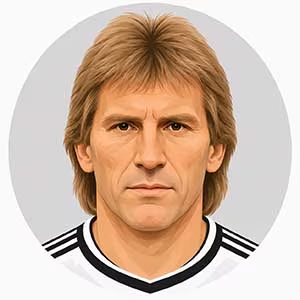
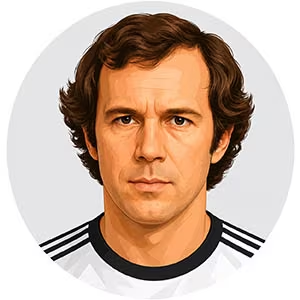
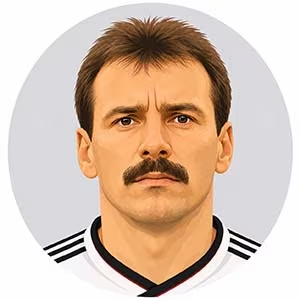
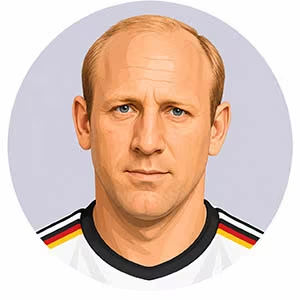
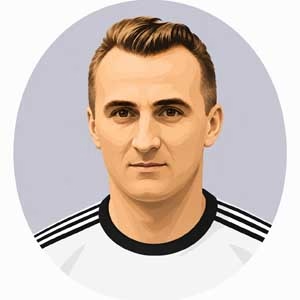
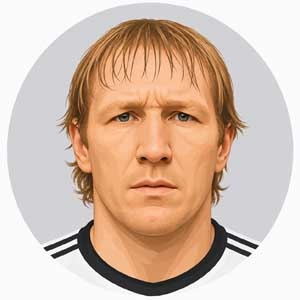
Germany - Right BackKaltz, Manfred
Curving deliveries struck with the outside instep of the right foot—immortalized in German football lexicon as the Bananenflanke (banana cross)—served as the primary tactical calling card of Manfred Kaltz throughout an extraordinary two-decade reign on the right flank of Hamburger SV. Operating as an attacking right-back or progressive sweeper, Manni became the driving wide engine of Branko Zebec and Ernst Happel’s legendary sides. Standing six feet tall with an upright, loping gait and exceptional cardiovascular endurance, he possessed a lethal dead-ball strike, converted an astonishing 53 Bundesliga penalties, and formed a near-telepathic synergy with target man Horst Hrubesch, whose aerial power turned Kaltz’s curling, dipping deliveries into an unstoppable scoring conveyor belt. Over 581 Bundesliga appearances for HSV, he captured three German league championships (1979, 1982, 1983), the 1976–77 European Cup Winners' Cup, and the 1982–83 European Cup triumph against Juventus in Athens. For West Germany, across 69 caps and eight goals, he anchored the right flank to victory at Euro 1980 and started every match during the run to the 1982 World Cup final in Spain.
Yet this ultra-specialized wide profile carried distinct tactical limits. When forced into tight, congested central zones, his short-space agility was noticeably stiff, his weak left foot was practically non-existent in open-field transitions, and his heavy commitment to high overlapping runs occasionally left vast spatial voids behind him for quick counter-attacking wingers to exploit.
Taciturn, stoic, and unyielding in his focus, Kaltz carried the dry, understated demeanor of the North German coastline. He possessed zero interest in self-aggrandizement, media theatrics, or emotional outbursts, approaching high-stakes European finals with the exact same deadpan, workmanlike concentration as a routine domestic fixture. On the pitch, his body language was completely impassive: whether burying a high-pressure spot-kick into the bottom corner or executing a recovery slide on the wet turf, his pulse never visibly quickened. Inside the Hamburg locker room, he was an immovable pillar of professional consistency, commanding universal respect through his spotless training discipline and total tactical obedience to demanding tacticians like Happel. When confronted by aggressive wingers who attempted to kick him out of his crossing rhythm, Kaltz absorbed the contact without complaint, picked himself up immediately, and delivered another viciously dipping ball into the eighteen-yard box on the next wave. Referees found him remarkably easy to manage due to his total absence of gamesmanship, leaving behind an immortal legacy as one of the most mechanically precise, durable, and influential crossing full-backs in modern European history.