We use Google Analytics to understand how visitors use this site. Analytics cookies are only activated with your consent. For details, read our Privacy Policy.
Profile lensThe same player, read from a different angle.
Athletic85
Acceleration
84
Pace
85
Agility
84
Strength
81
Balance
84
Jumping
85
Stamina
86
Fitness
87
Technical88
Dribbling
80
Short Passing
91
Long Passing
90
Finishing
77
Shot Accuracy
81
Shot Power
88
Shooting Technique
81
Heading
85
Tackling
87
Crossing
83
Free Kick
86
Penalties
82
First Touch
90
Mental90
Composure
92
Aggression
77
Consistency
87
Creativity
83
Leadership
96
Work Rate
84
Tactical88
Vision
88
Off the Ball
79
Defensive Positioning
92
Teamwork
89
Anticipation
92
Marking
87
Player Traits
Attacking81
Crossing
83
Finishing
77
Heading Accuracy
85
Shot Accuracy
81
Off the Ball
79
Technique86
Dribbling
80
Free Kick
86
Short Passing
91
Long Passing
90
First Touch
90
Shot Technique
81
Movement84
Acceleration
84
Pace
85
Agility
84
Balance
84
Physicality85
Shot Power
88
Jumping
85
Stamina
86
Strength
81
Fitness
87
Defending89
Marking
87
Tackling
87
Def. Positioning
92
Mentality & Game Reading87
Aggression
77
Composure
92
Penalties
82
Vision
88
Leadership
96
Work Rate
84
Teamwork
89
Anticipation
92
Consistency
87
Creativity
83
Curated interpretation
Signature Moves
Role-defining patterns—not attributes, traits or Inner Game measures. Three ways Franz Beckenbauer changes the meaning of the role around him.
01
Quiet Command
He imposes authority and control without theatricality, aggression or excessive gesture.
02
Compressed Time
He reads the action so early that he appears to own more time than the others, symbolically slowing or accelerating the match at will.
03
Two Games at Once
He defends and constructs simultaneously, fusing the work of the defender with the vision of the playmaker.
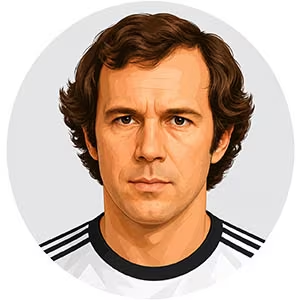
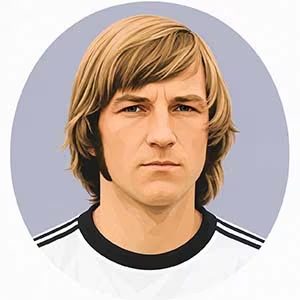
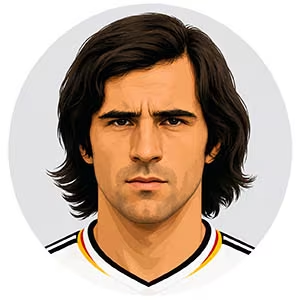
Germany - SweeperBeckenbauer, Franz
Calling Franz Beckenbauer "the greatest defender of all time" misses the transformative scope of his genius. He did not merely defend; he redesigned the geometry of football from the back, abolishing the rigid divide between destructive stopper and creative playmaker. Long before he perfected the sweeping role, the Munich native operated as an electric, box-to-box midfielder at the 1966 World Cup — combining lung-busting running power, crisp tackling, and a venomous shot with the pristine ball-striking of a South American number ten.
His immortal tactical breakthrough arrived when he retreated twenty yards into the libero position. Unburdened by direct man-marking duties, Beckenbauer transformed the sweeper from a desperate, sliding scavenger into an aristocratic offensive launchpad. Gliding across the turf with his chin up and chest out, he dictated tempo through fifty-yard outside-of-the-boot curved passes, subtle drop-shoulder feints, and sudden, majestic forward surges that sliced clean through opposition mid-blocks. Over a mythic career he became the undisputed sovereign of Bayern Munich's three consecutive European Cups (1974–1976), lifted five Bundesliga titles, and captained West Germany to glory at Euro 1972 and the 1974 World Cup, collecting two Ballons d'Or (1972, 1976) as the ultimate architect of German supremacy, before an unexpected final chapter with the New York Cosmos.
The elegance rested on a division of labour he could not perform himself. Beckenbauer was not an abrasive physical destroyer: he was ordinary in congested aerial contests, disliked the ugly, close-quarters defending of the six-yard box, and relied entirely on Hans-Georg Schwarzenbeck at Bayern and with West Germany to handle the target men and the dirty work. Deprived of that partner, or asked to defend a deep block under sustained aerial bombardment, he was considerably less imposing than his reputation suggests. His forward surges left space behind him that quick counter-attacking sides could exploit, and his anticipatory style depended on a team pressing high enough to make interception possible; against direct football played over the midfield, the libero role he had invented was largely bypassed.
Psychologically he played with a serene, almost infuriating detachment — an unshakeable Bavarian Lässigkeit that projected absolute supremacy over opponents and teammates alike. He never panicked, never rushed, and never engaged in frantic theatrics, demoralising rival forwards simply by retrieving possession without breaking sweat or dirtying his white shirt. Errors did not visibly register, hostile stadiums produced no measurable change, and his demeanour was identical in a routine league fixture and a World Cup final. When physical adversity struck, the stoicism turned gladiatorial: most famously during the 1970 semi-final against Italy, playing through extra time with a dislocated shoulder strapped in a sling, demanding the ball in tight spaces with his arm pinned to his ribs. He fouled rarely, argued with referees almost never, and projected an icy authority that commanded deference without vulgar dissent.
That composure was also a form of distance. Beckenbauer's leadership was political rather than emotional: he operated as a de facto co-manager, famously seizing control of West Germany's tactical setup and selections at the Malente retreat after the 1974 defeat to East Germany, overriding Helmut Schön to guide the nation to the trophy — an intervention performed by quiet negotiation rather than confrontation. His standards were exacting and magnetic, but he was not a warm presence in a dressing room; teammates admired him and few claimed to be close to him, and he showed little interest in the collective rituals that bound other captains to their squads. He avoided open conflict throughout his career, preferring to arrange outcomes than to fight for them, and this same instinct produced the most criticised decisions of his life — a permanent adaptability that allowed him to remain on good terms with almost every faction in German football and, decades later, entangled him in the corruption inquiries that shadowed his final years. Away from the pitch he was charming, socially fluent, drawn to the good life and to the company of the powerful, and considerably more calculating than the effortlessness implied. Majestic, unhurried and quietly self-serving, Der Kaiser ruled European football by making both dominance and detachment look like the same thing.