We use Google Analytics to understand how visitors use this site. Analytics cookies are only activated with your consent. For details, read our Privacy Policy.
Profile lensThe same player, read from a different angle.
Athletic81
Acceleration
75
Pace
71
Agility
79
Strength
87
Balance
86
Jumping
85
Stamina
74
Fitness
88
Technical61
Dribbling
71
Short Passing
73
Long Passing
76
Shot Accuracy
47
Shot Power
90
Shooting Technique
45
Heading
63
Free Kick
52
Penalties
68
First Touch
74
Mental90
Composure
91
Consistency
90
Leadership
87
Goalkeeping94
Reflexes
97
Positioning
91
Handling
96
Kicking
90
Goalkeeping94
Reflexes
97
Positioning
91
Handling
96
Kicking
90
Attacking55
Heading Accuracy
63
Shot Accuracy
47
Technique65
Dribbling
71
Free Kick
52
Short Passing
73
Long Passing
76
First Touch
74
Shot Technique
45
Physicality85
Shot Power
90
Jumping
85
Stamina
74
Strength
87
Fitness
88
Movement78
Acceleration
75
Pace
71
Agility
79
Balance
86
Mentality & Game Reading84
Composure
91
Penalties
68
Leadership
87
Consistency
90
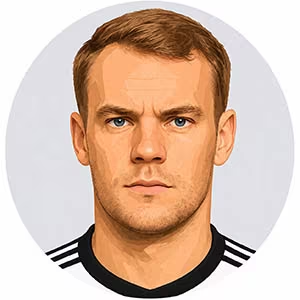
Germany - GoalkeeperNeuer, Manuel
Manuel Neuer spent much of Germany’s 2014 World Cup match against Algeria occupying territory in which a goalkeeper was not supposed to exist. Algeria repeatedly attacked the space behind Germany’s high defensive line, and Neuer repeatedly arrived before the forward: sprinting beyond the penalty area, clearing with his feet or head and once sliding towards the touchline to prevent another transition from developing. He completed more touches outside his penalty area than inside it. From the television angle the interventions looked increasingly hazardous; from Neuer’s perspective, leaving the goal was often the action that reduced the danger. Remaining on the line would have allowed the attacker to control the ball and approach an exposed goal. The match became the clearest demonstration of his defining tactical inversion: Neuer did not accept additional risk merely for the pleasure of intervention. He changed where the goalkeeper’s safest position could be.
At 1.93 metres, Neuer combined the reach and physical coverage of a large goalkeeper with unusually fast footwork and technical competence outside the penalty area. His shot-stopping remained elite independently of his sweeping: explosive lateral movement, strong one-on-one spread mechanics and the ability to hold or redirect powerful shots made him a complete conventional goalkeeper before his positional expansion is considered. In possession he could receive under pressure, pass through midfield lines and use either short combinations or longer distribution to change the point of attack. Under Pep Guardiola at Bayern, those qualities allowed the defensive line to remain extraordinarily high because Neuer effectively controlled the space behind it and became an additional passing option during construction. Germany used the same mechanism during the 2014 World Cup. His development had begun at Schalke, where he was already comfortable leaving the area and assuming responsibility with the ball, before Bayern gave those behaviours an increasingly systematic tactical function.
The style carried genuine limits because redefining safety did not abolish risk. Every advance outside the penalty area reduced the protection available if Neuer misread the trajectory, arrived late or lost possession. His technical confidence could occasionally produce unnecessary complexity when a simpler clearance existed, and opponents learned that early shooting or immediate vertical play could punish an incorrect starting position. The important distinction is between **structural risk and gratuitous risk**. Many actions described as reckless were required by Bayern’s high line; others genuinely exceeded what the situation demanded. Age and serious injuries made that boundary increasingly important. A goalkeeper who controls forty metres behind his defence needs acceleration as well as judgement, and declining speed reduces the margin available for even correct readings. His 2022 leg fracture and subsequent long absence therefore threatened more than shot-stopping availability: they affected the athletic basis of the expansive territory his role required. Later Neuer could retain distribution and anticipation while becoming more selective about how aggressively that territory was defended.
Psychologically, Neuer is best defined by **risk normalization through role definition**. His own explanations of sweeping repeatedly frame those actions not as demonstrations of courage but as decisions produced by the position of teammates, opponents and ball. This matters because it changes the interpretation of error. If leaving the penalty area is understood as an optional gamble, failure should encourage retreat; if it is understood as the correct execution of a systemic responsibility, one failed intervention does not invalidate the behaviour itself. Neuer’s career shows the latter pattern repeatedly: conspicuous errors did not permanently convert him into a line-bound goalkeeper. That does not establish emotional invulnerability. His move from Schalke to Bayern in 2011 generated intense hostility from sections of both supporter bases, and later injuries created uncertainty about whether he would recover his previous level. He nevertheless continued to occupy the same high-responsibility tactical territory when physically capable. His leadership likewise should not be reduced to serenity: he became captain of Bayern and Germany while communicating actively and assuming substantial responsibility in possession, rather than merely calming defenders through body language. Evidence for systematic retaliatory aggression, referee confrontation or teammate-directed blame is weak. Neuer’s distinctive behaviour is more specific: **once a high-risk action had been incorporated into his definition of correct goalkeeping, visible failure was more likely to trigger recalibration of timing than abandonment of the action itself**.