We use Google Analytics to understand how visitors use this site. Analytics cookies are only activated with your consent. For details, read our Privacy Policy.
Profile lensThe same player, read from a different angle.
Athletic85
Acceleration
85
Pace
81
Agility
87
Strength
83
Balance
92
Jumping
88
Stamina
81
Fitness
86
Technical86
Dribbling
81
Short Passing
78
Long Passing
71
Finishing
99
Shot Accuracy
98
Shot Power
79
Shooting Technique
96
Heading
93
Tackling
51
Crossing
63
Free Kick
64
Penalties
76
First Touch
80
Mental86
Composure
94
Aggression
77
Consistency
93
Creativity
65
Leadership
74
Work Rate
80
Tactical89
Vision
75
Off the Ball
98
Defensive Positioning
40
Teamwork
83
Anticipation
99
Marking
35
Player Traits
Attacking 90
Crossing
63
Finishing
99
Heading Accuracy
93
Shot Accuracy
98
Off the Ball
98
Technique 78
Dribbling
81
Free Kick
64
Short Passing
78
Long Passing
71
First Touch
80
Shot Technique
96
Movement 86
Acceleration
85
Pace
81
Agility
87
Balance
92
Physicality 83
Shot Power
79
Jumping
88
Stamina
81
Strength
83
Fitness
86
Defending 42
Marking
35
Tackling
51
Def. Positioning
40
Mentality & Game Reading 82
Aggression
77
Composure
94
Penalties
76
Vision
75
Leadership
74
Work Rate
80
Teamwork
83
Anticipation
99
Consistency
93
Creativity
65
Curated interpretation
Signature Moves
Role-defining patterns—not attributes, traits or Inner Game measures. Three ways Gerd Müller changes the meaning of the role around him.
01
The Second Before
He reads the decisive event before it becomes visible, arriving a second earlier than defenders, rebounds and even the apparent logic of the action.
02
Mr. Goal
Few players embody the goal itself—the game’s most beautiful and final gesture—as completely as he does.
03
No Extra Touch
Simplicity becomes maximum efficiency: no decorative contact, no unnecessary preparation, only the touch the goal requires.
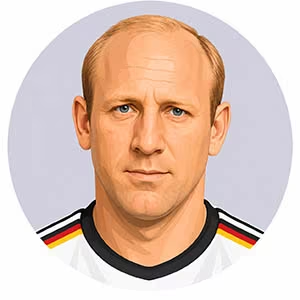
Germany - StrikerMüller, Gerd
In Munich on 7 July 1974, West Germany and the Netherlands were level at 1–1 when Rainer Bonhof reached the right side of the penalty area and pulled the ball backwards. Gerd Müller initially moved towards the near post, checked his run as the pass arrived slightly behind him and found himself surrounded by defenders. He did not create additional space. He controlled, rotated almost on the spot and struck low with his right foot before Jan Jongbloed could fully set himself. The goal won the World Cup. It was characteristic because the situation looked progressively worse until the instant Müller solved it: imperfect delivery, almost no separation, several bodies around him and no possibility of building momentum. His response was not to simplify the environment before shooting but to shorten the time between perception and execution. Four years earlier he had scored ten goals at the World Cup; in 1972 he scored twice in the European Championship final. The evidence therefore strongly supports execution under major-event pressure. It does not require the stronger—and much less defensible—claim that he experienced no anxiety.
Müller was a compact centre-forward whose unusual body shape became an advantage inside congested areas. At roughly 1.76 metres, with powerful thighs and a low centre of gravity, he could rotate rapidly while defenders were still trying to establish leverage against him. His acceleration mattered primarily over the first metres rather than across open field. More important was his anticipation: Müller continuously adjusted position according to the likely destination of crosses, rebounds, blocked shots and defensive touches, often beginning the decisive movement before possession had been clearly established. He could finish with either foot, score while falling or turning, improvise with knees and thighs and generate power without a conventional backswing. The apparent ugliness of some finishes reflected adaptation to insufficient time rather than deficient technique. For Bayern he scored 566 goals in 607 competitive appearances, including 365 in the Bundesliga; for West Germany he produced 68 in 62 internationals. His involvement outside the final phase was comparatively economical, but describing him as uninvolved in combination play goes too far: he could exchange short passes and create for teammates. His overwhelming comparative advantage simply emerged closer to goal.
That specialisation imposed real limits. Müller was not a striker designed to progress attacks over long distances, dominate aerially through height or create repeated separation through open-field dribbling. If opponents could keep the ball and Müller himself away from the penalty area, much of his extraordinary advantage disappeared. His relatively low involvement could also make performances appear anonymous when service never reached useful zones. This was functional intermittency rather than proof of psychological disappearance: the same player could contribute little visibly for long stretches and still retain full value if one unresolved ball entered his territory. Age eventually reduced even his short acceleration, and Bayern’s transition towards younger forwards increasingly threatened a role that had previously been automatic. The end was not psychologically smooth. In 1979, after coach Pál Csernai substituted him during a match against Eintracht Frankfurt, Müller reacted angrily and shortly afterwards left Bayern for the Fort Lauderdale Strikers. The episode prevents us from turning low-touch tactical patience into universal patience about status or selection.
Psychologically, Müller is best defined by **action-local certainty rather than global emotional detachment**. Contemporary and retrospective accounts describe a player who could be nervous before matches and highly dependent on familiar routines, while teammates repeatedly emphasised how radically his behaviour changed once the football problem became immediate. Franz Beckenbauer described Müller as indispensable because goals emerged from situations nobody else interpreted quickly enough; Müller himself consistently explained scoring less through abstract confidence than through anticipating where the ball would arrive. That mechanism allowed emotional state and execution to diverge. He did not need to feel globally invulnerable in order to act decisively once a rebound, cross or loose ball created a recognisable solution. His reaction to losing status late at Bayern provides the counterexample. Being substituted by Csernai provoked anger strong enough to contribute to his departure, showing that frustration could become behavioural when the issue concerned hierarchy rather than an isolated missed chance. Yet there is little evidence of missed opportunities producing prolonged avoidance of the next finish: the enormous volume of goals itself came from repeatedly re-entering scoring positions where failure was common and another decision arrived seconds later. Evidence for systematic referee confrontation, retaliatory aggression or teammate-directed blame is insufficient and should remain unknown. Müller therefore should not be described as robotic. **His emotional world could contain anxiety, irritation and insecurity; what became unusually stable was the narrow interval between recognising a scoring situation and committing completely to its solution.**



 All Time Germany NT
  All Time Bayern Munich Club
  All-Time 1970s 1970s
  All-Time Europe Europe