We use Google Analytics to understand how visitors use this site. Analytics cookies are only activated with your consent. For details, read our Privacy Policy.
Profile lensThe same player, read from a different angle.
Athletic88
Acceleration
91
Pace
93
Agility
84
Strength
86
Balance
83
Jumping
96
Stamina
84
Fitness
87
Technical90
Dribbling
89
Short Passing
80
Long Passing
83
Finishing
97
Shot Accuracy
90
Shot Power
94
Shooting Technique
86
Heading
91
Tackling
44
Crossing
77
Free Kick
83
Penalties
88
First Touch
92
Mental88
Composure
93
Aggression
85
Consistency
91
Creativity
85
Leadership
80
Work Rate
82
Tactical86
Vision
80
Off the Ball
96
Defensive Positioning
35
Teamwork
75
Anticipation
92
Marking
35
Player Traits
Attacking90
Crossing
77
Finishing
97
Heading Accuracy
91
Shot Accuracy
90
Off the Ball
96
Technique86
Dribbling
89
Free Kick
83
Short Passing
80
Long Passing
83
First Touch
92
Shot Technique
86
Movement88
Acceleration
91
Pace
93
Agility
84
Balance
83
Physicality89
Shot Power
94
Jumping
96
Stamina
84
Strength
86
Fitness
87
Defending38
Marking
35
Tackling
44
Def. Positioning
35
Mentality & Game Reading85
Aggression
85
Composure
93
Penalties
88
Vision
80
Leadership
80
Work Rate
82
Teamwork
75
Anticipation
92
Consistency
91
Creativity
85
Curated interpretation
Signature Moves
Role-defining patterns—not attributes, traits or Inner Game measures. Three ways Cristiano Ronaldo changes the meaning of the role around him.
01
Maximum Output
He drives offensive production toward its practical limit, optimising movement, finishing and penalty-area presence.
02
Built by Obsession
He constructs his level through an obsessive pursuit of physical, technical and competitive improvement.
03
Reinvented on Command
He repeatedly redesigns his game to meet the next demand: explosive winger, complete scorer, then penalty-box predator—without surrendering elite output.
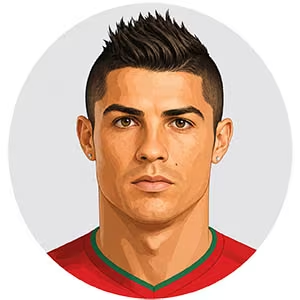
Portugal - StrikerRonaldo, Cristiano
Turin, March 2019, Atlético Madrid two goals ahead from the first leg and Juventus needing three. Cristiano Ronaldo scored all three, and after the last one — a penalty in the eighty-sixth minute — he turned to the crowd and performed the same gesture Diego Simeone had made towards Juventus supporters three weeks earlier. He was thirty-four years old, in his sixteenth season at the top, and he had just spent ninety minutes doing what he had done in Manchester and Madrid before it: converting the expectation of a stadium into a personal obligation, and then discharging it with a certainty that bordered on aggression. Nothing about Ronaldo has ever been accidental, and very little of it has ever been quiet.
Born in Funchal, Madeira, in 1985 into a poor family, Ronaldo left the island at twelve for Sporting CP and reached Manchester United at eighteen, where he arrived as something quite different from the player the world eventually knew: a dazzling, ornamental winger of enormous technical range, all stepovers and elastic feints, thrilling and frequently wasteful. The transformation he performed on himself over the following decade is close to unique in the sport. He rebuilt his body, stripped the decoration out of his game, and converted himself first into a wide forward and then into a centre-forward of extreme efficiency — reducing touches, eliminating risk, and specialising in the one-touch finish inside the box. At his peak he combined a genuinely elite shot with both feet, one of the finest headers in the history of the game, exceptional aerial spring, and movement inside the penalty area that was studied rather than instinctive. He won three Premier League titles and the 2008 Champions League at United, then four Champions Leagues and two La Liga titles at Real Madrid, where he scored 450 goals in 438 matches, before a Serie A double at Juventus, a return to United, and a final chapter in Saudi Arabia. He collected five Ballons d'Or, holds the record for goals in the Champions League and in men's international football, and captained Portugal to the 2016 European Championship and the 2019 Nations League — the first major trophies in the country's history.
His game contracted as it perfected itself, and the cost was real. From his late twenties onward Ronaldo pressed selectively, tracked back rarely, and offered almost nothing in build-up, which meant teams carried him structurally in exchange for his output — an arrangement that worked at Madrid and progressively less well at Juventus and at United on his return. He was ineffective when denied service, disappeared in matches where his side could not reach the final third, and his insistence on taking free-kicks long after his conversion rate had collapsed cost his teams chances a more clear-eyed player would have delegated. In tournaments and finals where the team required a system rather than a soloist, his presence could distort the shape around him.
The engine underneath all of it is a competitiveness that has never been modulated for social comfort. Ronaldo is openly, unapologetically driven by individual achievement: he counts his goals, states his own superiority in interviews without irony, and treats records as objectives rather than by-products. On the pitch his emotional state is fully legible — arms spread in complaint when a pass is not played to him, visible fury at teammates who shoot instead of squaring, hands on hips after a missed chance, and a physical reaction to substitution that has produced several public incidents across his career. He argues with referees, protests contact, and has gone down under minimal challenge often enough for it to be part of his reputation, yet he retaliates violently only rarely and his red cards are few for a player so constantly provoked. Criticism reaches him and stays: he has spoken about slights from coaches, clubs and journalists years after the fact, and his response is invariably to answer with output rather than words, which has made hostility one of the most reliable stimulants of his career — he raised his level in Madrid derbies, in returns to former clubs, and at the Bernabéu when his own supporters whistled him. His preparation is the most famous in the sport: obsessive conditioning, a controlled diet, sleep discipline, and a work volume that teammates at four clubs have described as intimidating rather than inspiring. Away from football he is a global commercial enterprise, permanently visible, devoted to his children and his mother, and largely free of the disorder that usually accompanies fame at that scale. Relentless, self-conscious and profoundly unsatisfied by anything less than the maximum, Ronaldo turned a gifted teenager into a machine through sheer refusal to accept his own ceiling.