We use Google Analytics to understand how visitors use this site. Analytics cookies are only activated with your consent. For details, read our Privacy Policy.
Profile lensThe same player, read from a different angle.
Athletic88
Acceleration
88
Pace
87
Agility
86
Strength
81
Balance
88
Jumping
85
Stamina
93
Fitness
95
Technical91
Dribbling
92
Short Passing
91
Long Passing
90
Finishing
93
Shot Accuracy
92
Shot Power
84
Shooting Technique
91
Heading
82
Tackling
68
Crossing
87
Free Kick
84
Penalties
85
First Touch
95
Mental92
Composure
91
Aggression
78
Consistency
93
Creativity
91
Leadership
94
Work Rate
88
Tactical92
Vision
94
Off the Ball
92
Defensive Positioning
74
Teamwork
96
Anticipation
91
Marking
67
Player Traits
Attacking 89
Crossing
87
Finishing
93
Heading Accuracy
82
Shot Accuracy
92
Off the Ball
92
Technique 91
Dribbling
92
Free Kick
84
Short Passing
91
Long Passing
90
First Touch
95
Shot Technique
91
Movement 87
Acceleration
88
Pace
87
Agility
86
Balance
88
Physicality 88
Shot Power
84
Jumping
85
Stamina
93
Strength
81
Fitness
95
Defending 70
Marking
67
Tackling
68
Def. Positioning
74
Mentality & Game Reading 90
Aggression
78
Composure
91
Penalties
85
Vision
94
Leadership
94
Work Rate
88
Teamwork
96
Anticipation
91
Consistency
93
Creativity
91
Curated interpretation
Signature Moves
Role-defining patterns—not attributes, traits or Inner Game measures. Three ways Alfredo Di Stéfano changes the meaning of the role around him.
01
Ageless Engine
Intensity, influence and decisive presence endure deep into his career, as though the engine ages more slowly than the player around it.
02
Sunday General
On matchday he assumes an almost military authority over the game, in striking contrast with the relaxed, pleasure-loving man away from it.
03
Everywhere at Once
He seems to inhabit several phases simultaneously: building, recovering, supporting, creating and finishing.
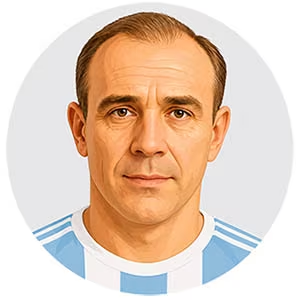
Argentina - ForwardDi Stéfano, Alfredo
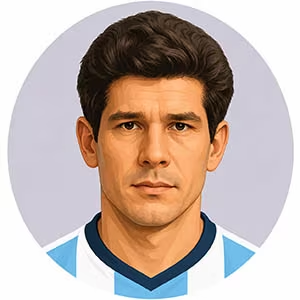
Watching a receding hairline and a flashing number nine jersey drop into his own six-yard box to dispossess a forward, receive the return pass on the edge of the center circle, and arrive at the back post five seconds later to score was how the football world learned what an omnipotent player looked like. Alfredo Stéfano Di Stéfano Laulhé—revered globally as La Saeta Rubia (The Blond Arrow)—was the ultimate universal footballer, erasing positional boundaries decades before modern tactics had even conceived of total fluidity.
Operating simultaneously as sweeper, deep-lying conductor, dynamic box-to-box engine, and ruthless penalty-box executioner, Di Stéfano possessed extraordinary cardiovascular endurance, rapid acceleration over short bursts, and an infallible tactical brain that read the game three moves ahead of everyone else. Forged in River Plate's legendary La Máquina era and Colombia’s El Dorado with Millonarios, his arrival in Spain transformed Real Madrid from an underachieving capital club into the greatest club dynasty in history. Across 396 matches and 308 goals for Los Blancos between 1953 and 1964, he swept eight La Liga titles, five consecutive European Cups (1956–1960)—scoring in all five finals, capped by a historic hat-trick in the 7–3 demolition of Eintracht Frankfurt—and the 1960 Intercontinental Cup, collecting two Ballon d'Or awards (1957, 1959) and the unique Super Ballon d'Or in 1989. For all his club omnipotence, his international career remains a cruel paradox: capped by Argentina, Colombia, and Spain (31 caps, 23 goals), he never played a single minute at a World Cup due to political withdrawals, FIFA disputes, and an ill-timed injury on the eve of Chile 1962.
His all-action, high-energy style, however, demanded an iron grip on the team's tactical structure that could leave little breathing room for creative peers who did not submit to his rhythm. If a match descended into an anarchic, fragmented contest where teammates failed to match his frenetic work rate or mistimed their movements into vacated spaces, his frustration could lead to structural friction. Furthermore, because he spent vast reserves of energy tracking back into his own defensive third, his presence as a pure, static penalty-box reference point could occasionally be missed against hyper-compact low blocks if the wide forwards failed to attack the box.Volcanic, tyrannical, and governed by an unbending obsession with victory, Di Stéfano led through unyielding intimidation and relentless personal example. He governed matches with his voice above all: a continuous, abrasive stream of instruction that reorganized the team in real time, summoning full-backs forward, dragging wingers infield, demanding the ball with a raised arm and a shout that carried to the stands. Teammates described a man who never stopped talking for ninety minutes and who treated a misplaced ten-yard pass as a personal insult, wheeling around to deliver the reprimand immediately, in front of everyone, regardless of the scoreline or the seniority of the offender. He had zero tolerance for laziness, vanity, or tactical complacency, famously barking furious reprimands at teammates who celebrated solo goals instead of resetting for the kickoff. Referees received the same treatment, and so did his own coaches; his authority inside the Chamartín dressing room was such that tactical decisions were frequently his rather than the manager's, an arrangement that functioned only because he was almost always right.
The same intensity made him a difficult man to keep. Fiercely proud, hard-nosed in negotiation, and permanently alert to any perceived slight over money or status, he fought contractual battles at River Plate, in Bogotá, and finally at Madrid, where a rupture with Santiago Bernabéu ended eleven years of dominance and pushed him to Espanyol at thirty-eight. He held grudges for decades and rarely offered public warmth, yet away from the pitch his life was disciplined and unglamorous: card games with teammates, cinema, family, an early bedtime, no interest whatsoever in the nightlife that surrounded the era's stars. Even when kidnapped by Venezuelan revolutionaries in Caracas in 1963, his captors noted that his only real anxiety was missing his next training session and card game. On the pitch his body language was all kinetic urgency: pointing furiously, dropping deep to demand possession, driving forward like a force of nature, visibly angrier when winning comfortably than when losing narrowly, because a slack lead offended him more than a defeat. Inside that locker room his word was absolute law, making Don Alfredo the undisputed spiritual father, architect, and eternal standard of Real Madrid's winning mythos.


 All Time Argentina NT
  All Time Real Madrid Club
  All-Time 1950s 1950s
  All-Time South America South America