We use Google Analytics to understand how visitors use this site. Analytics cookies are only activated with your consent. For details, read our Privacy Policy.
Profile lensThe same player, read from a different angle.
Athletic80
Acceleration
78
Pace
83
Agility
80
Strength
78
Balance
77
Jumping
82
Stamina
83
Fitness
78
Technical89
Dribbling
89
Short Passing
92
Long Passing
88
Finishing
89
Shot Accuracy
91
Shot Power
86
Shooting Technique
85
Heading
80
Tackling
57
Crossing
83
Free Kick
76
Penalties
77
First Touch
91
Mental85
Composure
92
Aggression
75
Consistency
85
Creativity
85
Leadership
79
Work Rate
78
Tactical89
Vision
88
Off the Ball
93
Defensive Positioning
57
Teamwork
95
Anticipation
86
Marking
48
Player Traits
Attacking87
Crossing
83
Finishing
89
Heading Accuracy
80
Shot Accuracy
91
Off the Ball
93
Technique87
Dribbling
89
Free Kick
76
Short Passing
92
Long Passing
88
First Touch
91
Shot Technique
85
Movement80
Acceleration
78
Pace
83
Agility
80
Balance
77
Physicality81
Shot Power
86
Jumping
82
Stamina
83
Strength
78
Fitness
78
Defending54
Marking
48
Tackling
57
Def. Positioning
57
Mentality & Game Reading84
Aggression
75
Composure
92
Penalties
77
Vision
88
Leadership
79
Work Rate
78
Teamwork
95
Anticipation
86
Consistency
85
Creativity
85
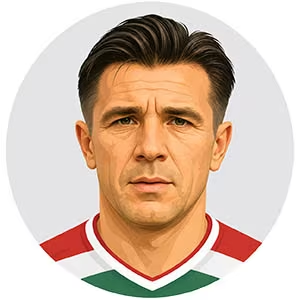
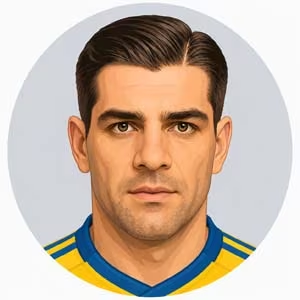
Hungary - ForwardHidegkuti, Nándor
Tactical revolutions often require a specific catalyst, and for Sebes’s Hungary, that catalyst was Nándor Hidegkuti, the cerebral deep-lying center-forward who dismantled orthodox man-marking systems forever. Developed at Elektromos and MTK Budapest under the progressive tactical guidance of Márton Bukovi, Hidegkuti was the original "false nine." Rather than engaging in static, aerial wrestling matches against traditional center-halves, he wore the number nine shirt but operated in the pocket twenty yards deeper, occupying an ambiguous zone between the opposition midfield and defensive line. Standing five-foot-ten with a slender build, his game relied on exceptional half-turn agility, pristine one-touch distribution, and sharp late arrivals into the eighteen-yard box. When English center-half Harry Johnston followed him into midfield during the historic 1953 "Match of the Century" at Wembley, massive passing corridors opened for Puskás and Kocsis to exploit, while Hidegkuti himself bagged a devastating hat-trick in the 6–3 triumph. With MTK (then known as Vörös Lobogó), he collected three Hungarian league titles and the 1955 Mitropa Cup. Across 69 caps and 39 goals for Hungary, he served as the tactical brain of the 1952 Olympic triumph and the 1954 World Cup campaign, where he scored four goals on the way to the final.
Quietly intellectual, modest, and completely devoid of personal vanity, Hidegkuti approached football with the methodical precision of a master craftsman. He was entirely indifferent to individual glory or goal tallies; his primary satisfaction came from solving spatial equations on the pitch and providing the structural balance that allowed Hungary’s explosive forward line to flourish. On the pitch, his emotional baseline was remarkably flat and analytical; while opposing stoppers grew frantic and confused by his deep movements, Hidegkuti remained calm, surveying the field with upright posture before delivering disguised, line-breaking passes. Inside the dressing room, he was an understated, highly mature veteran—affectionately nicknamed Öreg (Old Man) by his younger teammates—who commanded unconditional reverence for his tactical wisdom and selfless nature. When targetted by aggressive, frustrated defenders attempting to kick him out of his rhythm, he avoided theatrical reactions, using quick give-and-go sequences to punish their overzealous lunges. Referees and opponents regarded him as an immaculate gentleman of the game, cementing an eternal legacy as the tactical pioneer who fundamentally changed how forward play was understood across the globe.



 All-Time 1950s1950s