We use Google Analytics to understand how visitors use this site. Analytics cookies are only activated with your consent. For details, read our Privacy Policy.
Profile lensThe same player, read from a different angle.
Athletic86
Acceleration
82
Pace
85
Agility
78
Strength
95
Balance
93
Jumping
83
Stamina
85
Fitness
89
Technical87
Dribbling
82
Short Passing
77
Long Passing
71
Finishing
96
Shot Accuracy
93
Shot Power
94
Shooting Technique
93
Heading
91
Tackling
44
Crossing
64
Free Kick
74
Penalties
86
First Touch
81
Mental85
Composure
87
Aggression
86
Consistency
89
Creativity
68
Leadership
82
Work Rate
85
Tactical85
Vision
74
Off the Ball
93
Defensive Positioning
38
Teamwork
78
Anticipation
92
Marking
33
Player Traits
Attacking87
Crossing
64
Finishing
96
Heading Accuracy
91
Shot Accuracy
93
Off the Ball
93
Technique80
Dribbling
82
Free Kick
74
Short Passing
77
Long Passing
71
First Touch
81
Shot Technique
93
Movement85
Acceleration
82
Pace
85
Agility
78
Balance
93
Physicality89
Shot Power
94
Jumping
83
Stamina
85
Strength
95
Fitness
89
Defending38
Marking
33
Tackling
44
Def. Positioning
38
Mentality & Game Reading83
Aggression
86
Composure
87
Penalties
86
Vision
74
Leadership
82
Work Rate
85
Teamwork
78
Anticipation
92
Consistency
89
Creativity
68
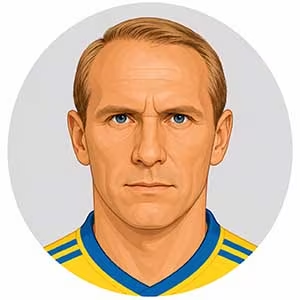
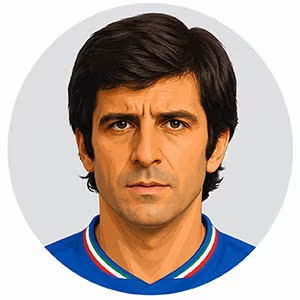
Sweden - StrikerNordahl, Gunnar
Gunnar Nordahl’s physique created an easy misunderstanding. At around 1.80 metres and more than 90 kilograms during parts of his career, he looked like a centre-forward whose advantage should begin and end with contact. Yet accounts from teammates and Italian observers repeatedly returned to the speed of his feet. Nordahl could receive with a defender tight behind him, shift the ball into shooting position and finish before the confrontation became a wrestling match. That capacity had been built rather than merely inherited. Before becoming a professional footballer he worked physically demanding jobs in Sweden, trained relentlessly and developed a body capable of producing explosive movement without resembling the lighter attacking ideal of the period. When Milan signed him in January 1949, the question was whether that unusual construction could survive Italian defensive football. He scored 16 league goals in half a season. Over the following seven full campaigns he never scored fewer than 20.
Nordahl was a central striker whose game combined physical superiority with remarkably economical technique. He could protect possession with his back to goal, turn rapidly onto either foot and generate enormous shooting power with little preparation. His acceleration was strongest over short distances, allowing him to attack the space between defenders before they could use their positional advantage. In the penalty area he adjusted quickly to rebounds and imperfect deliveries, while his heading added another route to goal. He was also more mobile than later caricatures suggest. Nordahl could move into channels, carry the ball over useful distances and exchange passes with teammates before continuing towards goal; the relationship with Gunnar Gren and Nils Liedholm worked partly because Nordahl understood how to vacate and reoccupy central space rather than simply waiting between centre-backs. Milan received the extraordinary return of 210 Serie A goals in 257 appearances, five Capocannoniere titles and two league championships. His scoring was therefore not simply volume created by a dominant team: the mechanism survived across changing seasons, teammates and defensive responses.
There were still meaningful limitations. Nordahl was not a primary creator and did not possess the dribbling repertoire of a forward designed to repeatedly eliminate defenders from deep positions. His size and explosive finishing were most valuable near goal; the farther possession moved from the penalty area, the less distinctive his contribution became. Defensive work was limited by modern standards, although projecting contemporary pressing requirements onto a 1950s centre-forward would be anachronistic. His aerial ability was strong but should not obscure that many of his goals came through feet, movement and rapid finishing rather than simple physical domination. Age eventually reduced the short acceleration that allowed his body weight to function as an advantage rather than a constraint. His final Milan season remained productive but no longer matched his extraordinary peak, and at Roma his scoring frequency fell further. Nordahl could compensate through positioning and finishing intelligence, but once defenders had more time to establish contact before he accelerated, the physical construction that had once made him unusually difficult to control became less overwhelming.
Psychologically, Nordahl is best defined by **production without recognition-seeking**. His career created every opportunity for scoring status to become social hierarchy: he became Milan’s record goalscorer, repeatedly finished as the league’s leading scorer and occupied the terminal position of an attack built to produce goals. Yet contemporary recollections consistently describe a player whose off-ball social behaviour did not expand in proportion to that statistical centrality. This should not be converted into generic humility. The more useful evidence is that Nordahl could remain the principal endpoint of the team without requiring equivalent control over teammates, tactical decisions or public attention. His relationship with scoring itself was similarly practical. Accounts of his training emphasise repetition and refinement of finishing rather than cultivation of an instinctive-genius mythology; goals were treated as a function that could be prepared for and reproduced. Nor does low verbal dominance imply passive competitiveness. Nordahl repeatedly sustained exceptional output while Italian defenders adjusted specifically to him, and Sweden’s decision to exclude professionals from the national team after his move abroad removed him from international football at twenty-seven without producing a return to amateur status simply to preserve selection. Evidence for referee conflict, retaliation, provocation, teammate blame or performance degradation after missed chances is insufficient and should remain unknown. The defensible distinction is therefore sharper than “quiet worker”: **Nordahl accepted extraordinary responsibility for production without demanding that being the team’s principal producer make him its principal authority**.