We use Google Analytics to understand how visitors use this site. Analytics cookies are only activated with your consent. For details, read our Privacy Policy.
Profile lensThe same player, read from a different angle.
Athletic85
Acceleration
83
Pace
86
Agility
78
Strength
85
Balance
82
Jumping
86
Stamina
87
Fitness
94
Technical82
Dribbling
80
Short Passing
81
Long Passing
81
Finishing
65
Shot Accuracy
67
Shot Power
81
Shooting Technique
79
Heading
85
Tackling
94
Crossing
88
Free Kick
65
Penalties
68
First Touch
85
Mental92
Composure
93
Aggression
86
Consistency
94
Creativity
71
Leadership
94
Work Rate
88
Tactical88
Vision
80
Off the Ball
75
Defensive Positioning
96
Teamwork
92
Anticipation
93
Marking
93
Player Traits
Attacking76
Crossing
88
Finishing
65
Heading Accuracy
85
Shot Accuracy
67
Off the Ball
75
Technique79
Dribbling
80
Free Kick
65
Short Passing
81
Long Passing
81
First Touch
85
Shot Technique
79
Movement82
Acceleration
83
Pace
86
Agility
78
Balance
82
Physicality87
Shot Power
81
Jumping
86
Stamina
87
Strength
85
Fitness
94
Defending94
Marking
93
Tackling
94
Def. Positioning
96
Mentality & Game Reading86
Aggression
86
Composure
93
Penalties
68
Vision
80
Leadership
94
Work Rate
88
Teamwork
92
Anticipation
93
Consistency
94
Creativity
71
Curated interpretation
Signature Moves
Role-defining patterns—not attributes, traits or Inner Game measures. Three ways Paolo Maldini changes the meaning of the role around him.
01
Rossonero Heart
Cesare, Paolo and Daniel form three generations of one family bound to AC Milan: the shirt becomes inheritance as much as identity.
02
Same Shirt, Different Century
One club shirt across three decades and two centuries: an almost unmatched continuity of standards, role and belonging.
03
No Tackle Needed
His football intelligence often stops the attacker before contact is necessary, turning positioning and anticipation into the cleanest form of defending.
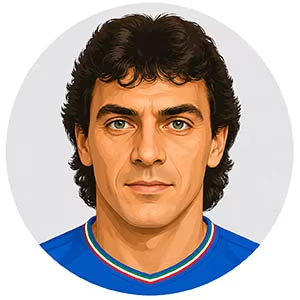
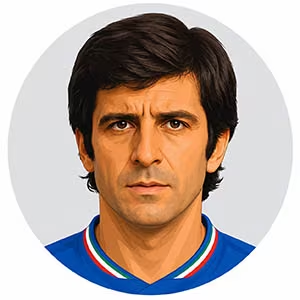
Italy - Left BackMaldini, Paolo
San Siro, 24 May 2009, the last home match of his career. Paolo Maldini walked out for the final time after twenty-five seasons and 902 appearances for the only club he had ever played for, and a section of the Curva Sud unfurled a banner accusing him of never having respected them. He read it, said nothing, completed the match, and never returned to the stadium for years. It was the single most graceless moment Italian football produced in that decade, and his response to it was exactly the response he had given to everything else in a quarter of a century: absolute composure, and a distance nobody could cross.
Born in Milan in 1968, the son of Cesare Maldini — a Milan libero and European Cup-winning captain of the 1960s — he made his Serie A debut at sixteen and played his last match at forty-one. He began as an attacking left-back, since Baresi, Costacurta and Tassotti occupied the other roles, and combined exceptional athleticism with two-footedness, refined technique, and a defensive intelligence that was mature before he was twenty. In Arrigo Sacchi's and then Fabio Capello's Milan he formed part of the most complete defensive unit the game has produced. In the second half of his career he moved inside to centre-back, where the loss of pace was fully compensated by positional reading so precise that he defended without needing to run — famously stating that if he had to make a sliding tackle, he had already made a mistake earlier. He won seven Serie A titles, five European Cups and Champions Leagues across three different eras of the competition, five European Super Cups, two Intercontinental Cups and the 2007 Club World Cup, alongside a Coppa Italia and six Supercoppe. For Italy he collected 126 caps and captained the side, but never won a trophy: third place at Italia '90, defeat on penalties in the 1994 World Cup final, and the golden-goal loss to France in the Euro 2000 final.
His career was not without weakness, though he made it look that way. Maldini was not physically dominant in the air against the biggest centre-forwards, and as a young full-back he could be beaten by pure explosiveness before his reading matured. He was largely a defender rather than a creator, contributing few goals and limited attacking output relative to modern full-backs, and his passing was safe rather than incisive. The most persistent criticism concerned Italy: he was accused, not entirely unfairly, of being less imposing in a national shirt than in a Milan one, and his four major tournaments as an established starter produced four narrow, painful failures in which he was excellent without ever being decisive. He also declined to play for Italy again after Euro 2002 at thirty-four, a decision the country never entirely forgave.
On the pitch he embodied a serene, aristocratic leadership, guiding Milan and Italy not through speeches but through technical consistency and positional discipline. He set the standard by example, maintaining an elite level of physical preparation and daily training rigour across twenty-five seasons — the single most important reason a defender was still starting a Champions League final at thirty-nine. Under maximum pressure, as in Istanbul in 2005 and Athens in 2007, his composure was absolute: he scored after fifty seconds of one final and lost it from three goals up, then returned two years later and won the rematch, and his demeanour in both was indistinguishable. With referees and opponents he maintained an impeccable standard, rarely dissenting, never simulating, and defending with clean, perfectly timed interventions rather than physical harassment, which produced a disciplinary record almost unmatched for his position and usage. What accompanied all of it was genuine coldness. Maldini was reserved to the point of remoteness, gave little to the press in three decades, kept clear distance from Milan's fanbase and from the emotional performances Italian football expects of its captains, and made no attempt to be loved — which is precisely why the banner in 2009 cut where it did. He absorbed failure in silence and returned to work, protected his dressing room and the club's institutional values without sentimentality, and later returned to Milan as technical director and rebuilt a title-winning squad with the same unhurried, unapologetic detachment. Flawless, restrained and never entirely knowable, Maldini defended for a quarter of a century without ever once appearing to be in a hurry.