We use Google Analytics to understand how visitors use this site. Analytics cookies are only activated with your consent. For details, read our Privacy Policy.
Profile lensThe same player, read from a different angle.
Athletic80
Acceleration
71
Pace
74
Agility
72
Strength
89
Balance
78
Jumping
85
Stamina
86
Fitness
83
Technical86
Dribbling
81
Short Passing
86
Long Passing
87
Finishing
78
Shot Accuracy
77
Shot Power
89
Shooting Technique
76
Heading
88
Tackling
90
Crossing
80
Free Kick
85
Penalties
87
First Touch
84
Mental86
Composure
87
Aggression
84
Consistency
79
Creativity
74
Leadership
91
Work Rate
91
Tactical87
Vision
87
Off the Ball
75
Defensive Positioning
91
Teamwork
90
Anticipation
87
Marking
87
Player Traits
Attacking80
Crossing
80
Finishing
78
Heading Accuracy
88
Shot Accuracy
77
Off the Ball
75
Technique83
Dribbling
81
Free Kick
85
Short Passing
86
Long Passing
87
First Touch
84
Shot Technique
76
Movement74
Acceleration
71
Pace
74
Agility
72
Balance
78
Physicality86
Shot Power
89
Jumping
85
Stamina
86
Strength
89
Fitness
83
Defending89
Marking
87
Tackling
90
Def. Positioning
91
Mentality & Game Reading86
Aggression
84
Composure
87
Penalties
87
Vision
87
Leadership
91
Work Rate
91
Teamwork
90
Anticipation
87
Consistency
79
Creativity
74
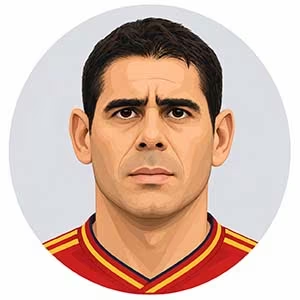
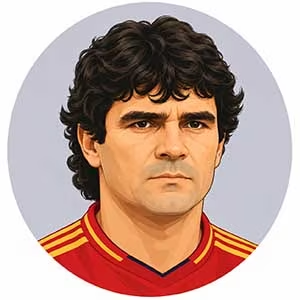
Spain - Centre-backHierro, Fernando
A towering patriarch whose tactical journey seamlessly bridged the engine room and the backline, Fernando Ruiz Hierro stood as the commanding spine of Real Madrid and the Spanish national team throughout the 1990s and early 2000s. Originally deployed as a dynamic, high-scoring central defensive midfielder before settling into an authoritative sweeper and central defensive role, Hierro combined imposing physical stature with the passing range of a luxury playmaker. His technical repertoire was marked by extraordinary aerial power on set-pieces, laser-guided 50-meter crossfield diagonals that bypassed opposition pressing structures, and a heavy, precise shooting technique from distance and the penalty spot. Across fourteen seasons in the Spanish capital, he captained Los Blancos with an iron fist, lifting three UEFA Champions League titles (1998, 2000, 2002) and five La Liga crowns while amassing over 100 goals for the club—a staggering statistical output for a defensive stalwart—alongside earning 89 caps and netting 29 goals for Spain.
Psychologically, Hierro operated with an unbending, old-school authority that established him as the undisputed moral and disciplinary compass of the Bernabéu dressing room. He possessed an intense, fierce pride in the institutional standards of Real Madrid, never hesitating to confront club directors, managers, or superstar arrivals if he felt squad unity or work ethic was being compromised. On the pitch, his leadership was vocal, aggressive, and fiercely protective; he directed the defensive line with constant spatial commands and acted as an impenetrable shield for younger teammates like Iker Casillas and Raúl. Under high-stakes continental pressure, his emotional posture was completely combative and unshakeable, relishing hostile European away nights and using high-friction environments to heighten his own concentration. Toward match officials and opposition forwards, Hierro played on the absolute outer edge of physical intimidation: delivering punishing tactical fouls, orchestrating sharp psychological gamesmanship, and forcefully contesting referee decisions to protect team territory, leaving an eternal legacy as one of the most formidable captains and complete defensive figures in Spanish football history.