We use Google Analytics to understand how visitors use this site. Analytics cookies are only activated with your consent. For details, read our Privacy Policy.
Profile lensThe same player, read from a different angle.
Athletic84
Acceleration
87
Pace
86
Agility
83
Strength
75
Balance
79
Jumping
74
Stamina
97
Fitness
89
Technical81
Dribbling
84
Short Passing
80
Long Passing
85
Finishing
73
Shot Accuracy
71
Shot Power
86
Shooting Technique
77
Heading
70
Tackling
70
Crossing
89
Free Kick
69
Penalties
68
First Touch
83
Mental86
Composure
83
Aggression
86
Consistency
87
Creativity
82
Leadership
88
Work Rate
86
Tactical78
Vision
84
Off the Ball
78
Defensive Positioning
67
Teamwork
89
Anticipation
77
Marking
70
Player Traits
Attacking76
Crossing
89
Finishing
73
Heading Accuracy
70
Shot Accuracy
71
Off the Ball
78
Technique80
Dribbling
84
Free Kick
69
Short Passing
80
Long Passing
85
First Touch
83
Shot Technique
77
Movement84
Acceleration
87
Pace
86
Agility
83
Balance
79
Physicality84
Shot Power
86
Jumping
74
Stamina
97
Strength
75
Fitness
89
Defending69
Marking
70
Tackling
70
Def. Positioning
67
Mentality & Game Reading83
Aggression
86
Composure
83
Penalties
68
Vision
84
Leadership
88
Work Rate
86
Teamwork
89
Anticipation
77
Consistency
87
Creativity
82
Curated interpretation
Signature Moves
Role-defining patterns—not attributes, traits or Inner Game measures. Three ways Cafu changes the meaning of the role around him.
01
Killer Smile
Warmth off the ball, relentlessness on it—the smile never gives away what is coming next.
02
Perpetual Motion
Full-back runs sustained for a full match, repeated for the better part of two decades.
03
The Ever-Present
The only player in history to reach three consecutive World Cup finals.
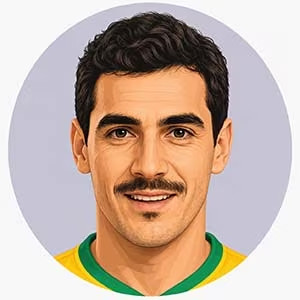
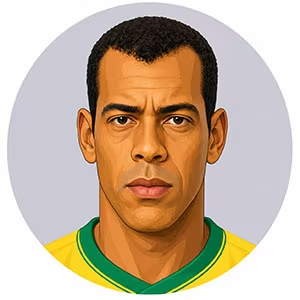
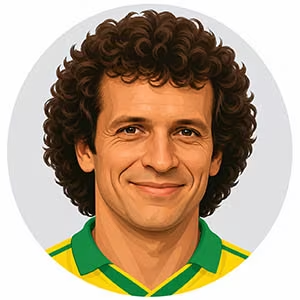
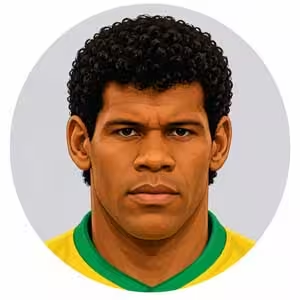
Brazil - Right BackCafu
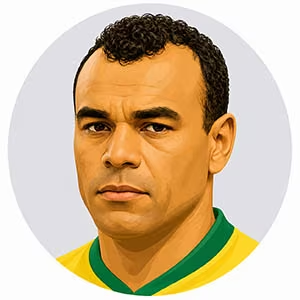
Yokohama, 30 June 2002. Cafu climbed onto the podium, took the World Cup, and before lifting it held up a headband on which he had written 100% Jardim Irene — the name of the favela on the outskirts of São Paulo where he grew up. He was thirty-two, captaining Brazil, and had just become the only footballer in history to play in three consecutive World Cup finals. Four clubs had rejected him as a teenager for being physically inadequate. He never once let anyone forget where the journey had started.
Born Marcos Evangelista de Morais in 1970, Cafu turned the right-back position into an unrelenting wide attacking station. Nicknamed Pendolino after the Italian express train, he was built on a bottomless stamina reserve and astonishing recovery speed: he overlapped at maximum pace for ninety minutes, whipped low, precise crosses into the six-yard box, and used sharp, short-touch dribbling to escape defensive blocks in tight areas. He broke through at São Paulo, winning back-to-back Copas Libertadores and Intercontinental Cups in 1992 and 1993, then moved to Europe with Real Zaragoza and Palmeiras before joining Roma in 1997. There he became a symbol of the side that won the 2001 Scudetto, the club's first in eighteen years, before moving to Milan, where he added a Serie A title and the 2007 Champions League. For Brazil he won 142 caps, a national record at the time, played at four World Cups, won two of them in 1994 and 2002, and captained the 2002 side throughout.
His aggression cost his teams structurally. Cafu's positioning left enormous space behind him, forcing centre-backs into wide cover duties they were not always equipped for, and his eager tackling could be bypassed by intelligent combination play down his flank. He was a functional rather than refined defender in isolation, and his crossing volume was high relative to its accuracy. That same self-belief occasionally showed as complacency: his tracking could relax in low-stakes phases of a match, and he was more reliable when the game demanded everything than when it demanded consistency.
Psychologically he was a joyful, unshakeable force who played with a permanent smile and near-total immunity to pressure — his demeanour in a World Cup final was indistinguishable from a friendly, and finals, hostile stadiums and decisive moments produced no measurable change in him. He led vocally and warmly rather than critically, encouraging teammates rather than correcting them, and he was popular in every dressing room he entered across three countries and two decades. He almost never argued with referees, fouled infrequently for a full-back of his usage, did not simulate, and responded to provocation by laughing at it. Behind the exuberance sat a professional discipline that his personality successfully disguised: he played top-level football until thirty-eight, maintained an extraordinary physical standard into his late thirties, and was available for selection with a consistency few full-backs in history have matched. He was deeply religious, wore his faith openly, and spoke about his origins constantly — not as a grievance but as a debt, funding projects in Jardim Irene throughout his career and after it. Away from football he was family-centred and free of controversy across twenty-five years of public life. Relentless, sunlit and physically indestructible, Cafu ran the same flank for two decades and never once appeared to be tired of it.