We use Google Analytics to understand how visitors use this site. Analytics cookies are only activated with your consent. For details, read our Privacy Policy.
Profile lensThe same player, read from a different angle.
Athletic80
Acceleration
77
Pace
79
Agility
80
Strength
73
Balance
81
Jumping
78
Stamina
88
Fitness
81
Technical88
Dribbling
90
Short Passing
93
Long Passing
90
Finishing
78
Shot Accuracy
81
Shot Power
85
Shooting Technique
86
Heading
76
Tackling
68
Crossing
86
Free Kick
78
Penalties
77
First Touch
90
Mental82
Composure
89
Aggression
75
Consistency
78
Creativity
90
Leadership
76
Work Rate
80
Tactical86
Vision
91
Off the Ball
84
Defensive Positioning
69
Teamwork
93
Anticipation
82
Marking
66
Player Traits
Attacking 81
Crossing
86
Finishing
78
Heading Accuracy
76
Shot Accuracy
81
Off the Ball
84
Technique 88
Dribbling
90
Free Kick
78
Short Passing
93
Long Passing
90
First Touch
90
Shot Technique
86
Movement 79
Acceleration
77
Pace
79
Agility
80
Balance
81
Physicality 81
Shot Power
85
Jumping
78
Stamina
88
Strength
73
Fitness
81
Defending 68
Marking
66
Tackling
68
Def. Positioning
69
Mentality & Game Reading 83
Aggression
75
Composure
89
Penalties
77
Vision
91
Leadership
76
Work Rate
80
Teamwork
93
Anticipation
82
Consistency
78
Creativity
90
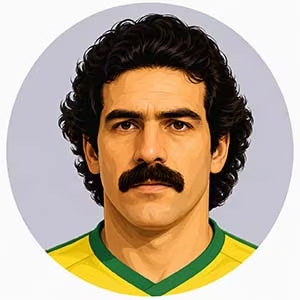
Brazil - Centre MidfielderFalcão, Paulo Roberto
At the Stadio Olimpico on 30 May 1984, Roma and Liverpool reached a penalty shoot-out in the European Cup final after 120 minutes at 1–1. Paulo Roberto Falcão did not take a penalty. For the most important club match of his career, played in Roma’s own stadium, the team’s principal midfielder remained outside the sequence that decided the trophy. The omission immediately became part of the mythology of the defeat, sometimes simplified into an accusation that Falcão had refused responsibility. His own explanation was different: he was carrying a knee problem, had received treatment to play and did not consider himself sufficiently secure to take a penalty. Whatever judgement is made about that choice, it cannot simply be reconciled with the image of a player who always assumed maximum responsibility without hesitation. Nor does it establish competitive fear. Falcão had already spent two hours directing possession in the most pressurised match Roma had ever played. The useful evidence is narrower: when his internal assessment of physical readiness fell below a threshold, he could decline a highly symbolic responsibility rather than allow status to compel him into an action he did not trust himself to execute.
Falcão was a central midfielder whose range made the distinction between regista and box-to-box player unusually porous. He could drop towards the defenders to receive, turn away from pressure and determine the direction of possession, but he was not restricted to orchestrating from behind the ball. At Internacional he had already combined construction with forward running and scoring; at Roma, Nils Liedholm gave him responsibility for controlling tempo while allowing him to advance when the structure opened. His first touch, body orientation and passing range enabled him to alter attacks without excessive touches, while anticipation allowed him to recover possession through positioning rather than constant physical confrontation. He could accelerate into the final third, combine around the penalty area and finish powerfully, as his goal against Italy at the 1982 World Cup demonstrated. Roma’s 1982–83 championship depended heavily on that breadth: Falcão could stabilise possession when the match became disordered and then become an additional attacker when control had been established. “Ottavo Re di Roma” reflected not merely elegance but the degree to which the team entrusted him with deciding its rhythm.
There were genuine limits behind that control. Falcão was not a specialist defensive destroyer and could be less effective when the match became a sequence of high-speed physical transitions in which positional anticipation no longer provided enough time to organise the next action. His elegance in possession should not obscure that his best football required substantial access to the ball; opponents capable of denying him clean central reception could force Roma to construct through less influential players. Physical availability eventually became the larger problem. Knee trouble increasingly affected his final period in Italy, limiting both training and match performance and becoming entangled with disagreement over medical treatment and contractual obligations. Roma president Dino Viola eventually terminated his contract in 1985 after Falcão underwent surgery in the United States without the club’s authorisation. The episode demonstrates a real degradation condition: once physical confidence deteriorated, the midfielder who depended on continuous spatial adjustment could no longer reproduce the same authority. It also created institutional conflict rather than passive acceptance of the club’s judgement.
Psychologically, Falcão is best defined by **self-assessed readiness sovereignty**. He accepted enormous tactical responsibility when he trusted his capacity to execute it, but he did not automatically allow hierarchy, symbolism or external expectation to override his own assessment of physical condition. The 1984 penalty shoot-out is the clearest example. His decision can be criticised competitively, but treating it as simple fear ignores both his stated physical concerns and his willingness to remain central throughout the preceding 120 minutes. The later dispute with Roma makes the pattern harder to dismiss as a single episode. With his knee continuing to trouble him, Falcão sought medical opinions outside the club and ultimately underwent surgery in New York without Roma’s permission; Viola responded by terminating his contract. Falcão therefore did not behave as a serene subordinate when institutional authority conflicted with his judgement about his own body. This assertiveness coexisted with strong tactical discipline under Liedholm, whose footballing authority he respected and within whose structure he flourished. The distinction is crucial: Falcão was not generically rebellious. He could subordinate enormous portions of his game to a coherent collective system, but retained a strong boundary around decisions he considered personally his to make. Evidence for systematic referee conflict, retaliatory aggression, teammate-directed blame or provocation-driven degradation is insufficient and should remain unknown. His apparent serenity therefore needs qualification: **Falcão could be extraordinarily controlled while solving the match, yet become uncompromising when another authority attempted to overrule his own assessment of whether he was physically capable of solving it**.



 All Time Brazil NT
  All Time Roma Club
  All-Time 1980s 1980s
  All-Time South America South America