We use Google Analytics to understand how visitors use this site. Analytics cookies are only activated with your consent. For details, read our Privacy Policy.
Profile lensThe same player, read from a different angle.
Athletic80
Acceleration
77
Pace
81
Agility
83
Strength
76
Balance
86
Jumping
78
Stamina
77
Fitness
78
Technical94
Dribbling
92
Short Passing
95
Long Passing
97
Finishing
91
Shot Accuracy
93
Shot Power
79
Shooting Technique
92
Heading
84
Tackling
38
Crossing
90
Free Kick
95
Penalties
92
First Touch
96
Mental89
Composure
94
Aggression
75
Consistency
90
Creativity
95
Leadership
90
Work Rate
78
Tactical93
Vision
96
Off the Ball
93
Defensive Positioning
37
Teamwork
94
Anticipation
89
Marking
30
Player Traits
Attacking90
Crossing
90
Finishing
91
Heading Accuracy
84
Shot Accuracy
93
Off the Ball
93
Technique95
Dribbling
92
Free Kick
95
Short Passing
95
Long Passing
97
First Touch
96
Shot Technique
92
Movement82
Acceleration
77
Pace
81
Agility
83
Balance
86
Physicality78
Shot Power
79
Jumping
78
Stamina
77
Strength
76
Fitness
78
Defending35
Marking
30
Tackling
38
Def. Positioning
37
Mentality & Game Reading89
Aggression
75
Composure
94
Penalties
92
Vision
96
Leadership
90
Work Rate
78
Teamwork
94
Anticipation
89
Consistency
90
Creativity
95
Curated interpretation
Signature Moves
Role-defining patterns—not attributes, traits or Inner Game measures. Three ways Michel Platini changes the meaning of the role around him.
01
Low Shorts
Low-slung shorts, relaxed posture and a roguish nonchalance contrast beautifully with the lucidity and competitive precision of his football.
02
Calculated Inspiration
Imagination without chaos: the unpredictable idea is guided by an intensely rational search for the most effective solution.
03
Killer in Disguise
He looks and operates like a playmaker, yet attacks the final metres with a scorer’s timing, movement and coldness.
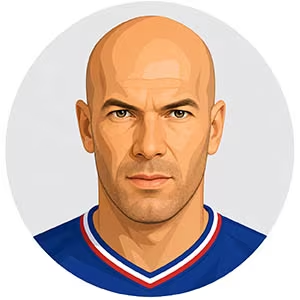
France - Attacking MidfielderPlatini, Michel
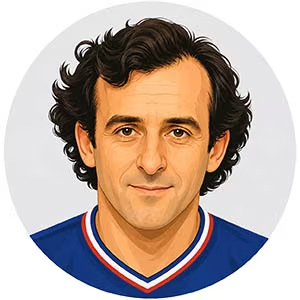
Lying casually on his side on the turf in Tokyo, head resting in his hand in theatrical mock-despair after a referee mistakenly disallowed one of the most sublime chest-and-volley goals ever conceived, captured the effortless, aristocratic swagger of a playmaker from Jœuf who ruled European football throughout the mid-1980s. Michel François Platini — revered across Turin as Le Roi Michel — was the ultimate cerebral diez and goalscoring maestro, possessing an uncanny ability to combine the tempo-dictating vision of a deep orchestrator with the ruthless, double-digit finishing instincts of a world-class centre-forward.
Operating in the pocket behind the attack or dropping into the centre circle to spray raking forty-yard passes, Platini played the game entirely in his head before the ball arrived. He was not a rapid sprinter or a physical powerhouse, but his first touch was immaculate, his spatial anticipation infallible, and his dead-ball striking legendary: perfecting the art of the curling free-kick that cleared the wall and dipped viciously under the crossbar before goalkeepers could take a step. Rising through AS Nancy, where he won the 1978 Coupe de France, and Saint-Étienne, where he lifted the 1980–81 Division 1 title, his apex arrived at Giovanni Trapattoni's Juventus between 1982 and 1987. In Italy's fiercely defensive Serie A he accomplished the extraordinary feat of winning three consecutive Capocannoniere crowns from midfield (1983, 1984, 1985), sweeping two Scudetti, the 1983–84 Cup Winners' Cup, the 1984 European Super Cup, the 1985 Intercontinental Cup and the 1985 European Cup at Heysel. For France, across 72 caps and 41 goals, he was the crown jewel of the Carré Magique alongside Alain Giresse, Jean Tigana and Luis Fernández, leading Les Bleus to two World Cup semi-finals and authoring the most dominant individual tournament in European Championship history at Euro '84, scoring nine goals in five matches to claim the trophy and earning three consecutive Ballons d'Or.
That supreme footballing intellect existed within clear physical boundaries. Platini was devoid of top-end sprint speed and possessed an open aversion to defensive work; he rarely tracked back into his own third, relying entirely on destroyers like Bonini, Tardelli and Tigana to handle friction and ball recovery. His first season in Turin was, by his own account, close to a failure — he struggled badly with the physicality of Serie A and the man-marking systems designed specifically to erase him, and required a year to solve a league that had never seen his type of player succeed. In his final seasons chronic heel inflammation and pubalgia severely restricted his mobility, forcing him to rely almost exclusively on passing geometry and static set pieces before retiring at thirty-one, an age that surprised nobody who knew how little he had ever enjoyed the physical parts of the job.
Ironic, fiercely intelligent and carrying a Gallic coolness that bordered on calculated arrogance, Platini played with a sharp sense of aesthetic drama and an emotional detachment that ran deeper than the wit suggested. He was genuinely immune to crowd hostility, answering whistles in away stadiums with a shrug and a curled free-kick, and he was equally unmoved by his own errors — a missed chance produced no visible reaction, and his demeanour was almost identical in a routine league fixture and a European final. He despised rigid tactical drilling and made no secret of it, clashing repeatedly with Trapattoni over training methods and defensive obligations he considered irrelevant to him, and he negotiated his own exemptions rather than complying. He was not warm inside a dressing room: sharp-tongued, sarcastic, and dismissive of teammates he judged intellectually slower, he led by authority and results rather than by encouragement, and several colleagues described a man who was admired far more easily than he was known. He almost never fouled, rarely simulated, and argued with referees in short, contemptuous bursts rather than sustained protest. That capacity for detachment reached its most disturbing expression at Heysel on 29 May 1985: with thirty-nine people dead in the stadium, Platini played the final, converted the penalty that won it, and celebrated the trophy visibly — a decision he defended for the rest of his life without ever expressing regret, insisting the match had been played to prevent worse and that he had not known the scale of it. Away from the pitch he was sociable, worldly and politically ambitious in a way that pointed clearly toward the administrative career that followed, comfortable among executives and journalists, and entirely without personal disorder. Cool, cerebral and unsentimental to a degree that unsettled people, Platini set the eternal benchmark for the European attacking midfielder while giving almost nothing of himself away.