We use Google Analytics to understand how visitors use this site. Analytics cookies are only activated with your consent. For details, read our Privacy Policy.
Profile lensThe same player, read from a different angle.
Athletic82
Acceleration
91
Pace
87
Agility
89
Strength
73
Balance
83
Jumping
72
Stamina
85
Fitness
77
Technical84
Dribbling
91
Short Passing
85
Long Passing
87
Finishing
77
Shot Accuracy
81
Shot Power
83
Shooting Technique
85
Heading
64
Tackling
44
Crossing
84
Free Kick
75
Penalties
76
First Touch
90
Mental80
Composure
84
Aggression
74
Consistency
78
Creativity
91
Leadership
72
Work Rate
83
Tactical82
Vision
86
Off the Ball
87
Defensive Positioning
50
Teamwork
81
Anticipation
82
Marking
41
Player Traits
Attacking79
Crossing
84
Finishing
77
Heading Accuracy
64
Shot Accuracy
81
Off the Ball
87
Technique86
Dribbling
91
Free Kick
75
Short Passing
85
Long Passing
87
First Touch
90
Shot Technique
85
Movement88
Acceleration
91
Pace
87
Agility
89
Balance
83
Physicality78
Shot Power
83
Jumping
72
Stamina
85
Strength
73
Fitness
77
Defending45
Marking
41
Tackling
44
Def. Positioning
50
Mentality & Game Reading81
Aggression
74
Composure
84
Penalties
76
Vision
86
Leadership
72
Work Rate
83
Teamwork
81
Anticipation
82
Consistency
78
Creativity
91
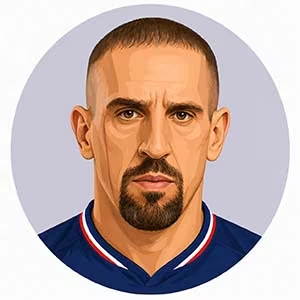
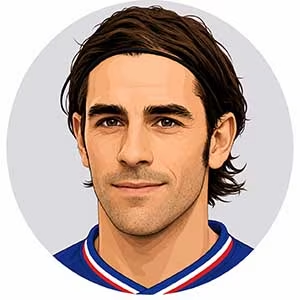
France - Left MidfielderRibery, Franck
Few sights in European football over the past two decades were more terrifying for a right-back than a low-socked, scarred Frenchman dropping his shoulder to unleash pure vertical chaos down the left wing. Recruited by Bayern Munich from Marseille in the summer of 2007 for a then-record fee, Franck Henry Pierre Ribéry instantly transformed the tactical identity of the Bavarian giants, evolving into the dynamic engine of an era that culminated in the iconic Robbery wing partnership alongside Arjen Robben. Operating from the wide-left flank with a low center of gravity and devastating short-area acceleration, Ribéry was an unstoppable transition force: cutting inside onto his right foot with violent hip deceleration, driving directly into the heart of the eighteen-yard box, and executing pinpoint cut-backs or venomous low drives into the bottom corner. Across 425 appearances and 124 goals in Munich, he collected nine Bundesliga championships, six DFB-Pokals, and the historic 2012–13 continental treble—crowned as UEFA Best Player in Europe and finishing third in the controversial 2013 Ballon d'Or. For France, across 81 caps and 16 goals, his international zenith arrived at the 2006 World Cup in Germany, where his explosive performances helped Les Bleus reach the final.
Yet Ribéry’s high-friction style brought significant mechanical vulnerabilities. His entire game was built on sudden, violent changes of direction and absorbing heavy contact, leading to chronic ankle and knee ailments that frequently sidelined him for crucial spring knockout stretches in the latter half of his career. Tactically, when isolated against ultra-compact defensive low blocks that effectively doubled his flank and denied him the initial three yards of acceleration, his crossing from deep wide angles was less effective, and his fierce, combustible temperament occasionally boiled over into rash, retaliatory fouls when markers successfully frustrated his dribbles.
Street-forged, relentlessly hungry, and playing with an aggressive competitive chip on his shoulder, Ribéry treated every ninety minutes as an existential fight for survival. He was an emotional lightning bolt on the field: chasing lost causes with manic intensity, celebrating goals with raw terrace passion, and using the hostility of opposing crowds to sharpen his attacking output. On the pitch, his body language radiated non-stop urgency: he demanded the ball relentlessly, dragged entire defensive blocks toward him through pure intimidation, and led the team's counter-pressing with aggressive forward tackles. Inside the Bayern locker room, he was the emotional heartbeat—intensely charismatic, protective of younger teammates, and an essential bridge between foreign stars and the German core. When subjected to cynical fouling, Ribéry responded not by retreating into his shell, but by isolating his marker on the very next sequence to dismantle them with blistering speed and sharp physical balance, leaving an eternal legacy as one of the most destructive, electrifying, and decorated wingers of the modern era.