We use Google Analytics to understand how visitors use this site. Analytics cookies are only activated with your consent. For details, read our Privacy Policy.
Profile lensThe same player, read from a different angle.
Athletic80
Acceleration
82
Pace
83
Agility
82
Strength
82
Balance
76
Jumping
74
Stamina
81
Fitness
80
Technical87
Dribbling
93
Short Passing
90
Long Passing
87
Finishing
82
Shot Accuracy
84
Shot Power
83
Shooting Technique
83
Heading
76
Tackling
44
Crossing
88
Free Kick
75
Penalties
78
First Touch
90
Mental81
Composure
87
Aggression
76
Consistency
78
Creativity
90
Leadership
80
Work Rate
76
Tactical83
Vision
87
Off the Ball
87
Defensive Positioning
48
Teamwork
85
Anticipation
82
Marking
44
Player Traits
Attacking83
Crossing
88
Finishing
82
Heading Accuracy
76
Shot Accuracy
84
Off the Ball
87
Technique86
Dribbling
93
Free Kick
75
Short Passing
90
Long Passing
87
First Touch
90
Shot Technique
83
Movement81
Acceleration
82
Pace
83
Agility
82
Balance
76
Physicality80
Shot Power
83
Jumping
74
Stamina
81
Strength
82
Fitness
80
Defending45
Marking
44
Tackling
44
Def. Positioning
48
Mentality & Game Reading82
Aggression
76
Composure
87
Penalties
78
Vision
87
Leadership
80
Work Rate
76
Teamwork
85
Anticipation
82
Consistency
78
Creativity
90
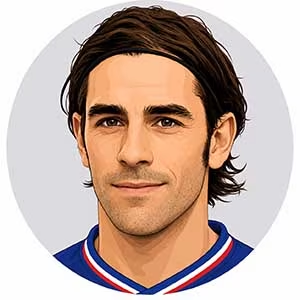
France - Left MidfielderPirès, Robert
Highbury’s manicured grass in the early 2000s belonged to a duck-footed French artist who drifted off the left flank with deceptive, floating grace, turning Arsène Wenger’s lightning transitions into pure choreography. Robert Emmanuel Pirès was the creative brain and finishing touch of Arsenal’s historic Invincibles, forming an almost telepathic left-side triangle alongside Thierry Henry and Ashley Cole. Eschewing traditional touchline chalk-hugging, Pirès operated as a sophisticated inverted playmaker: using a fluid first touch on the half-turn, sliding disguise passes into the channel, and curling exquisite right-footed finishes into the far corner with minimal backlift. Between 2000 and 2006 in North London, he claimed two Premier League titles (including the unbeaten 2003–04 campaign), three FA Cups, and was crowned FWA Footballer of the Year in 2002 despite missing the final two months with injury. For France, across 79 caps and 14 goals, he earned global honors by winning the 1998 World Cup, delivering the decisive extra-time assist for David Trezeguet’s golden goal in the Euro 2000 final, and dominating the 2001 FIFA Confederations Cup as tournament MVP and top scorer.
Yet Pirès’s subtle elegance contained real physical vulnerabilities. He was entirely allergic to heavy defensive tracking and physical dogfights in midfield, relying heavily on Patrick Vieira and Gilberto Silva to supply the muscle behind him. His straight-line top speed was unexceptional over long distances, and following a severe anterior cruciate ligament tear in March 2002, he permanently lost a fraction of his sharp turning agility, making him easier to contain when bruising right-backs pressed him tightly and denied him space to turn inside.
Gentle, unpretentious, and completely devoted to the collective aesthetic, Pirès played the game with the effortless ease of a natural romantic. He had zero appetite for cynical fouls, tactical theatrics, or dressing-room politics; his entire focus was channelled into fluid, one-touch passing sequences and spatial rhythm. On the pitch, his body language was relaxed and upright: absorbing rough tackles without lashing out, shaking his long locks, and immediately looking for the next give-and-go. Inside the Arsenal and French dressing rooms, he was an universally adored, serene presence who bonded effortlessly with both explosive superstars and quiet squad members, serving as a tactical favorite for Wenger. Referees admired his clean, non-confrontational conduct, leaving an eternal legacy as one of the most intelligent, technically refined, and aesthetically pleasing wide playmakers in modern European football history.


 All Time ArsenalClub