We use Google Analytics to understand how visitors use this site. Analytics cookies are only activated with your consent. For details, read our Privacy Policy.
Profile lensThe same player, read from a different angle.
Athletic85
Acceleration
89
Pace
87
Agility
92
Strength
84
Balance
90
Jumping
78
Stamina
78
Fitness
78
Technical92
Dribbling
97
Short Passing
88
Long Passing
91
Finishing
86
Shot Accuracy
82
Shot Power
85
Shooting Technique
88
Heading
76
Tackling
41
Crossing
89
Free Kick
86
Penalties
89
First Touch
98
Mental79
Composure
85
Aggression
74
Consistency
78
Creativity
99
Leadership
74
Work Rate
73
Tactical83
Vision
91
Off the Ball
86
Defensive Positioning
35
Teamwork
77
Anticipation
78
Marking
33
Player Traits
Attacking84
Crossing
89
Finishing
86
Heading Accuracy
76
Shot Accuracy
82
Off the Ball
86
Technique91
Dribbling
97
Free Kick
86
Short Passing
88
Long Passing
91
First Touch
98
Shot Technique
88
Movement90
Acceleration
89
Pace
87
Agility
92
Balance
90
Physicality81
Shot Power
85
Jumping
78
Stamina
78
Strength
84
Fitness
78
Defending36
Marking
33
Tackling
41
Def. Positioning
35
Mentality & Game Reading82
Aggression
74
Composure
85
Penalties
89
Vision
91
Leadership
74
Work Rate
73
Teamwork
77
Anticipation
78
Consistency
78
Creativity
99
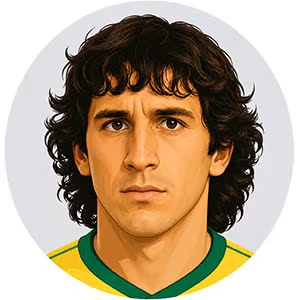
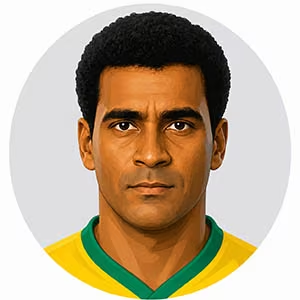
Brazil - Attacking MidfielderRonaldinho
At the Santiago Bernabéu on 19 November 2005, Barcelona were leading Real Madrid when Ronaldinho received possession on the left, accelerated inside Sergio Ramos and drove the ball beyond Iker Casillas. Later he attacked Ramos again, changed direction across him and scored a second. Sections of the Madrid crowd stood and applauded. The gestures were recognisably Ronaldinho—changes of rhythm, manipulation of the defender’s balance, a finish delayed until the goalkeeper had committed—but the setting matters more than the spectacle. He did not respond to the hostility and attention of the Clásico by reducing his repertoire towards safer decisions. The actions through which he controlled pressure were essentially the same actions through which he expressed himself in less consequential matches. That pattern appeared repeatedly during his Barcelona peak. Ronaldinho could make an elite match look informal not because the stakes had disappeared, but because retaining the behavioural vocabulary of play prevented the stakes from dictating how narrowly he was willing to act.
Ronaldinho was primarily an attacking midfielder or left-sided creator whose technical repertoire allowed him to generate advantages without fixed positional routes. His first touch could orient possession immediately away from pressure; exceptional balance and considerable lower-body strength allowed him to absorb contact while continuing to manipulate the ball. The elastico, stepovers, disguised passes and no-look deliveries were not independent tricks layered over the football: each could alter the defender’s information and create a passing or dribbling lane that had not existed a moment earlier. During his peak he combined that deception with powerful short acceleration and unusually ambitious passing, making him dangerous both carrying through compressed space and releasing teammates behind the defence. His shooting and set pieces added direct scoring threat. Under Frank Rijkaard, Barcelona gave him substantial freedom from the left while surrounding that freedom with positional and defensive responsibilities performed by the collective. The result culminated in consecutive FIFA World Player awards and the 2005–06 Champions League. His creative game could therefore operate inside an organised elite structure; spontaneity did not require tactical anarchy.
There were significant limits, and the decline cannot be explained simply as physical ageing. Ronaldinho’s defensive contribution was relatively low and his optimal role required teammates to absorb some structural cost when possession was lost. His game also depended on repeated explosiveness and the capacity to receive enough touches for improvisation to accumulate influence. When acceleration declined, defenders could recover from the first deception more easily. More importantly, his performance level became less consistent after the 2006 peak. The World Cup that year provides the clearest warning against describing him as automatically liberated by greater pressure: Brazil entered as favourites, Ronaldinho arrived as the reigning Ballon d’Or holder, yet he produced a subdued tournament and had limited influence in the quarter-final defeat to France. Pressure therefore did not mechanically activate creativity. At Barcelona, declining physical condition and reduced training consistency increasingly affected his ability to reproduce the intensity required by the team, and Pep Guardiola’s arrival in 2008 ended his place in the project. At Milan he could still produce exceptional creation, but no longer with the continuous athletic dominance of his Barcelona peak.
Psychologically, Ronaldinho is best defined by **play-mediated pressure regulation** rather than fearlessness. Teammates and coaches repeatedly described a player whose enjoyment of improvisation survived high-stakes environments, and his own accounts consistently frame football through pleasure and invention rather than through emotional combat. The behavioural evidence is stronger than the smile itself: against elite opposition he continued attempting actions whose failure would be highly visible, rather than protecting himself through conservative possession. This separates him from players whose pressure response is to simplify. It also separates him from pure risk-seeking. Ronaldinho’s gestures often served practical deception, and when the playful solution stopped generating advantages its value declined sharply. His response to physical provocation is also relevant: opponents frequently fouled him to prevent progression, yet systematic retaliatory aggression or prolonged referee confrontation was not a defining feature of his game. Authority presents a more complicated picture. Under Rijkaard, substantial expressive freedom coexisted with elite performance; later environments that demanded greater training and structural conformity did not produce the same sustained engagement. The evidence supports a decline in professional consistency, but not a simple psychological diagnosis for why it occurred. Likewise, 2006 demonstrates that external expectation could overwhelm the effectiveness of the mechanism without proving that Ronaldinho became emotionally fearful. His strongest pattern is narrower: **when functioning well, he preserved creative play as a way of preventing competitive seriousness from narrowing his decisions; when physical and behavioural conditions no longer sustained that play, the smile itself could not preserve the performance**.