We use Google Analytics to understand how visitors use this site. Analytics cookies are only activated with your consent. For details, read our Privacy Policy.
Profile lensThe same player, read from a different angle.
Athletic79
Acceleration
82
Pace
77
Agility
86
Strength
64
Balance
87
Jumping
76
Stamina
79
Fitness
80
Technical94
Dribbling
96
Short Passing
96
Long Passing
91
Finishing
91
Shot Accuracy
89
Shot Power
80
Shooting Technique
91
Heading
82
Tackling
38
Crossing
87
Free Kick
95
Penalties
93
First Touch
95
Mental83
Composure
90
Aggression
74
Consistency
78
Creativity
95
Leadership
84
Work Rate
73
Tactical89
Vision
93
Off the Ball
88
Defensive Positioning
43
Teamwork
85
Anticipation
87
Marking
33
Player Traits
Attacking87
Crossing
87
Finishing
91
Heading Accuracy
82
Shot Accuracy
89
Off the Ball
88
Technique94
Dribbling
96
Free Kick
95
Short Passing
96
Long Passing
91
First Touch
95
Shot Technique
91
Movement83
Acceleration
82
Pace
77
Agility
86
Balance
87
Physicality76
Shot Power
80
Jumping
76
Stamina
79
Strength
64
Fitness
80
Defending38
Marking
33
Tackling
38
Def. Positioning
43
Mentality & Game Reading85
Aggression
74
Composure
90
Penalties
93
Vision
93
Leadership
84
Work Rate
73
Teamwork
85
Anticipation
87
Consistency
78
Creativity
95
Curated interpretation
Signature Moves
Role-defining patterns—not attributes, traits or Inner Game measures. Three ways Zico changes the meaning of the role around him.
01
Ten with Teeth
A refined Brazilian number ten who does not merely create: he attacks the goal aggressively and scores with a ferocity beyond the classic playmaker image.
02
Over the Wall
Free-kick technique repeated and perfected until clearing the wall becomes almost systematic rather than an occasional flash of talent.
03
Crafted Genius
The talent is natural, but the player is also built through methodical repetition: technique, physique and specific gestures refined by a genius shaping himself.
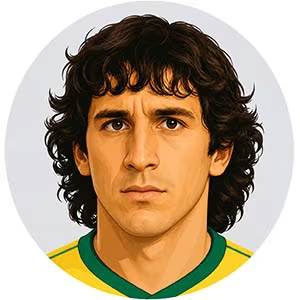
Brazil - Attacking MidfielderZico
In Guadalajara on 21 June 1986, Brazil and France were level when Zico entered after seventy-one minutes, still short of full fitness following a serious knee injury. Within minutes Branco broke into the penalty area and was fouled by Joël Bats. Zico took the penalty. Bats saved it. Brazil eventually reached a shoot-out after extra time, and Zico walked forward again. This time he sent Bats the wrong way and scored. Brazil were nevertheless eliminated. The sequence compresses several parts of Zico’s career into a few minutes: physical limitation, immediate technical responsibility, conspicuous failure and voluntary return to precisely the same task before the emotional residue of the first miss could plausibly have disappeared. His response was not evidence that the miss meant nothing. Zico later remembered the defeat as one of the most painful moments of his career. What is observable is narrower and more useful: failure did not remove his willingness to become responsible for the next penalty.
Zico was an attacking midfielder whose influence extended far beyond conventional playmaking. He could drop towards midfield to organise possession, receive between lines, accelerate through combinations and then arrive inside the penalty area as a scorer. His first touch allowed him to orient possession immediately towards the next action, while exceptional passing range made him equally dangerous through short combinations and longer penetrative balls. Around the box he possessed a powerful, accurate shot and unusually sophisticated movement for a midfielder; despite his relatively slight frame, timing also made him effective in the air. Set pieces became another major source of value. His free-kick technique combined minimal run-up, precise contact and the ability to alter trajectory according to distance and wall position. At Flamengo this breadth made him the central attacking reference of the side that won the 1981 Copa Libertadores and Intercontinental Cup. His move to Udinese in 1983 tested the same qualities in a much more restrictive environment: he scored 19 Serie A goals in his first season despite joining a team outside the traditional title contenders. His influence therefore did not depend exclusively on Flamengo’s superiority or Brazilian defensive conditions.
There were real limits beneath that technical breadth. Zico was neither physically imposing nor naturally suited to repeated shoulder-to-shoulder contests, and opponents could reduce his freedom through aggressive marking and tactical fouling. His defensive contribution was intelligent rather than physically dominant; asking him to spend prolonged phases recovering possession would remove energy from the areas in which he transformed matches. More importantly, availability became a serious constraint. Injuries disrupted his second Udinese season and later his return to Flamengo, culminating in the severe knee damage suffered after a challenge by Márcio Nunes in 1985. Recovery required surgery and left him racing to become available for the 1986 World Cup. He arrived without full match fitness and was used selectively. This matters because Brazil’s elimination should not be converted into a psychological failure of its principal creator: Zico entered the tournament physically compromised before the decisive penalty miss ever occurred. As his body became less reliable, the repeated movement connecting midfield and attack became harder to sustain even though technique and decision-making remained.
Psychologically, Zico is best defined by **immediate responsibility reacquisition after visible failure**. The France match provides unusually direct evidence. His first penalty carried immediate elimination-level consequences, he missed it, remained in the match through extra time and then voluntarily entered the shoot-out rather than allowing the earlier failure to disqualify him from responsibility. This differs from generic confidence because the second action occurred before time could meaningfully distance him from the first. His relationship with responsibility extended beyond penalties. Flamengo teammates regarded him as the technical reference, and Zico accepted the scoring, creation and set-piece burden that followed without restricting himself to one form of contribution. Yet leadership should not be confused with emotional dominance. His public behaviour was generally less confrontational than his centrality might suggest, and there is insufficient evidence to describe referee conflict, retaliatory aggression or teammate-directed blame as defining characteristics. The 1985 injury provides another boundary. Zico returned after a challenge severe enough to threaten his career, but the relevant evidence is rehabilitation and re-entry into competition, not a claim that physical fear disappeared. Likewise, the 1986 miss remained emotionally significant despite his successful second penalty. His pattern is therefore not “composure” in the abstract. **Zico could experience failure as consequential, retain its emotional meaning and nevertheless reclaim the same responsibility almost immediately when the team required someone to assume it again.**