We use Google Analytics to understand how visitors use this site. Analytics cookies are only activated with your consent. For details, read our Privacy Policy.
Profile lensThe same player, read from a different angle.
Athletic77
Acceleration
86
Pace
82
Agility
84
Strength
66
Balance
74
Jumping
72
Stamina
79
Fitness
74
Technical82
Dribbling
87
Short Passing
83
Long Passing
77
Finishing
76
Shot Accuracy
76
Shot Power
78
Shooting Technique
82
Heading
68
Tackling
48
Crossing
76
Free Kick
72
Penalties
74
First Touch
86
Mental76
Composure
82
Aggression
68
Consistency
74
Creativity
84
Leadership
73
Work Rate
68
Tactical78
Vision
82
Off the Ball
78
Defensive Positioning
45
Teamwork
77
Anticipation
76
Marking
42
Player Traits
Attacking75
Crossing
76
Finishing
76
Heading Accuracy
68
Shot Accuracy
76
Off the Ball
78
Technique81
Dribbling
87
Free Kick
72
Short Passing
83
Long Passing
77
First Touch
86
Shot Technique
82
Movement82
Acceleration
86
Pace
82
Agility
84
Balance
74
Physicality74
Shot Power
78
Jumping
72
Stamina
79
Strength
66
Fitness
74
Defending45
Marking
42
Tackling
48
Def. Positioning
45
Mentality & Game Reading76
Aggression
68
Composure
82
Penalties
74
Vision
82
Leadership
73
Work Rate
68
Teamwork
77
Anticipation
76
Consistency
74
Creativity
84
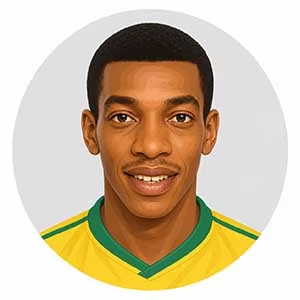
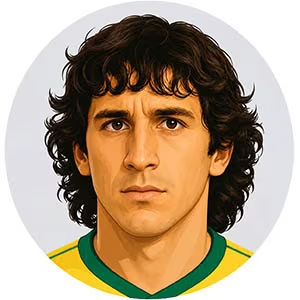
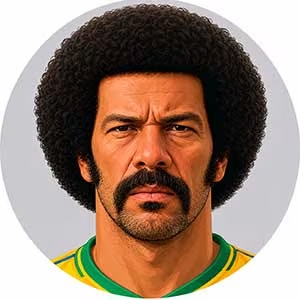
Brazil - Attacking MidfielderMoacir
His father gave him money one evening to place on the illegal numbers game and told him to bet it. Moacyr Claudino Pinto, seven or eight years old, went to play a pickup match instead and buried the money under a rock in the field to retrieve later — then couldn't find it again, because the field was covered in identical rocks. His father beat him for it and locked him outside for the night with the chickens, in weather he remembered as terribly cold. Not long afterward, the boy ran away from home, was picked up by police, and ended up in an orphanage in Osasco, where he lived for more than ten years despite having a living family the whole time.
Born in São Paulo in 1936, Moacir found his way to football almost by accident of institutional geography: a teacher at the orphanage, a fanatical Flamengo supporter, recommended him to the club's youth system, and he moved into the team's dormitories as a teenager. He became, across the second half of the 1950s, one of the most technically refined players Flamengo produced in that era — an attacking midfielder nicknamed O Canivete, the penknife, for the precision of his short dribbling, his ability to cut sharply past defenders, and a passing range that made him equally dangerous with a short combination or a long diagonal switch. He wore the number 8 shirt in a lineage the club still measures its playmakers against, alongside Zizinho before him and Geraldo Assoviador and Adílio after. He played 233 matches for Flamengo between 1956 and 1961, scoring 57 goals, and formed part of the forward line — alongside Joel, Henrique, Dida and Zagallo — that won the 1959 Gran Series Sudamericana in Lima. For Brazil he won only seven caps, but they included the 1957 Copa Roca, the 1960 Taça do Atlântico, and a World Cup winner's medal from Sweden in 1958, earned entirely as Didi's backup without playing a single minute of the tournament itself. After Flamengo he moved to River Plate, where a free kick scored from almost the byline against Boca Juniors became famous enough in Argentina to inspire a short story by the writer Roberto Fontanarrosa, titled after him. He continued to Peñarol in Uruguay, winning the domestic championship and reaching a Copa Libertadores final, before a final chapter in Ecuador with Everest and Barcelona de Guayaquil, where he retired in his early forties and later coached.
His limitations on the pitch were tied to his frame and to a game built on technique rather than physical presence — his contribution depended on space and time to work in tight areas, and against sides that denied him both, his influence narrowed considerably. More consequential, by the account of those who followed his later career, was an apparent inability to convert what he earned across three countries into any lasting personal stability; the record notes, without elaborating, that he never quite managed to make the most of it.
Temperamentally the surviving picture is one of a man whose early life left him institutionally formed rather than family-formed — raised inside a system rather than a household, discovered by an adult outside his own family who happened to love the right club, and shaped by a childhood punishment severe enough that he recounted it in detail decades later without visible bitterness, simply as fact. He was talented enough to captain his generation's attention at Flamengo yet left comparatively quickly, after just over four years in the first team, and is today, by his own club's more recent acknowledgment, less remembered than the World Cup-winning teammates who stayed. His career afterward scattered him across four countries — Argentina, Uruguay, Ecuador, Peru — and his personal life scattered with it: he separated from his wife and two children before settling permanently in Guayaquil, where he built a second family and remained for the rest of his life, largely disconnected from the football culture that had first given him a path out of an orphanage. Skilled, itinerant, and shaped early by instability he never fully resolved, Moacir's story is less one of triumph or disaster than of a man who kept moving, professionally and personally, without ever quite finding a place that held him the way Flamengo's dormitories once had.