We use Google Analytics to understand how visitors use this site. Analytics cookies are only activated with your consent. For details, read our Privacy Policy.
Profile lensThe same player, read from a different angle.
Athletic82
Acceleration
84
Pace
82
Agility
83
Strength
74
Balance
77
Jumping
74
Stamina
90
Fitness
95
Technical84
Dribbling
88
Short Passing
85
Long Passing
87
Finishing
74
Shot Accuracy
74
Shot Power
86
Shooting Technique
82
Heading
68
Tackling
67
Crossing
86
Free Kick
83
Penalties
87
First Touch
87
Mental80
Composure
88
Aggression
78
Consistency
80
Creativity
82
Leadership
70
Work Rate
78
Tactical80
Vision
86
Off the Ball
80
Defensive Positioning
70
Teamwork
94
Anticipation
78
Marking
72
Player Traits
Attacking76
Crossing
86
Finishing
74
Heading Accuracy
68
Shot Accuracy
74
Off the Ball
80
Technique85
Dribbling
88
Free Kick
83
Short Passing
85
Long Passing
87
First Touch
87
Shot Technique
82
Movement82
Acceleration
84
Pace
82
Agility
83
Balance
77
Physicality84
Shot Power
86
Jumping
74
Stamina
90
Strength
74
Fitness
95
Defending70
Marking
72
Tackling
67
Def. Positioning
70
Mentality & Game Reading82
Aggression
78
Composure
88
Penalties
87
Vision
86
Leadership
70
Work Rate
78
Teamwork
94
Anticipation
78
Consistency
80
Creativity
82
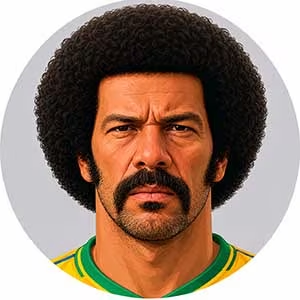
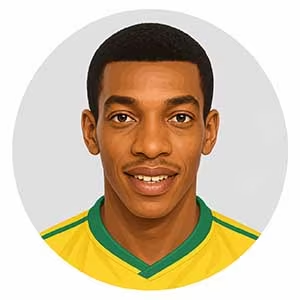
Brazil - Left BackJúnior
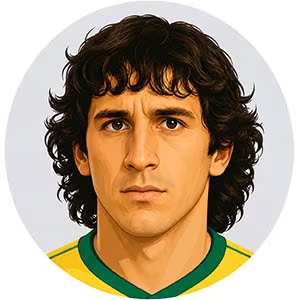
A headband holding back thick curls and an effortless swing of the right boot turned Leovegildo Lins da Gama Júnior into the fluid tactical engine of both Flamengo’s greatest generation and Telê Santana’s iconic 1982 Brazil side. Operating as an attacking left-back before transitioning seamlessly into an orchestrating deep-lying central midfielder in Serie A with Torino and Pescara, Júnior defied rigid positional dogma through supreme bilateral technical mastery. He delivered laser-guided forty-yard diagonals, threaded intricate combinations in crowded half-spaces, and arrived on the edge of the box to score dipping long-range strikes. Over nearly nine hundred appearances across two spells with Flamengo, he lifted four Brazilian national titles, the 1981 Copa Libertadores, and dismantled Liverpool 3–0 in the 1981 Intercontinental Cup in Tokyo. Across 70 caps and six goals for the Seleção, he was an undisputed standout at the 1982 and 1986 World Cups, scoring against Argentina in Barcelona and making the 1982 All-Star Team.
Yet Júnior’s expansive, possession-heavy style contained natural structural risks. As a full-back, his constant forward adventures into the final third vacated massive defensive territory down the left flank, forcing his central defenders to cover extensive ground during rapid counter-attacks. He was not an explosive, recovery-sprinting defender who relied on raw speed or bruising physical tackles, and when deployed in deep midfield against hyper-physical, pressing engines, his measured tempo could be disrupted if denied time on the turn.
Joyful, artistic, and exuding natural charisma, Júnior played the game as a celebration of rhythm and spatial freedom. He approached high-stakes international football without a trace of anxiety, famously recording samba tracks during his playing career and keeping the Brazil squad emotionally grounded through music and camaraderie. On the pitch, his body language was smooth and upright, dictating transitions with relaxed confidence and commanding the respect of teammates through supreme technical execution. Inside the Flamengo and Torino dressing rooms, he was an untouchable patriarch and unifying leader whose tactical intelligence made him a de facto coach on the field, leaving behind an immortal legacy as one of the most versatile, technically gifted, and joyful footballing visionaries Brazil ever produced.