We use Google Analytics to understand how visitors use this site. Analytics cookies are only activated with your consent. For details, read our Privacy Policy.
Profile lensThe same player, read from a different angle.
Athletic82
Acceleration
85
Pace
80
Agility
82
Strength
70
Balance
76
Jumping
81
Stamina
90
Fitness
90
Technical78
Dribbling
79
Short Passing
77
Long Passing
82
Finishing
69
Shot Accuracy
63
Shot Power
74
Shooting Technique
74
Heading
81
Tackling
75
Crossing
79
Free Kick
62
Penalties
66
First Touch
79
Mental81
Composure
82
Aggression
82
Consistency
88
Creativity
67
Leadership
70
Work Rate
83
Tactical78
Vision
73
Off the Ball
77
Defensive Positioning
76
Teamwork
85
Anticipation
82
Marking
73
Attacking74
Crossing
79
Finishing
69
Heading Accuracy
81
Shot Accuracy
63
Off the Ball
77
Technique76
Dribbling
79
Free Kick
62
Short Passing
77
Long Passing
82
First Touch
79
Shot Technique
74
Movement81
Acceleration
85
Pace
80
Agility
82
Balance
76
Physicality81
Shot Power
74
Jumping
81
Stamina
90
Strength
70
Fitness
90
Defending75
Marking
73
Tackling
75
Def. Positioning
76
Mentality & Game Reading78
Aggression
82
Composure
82
Penalties
66
Vision
73
Leadership
70
Work Rate
83
Teamwork
85
Anticipation
82
Consistency
88
Creativity
67
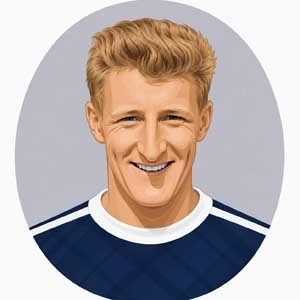
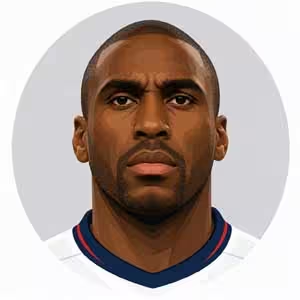
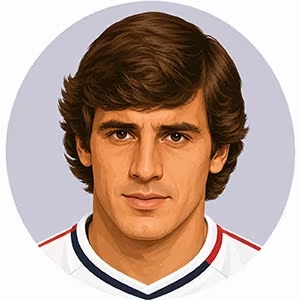
England - Left BackSansom, Kenny
Born in Camberwell, south London, in 1958, Sansom made his professional debut for Crystal Palace at sixteen and quickly became first choice at eighteen, part of Terry Venables' "Team of the Eighties" side that won promotion to the First Division in 1979. Arsenal signed him in 1980, in a swap deal that sent Clive Allen the other way, and he spent eight seasons as the club's first-choice left-back, making over 300 appearances. He was a complete full-back for his era: quick, technically composed on the ball for a defender, reliable in one-on-one defending, and increasingly effective going forward as tactical expectations of the position evolved through the decade. He won the 1987 League Cup with Arsenal and reached two other domestic cup finals. For England he won 86 caps, a national record for a left-back that stood for years, captained the side on occasion, and played at the 1982 and 1986 World Cups, missing the latter's most celebrated match through suspension.
His limitations were modest relative to his consistency, which was itself the rarer quality. Sansom was not physically dominant and could be troubled by powerful, direct wingers who engaged him in prolonged physical duels rather than technical ones. His distribution, while composed, was rarely progressive in the sense the position would later demand, remaining a product of its era — safe and functional rather than creative. Injuries and, eventually, the emergence of younger competition ended his England career earlier than his form alone might have justified, and his final Arsenal seasons saw his place challenged for the first time in nearly a decade.
Temperamentally he was even-tempered, popular and largely without controversy during his playing days. Sansom was well liked in every dressing room he occupied, remembered by teammates as sociable and easy company rather than as a confrontational or intensely driven personality, and his disciplinary record across a long top-flight career was unremarkable in the best sense — he defended cleanly rather than through persistent fouling, and rarely featured in disputes with referees or opponents. He captained club and country capably without needing to dominate a room to do so, leading through consistency and reliability rather than vocal authority. He adapted to different managers and different tactical demands across two decades — from Venables' expansive Palace to the more pragmatic Arsenal sides of the early eighties to the loosening tactical conventions of the England set-up under Bobby Robson — without friction recorded on either side. Composed, well-regarded and remarkably durable through his playing career, Sansom was, for the better part of a decade, the answer to a question English football kept asking and rarely settled so comfortably before or after him.


 All Time ArsenalClub