We use Google Analytics to understand how visitors use this site. Analytics cookies are only activated with your consent. For details, read our Privacy Policy.
Profile lensThe same player, read from a different angle.
Athletic84
Acceleration
85
Pace
82
Agility
83
Strength
78
Balance
86
Jumping
84
Stamina
88
Fitness
87
Technical83
Dribbling
80
Short Passing
82
Long Passing
85
Finishing
60
Shot Accuracy
73
Shot Power
84
Shooting Technique
72
Heading
80
Tackling
93
Crossing
81
Free Kick
68
Penalties
80
First Touch
81
Mental93
Composure
94
Aggression
89
Consistency
94
Creativity
68
Leadership
95
Work Rate
92
Tactical92
Vision
79
Off the Ball
71
Defensive Positioning
98
Teamwork
97
Anticipation
96
Marking
94
Player Traits
Attacking73
Crossing
81
Finishing
60
Heading Accuracy
80
Shot Accuracy
73
Off the Ball
71
Technique78
Dribbling
80
Free Kick
68
Short Passing
82
Long Passing
85
First Touch
81
Shot Technique
72
Movement84
Acceleration
85
Pace
82
Agility
83
Balance
86
Physicality84
Shot Power
84
Jumping
84
Stamina
88
Strength
78
Fitness
87
Defending95
Marking
94
Tackling
93
Def. Positioning
98
Mentality & Game Reading88
Aggression
89
Composure
94
Penalties
80
Vision
79
Leadership
95
Work Rate
92
Teamwork
97
Anticipation
96
Consistency
94
Creativity
68
Curated interpretation
Signature Moves
Role-defining patterns—not attributes, traits or Inner Game measures. Three ways Franco Baresi changes the meaning of the role around him.
01
Line Conductor
He does not merely occupy the defensive line; he directs it, turning steps, cover, distance and the offside trap into one collective movement.
02
Live Wire
A relatively small centre-back charged with extraordinary nervous energy, controlled aggression and a force far greater than his frame suggests.
03
Two Systems, One Master
First a world-class libero, then the absolute reference of zonal defending: he masters two nearly opposite conceptions of the role.
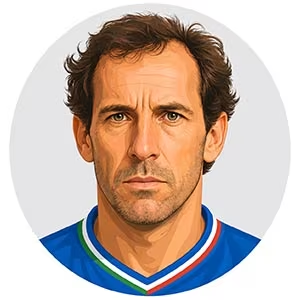
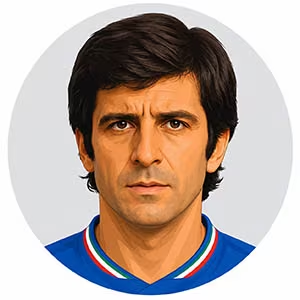
Italy - Centre-backBaresi, Franco
Pasadena, 17 July 1994. Franco Baresi had torn the meniscus in his right knee twenty-five days earlier, been operated on, and rehabilitated at a speed his surgeons considered reckless. He played the World Cup final anyway, and for a hundred and twenty minutes in forty-degree heat he erased Romário — the best striker in the world that year — with a performance that remains among the greatest defensive displays ever given. Then he took the first penalty of the shootout and put it over the bar, and the photograph that survives is of a thirty-four-year-old captain bent double on the centre circle, hands on his knees, in tears. He had given more than his body could offer and it had not been enough, which is the shape of almost everything that happened to him in an Italy shirt.
Born in Travagliato in 1960 and orphaned as a teenager, Baresi was rejected by Inter for being too slight — they took his older brother Giuseppe instead — and signed for Milan, where he stayed for twenty years and 719 matches. He began as a sweeper of exceptional range: aggressive in stepping out of the line, launching play with long diagonals, and advancing into central areas to influence the game rather than merely protect it. When Arrigo Sacchi abolished man-marking and imposed a zonal system with an extreme high line, Baresi became its conductor, and the raised arm calling the offside trap became the defining image of the most dominant defensive unit in the sport's history, alongside Costacurta, Maldini and Tassotti. He was not tall at 1.76m and compensated with anticipation, acceleration, and a reading of sequences so fast it appeared precognitive. He won six Serie A titles, three European Cups, two Intercontinental Cups and three European Super Cups, including the 1991–92 season in which Milan conceded twelve goals in thirty-four matches. For Italy he collected 81 caps: an unused squad member in the 1982 World Cup win behind Gaetano Scirea, third place in 1990, and the 1994 final.
His weaknesses were physical and temperamental in equal measure. Baresi was small for a central defender and could be outmuscled by powerful target men in the box, depending on positioning to prevent contests he would lose. The extreme high line he commanded was structurally fragile — a single mistimed step exposed the entire team, and Milan conceded a number of goals in that manner over the years. He was also, by his own admission, wound extremely tight: his concentration was ferocious but brittle under provocation, and the two red cards that shaped his career — in the 1990 World Cup group stage under Sacchi's successor and, most costly, in the 1994 tournament — came from a competitive intensity he did not always regulate.
He was the ultimate embodiment of silent, fiercely demanding leadership, governing the Milan and Italy backlines through the raised arm, razor-sharp positioning, and pure technical authority. He rarely gave speeches, leading instead through work ethic, daily focus, and an absolute refusal to concede ground. Under maximum pressure his response was physical and resolute: stepping aggressively forward to cut off a pass, or producing a perfectly timed sliding intervention inside his own box. With teammates he combined high standards and protective solidarity, commanding deep respect from senior players and young defenders without any public theatricality. Towards officials he maintained constant, assertive dialogue — challenging offside calls and fouls with sharp gestures — while preserving a dignified authority that shielded his defensive partners from cards. Underneath ran a permanent nervous charge that never fully discharged: he was intense to the point of severity in training, unforgiving of lapses in himself first, and visibly incapable of relaxing during a match his team was winning. He absorbed failure in silence rather than in explanation, and the Pasadena penalty was something he spoke about only rarely and briefly for the rest of his life. Away from the pitch he was private, reserved, and bound to Milan so completely that he never played for another club and never seriously considered it. Small, wound tight and utterly immovable, Baresi organised the greatest defence in football history through nothing but the certainty of his own reading.