We use Google Analytics to understand how visitors use this site. Analytics cookies are only activated with your consent. For details, read our Privacy Policy.
Profile lensThe same player, read from a different angle.
Athletic79
Acceleration
76
Pace
81
Agility
77
Strength
85
Balance
77
Jumping
85
Stamina
81
Fitness
72
Technical80
Dribbling
77
Short Passing
78
Long Passing
76
Finishing
50
Shot Accuracy
55
Shot Power
74
Shooting Technique
71
Heading
82
Tackling
95
Crossing
71
Free Kick
58
Penalties
55
First Touch
79
Mental82
Composure
92
Aggression
75
Consistency
77
Creativity
68
Leadership
78
Work Rate
78
Tactical86
Vision
77
Off the Ball
54
Defensive Positioning
94
Teamwork
85
Anticipation
93
Marking
91
Player Traits
Attacking62
Crossing
71
Finishing
50
Heading Accuracy
82
Shot Accuracy
55
Off the Ball
54
Technique73
Dribbling
77
Free Kick
58
Short Passing
78
Long Passing
76
First Touch
79
Shot Technique
71
Movement78
Acceleration
76
Pace
81
Agility
77
Balance
77
Physicality79
Shot Power
74
Jumping
85
Stamina
81
Strength
85
Fitness
72
Defending93
Marking
91
Tackling
95
Def. Positioning
94
Mentality & Game Reading78
Aggression
75
Composure
92
Penalties
55
Vision
77
Leadership
78
Work Rate
78
Teamwork
85
Anticipation
93
Consistency
77
Creativity
68
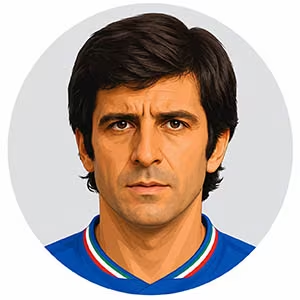
Italy - Centre-backNesta, Alessandro
At Old Trafford on 28 May 2003, Milan and Juventus had played 120 minutes without scoring when Alessandro Nesta walked towards the penalty spot for the fourth Italian kick of the Champions League final shoot-out. He was a centre-back, not a regular penalty taker, and Milan had already watched Clarence Seedorf and Kakha Kaladze fail. Nesta scored low beyond Gianluigi Buffon. Minutes later Andriy Shevchenko converted the decisive kick. The action was unusual enough to be revealing: Nesta’s normal responsibility consisted of preventing decisive errors rather than volunteering for an isolated attacking execution, yet when the shoot-out required another taker he accepted the task. That did not mean the situation felt emotionally neutral. Nesta has subsequently described himself as someone who suffered considerable tension around important matches. The distinction matters because his football often looked serene precisely when the internal experience was not. His competitive skill was not the elimination of anxiety but the preservation of defensive timing while anxiety remained present.
Nesta was a centre-back whose greatest advantage was the ability to delay intervention until the opponent had committed enough information to make the tackle reliable. He possessed excellent acceleration over short distances, balance and unusually flexible tackling mechanics, allowing him to reach across or around attackers without needing to collide directly through them. Sliding challenges became visually characteristic because Nesta could use them as controlled retrieval rather than emergency destruction, often remaining technically connected to the ball after winning it. His positional reading reduced how frequently those tackles were required. He could track movement behind another defender, cover channels and adjust body orientation early enough to confront attackers without giving them an obvious direction. In possession he was technically secure, capable of carrying beyond the first press and passing progressively, although describing him as a playmaker overstates his creative volume. Lazio made him captain while still young, and he led the club through its most successful period before moving to Milan in 2002. There he won two Champions Leagues and two Serie A titles while adapting to partnerships and defensive structures that changed around him.
His limitations were more physical than technical. Nesta’s defending depended on mobility, flexibility and the confidence to accelerate into precisely timed interventions; recurrent muscular problems and eventually serious back and knee issues repeatedly interrupted those mechanisms. He missed substantial periods throughout his Milan career and suffered perhaps the most consequential interruption at the 2006 World Cup, when an injury against the Czech Republic ended his participation after the group stage. Italy became world champions without him returning to the field. His later career demonstrates how availability, rather than tactical understanding, increasingly became the limiting variable. Nor was every elegant intervention intrinsically safe. Nesta’s willingness to wait and then tackle at the last possible moment created enormous defensive value when timing was correct, but an error at that point left little recovery margin. He was strong and competitive physically but not a defender whose primary advantage was overwhelming aerial or bodily dominance. Against repeated power contests, or once injury removed his acceleration and flexibility, more of the defensive problem had to be solved before direct confrontation occurred.
Psychologically, Nesta is best defined by **anxiety-compatible precision**. His restrained body language and clean defending encouraged the impression of natural serenity, yet his own retrospective descriptions are less romantic. Nesta has spoken of experiencing substantial nervousness before important matches and of football becoming increasingly psychologically demanding as responsibility grew. The relevant behavioural evidence is what happened to his decisions once play began. His defending did not characteristically become earlier, wilder or more confrontational as the stakes increased; he continued relying on delayed commitment, positional reading and precise intervention. The 2003 shoot-out adds a different form of responsibility: despite not being a specialist, he accepted a penalty after two Milan teammates had already missed and converted it. His captaincy at Lazio similarly should not be translated into vocal dominance. Nesta could exercise authority without requiring the emotional temperature of the defence to mirror his own internal state. Injury provides the more difficult counterpoint. Repeated physical interruptions frustrated him deeply and at times created uncertainty about whether his body would allow him to continue at elite level; those reactions should not be confused with pressure fragility during matches. Evidence for persistent referee confrontation, retaliatory aggression, teammate-directed blame or provocation-driven loss of control is weak and should remain unknown. The more defensible conclusion reverses the old stereotype: **Nesta was not remarkable because pressure failed to reach him; he was remarkable because tension could reach him without reliably changing the timing on which his football depended**.