We use Google Analytics to understand how visitors use this site. Analytics cookies are only activated with your consent. For details, read our Privacy Policy.
Profile lensThe same player, read from a different angle.
Athletic80
Acceleration
74
Pace
74
Agility
74
Strength
83
Balance
80
Jumping
88
Stamina
82
Fitness
83
Technical78
Dribbling
72
Short Passing
75
Long Passing
73
Finishing
61
Shot Accuracy
66
Shot Power
75
Shooting Technique
68
Heading
85
Tackling
89
Crossing
65
Free Kick
63
Penalties
61
First Touch
78
Mental85
Composure
87
Aggression
89
Consistency
87
Creativity
68
Leadership
83
Work Rate
84
Tactical84
Vision
72
Off the Ball
63
Defensive Positioning
91
Teamwork
83
Anticipation
87
Marking
92
Player Traits
Attacking68
Crossing
65
Finishing
61
Heading Accuracy
85
Shot Accuracy
66
Off the Ball
63
Technique72
Dribbling
72
Free Kick
63
Short Passing
75
Long Passing
73
First Touch
78
Shot Technique
68
Movement76
Acceleration
74
Pace
74
Agility
74
Balance
80
Physicality82
Shot Power
75
Jumping
88
Stamina
82
Strength
83
Fitness
83
Defending91
Marking
92
Tackling
89
Def. Positioning
91
Mentality & Game Reading80
Aggression
89
Composure
87
Penalties
61
Vision
72
Leadership
83
Work Rate
84
Teamwork
83
Anticipation
87
Consistency
87
Creativity
68
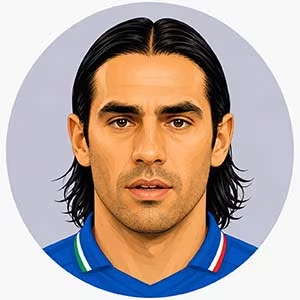
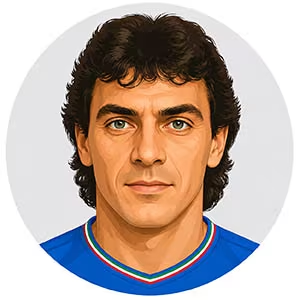
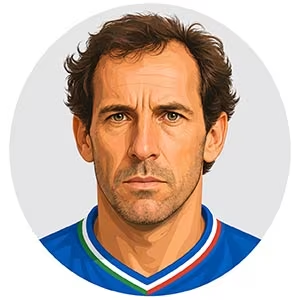
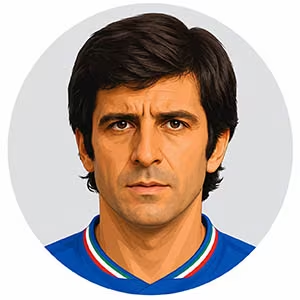
Italy - Centre-backCollovati, Fulvio
Thrust into the unforgiving cauldron of San Siro as a teenager before maturing into the resolute, man-marking cornerstone of Italy’s 1982 World Cup triumph, Fulvio Collovati was the quintessential classic Italian stopper of the late 1970s and 1980s. A product of AC Milan’s youth sector, Collovati combined a tall, upright, and muscular six-foot frame with exceptional aerial timing and a disciplined, back-to-basics defensive approach. Playing during the golden age of rigid man-to-man marking, his primary tactical mandate was singular: gluing himself to the opponent’s primary center-forward, denying them turning space, and using his strong upper-body balance to win primary aerial balls and physical duels. He was a central pillar of Milan’s historic tenth Scudetto (the Stella) in 1978–79, later weathering the turbulence of the Totonero scandal by sticking with the club in Serie B, before making a deeply controversial cross-city switch to Inter Milan in 1982 to maintain his top-flight and international status. His career pinnacle arrived under Enzo Bearzot at the 1982 World Cup in Spain: after early tournament doubts, Collovati formed an impenetrable, complementary defensive triangle alongside Gaetano Scirea and Claudio Gentile, neutralizing the lethal central attacks of Argentina, Brazil, and West Germany to lift the trophy, earning a spot in the FIFA All-Star Team. Earning 50 caps for the Azzurri, his later career saw solid, dependable Serie A spells with Udinese, AS Roma, and Genoa. Psychologically, Collovati was a serious, disciplined, and remarkably stoic professional who shouldered massive competitive burdens and public controversy with steady composure. His mental toughness was tested severely in 1982 when his decision to leave a relegated Milan for rival Inter made him a target of intense fan resentment; yet, he compartmentalized the external hostility entirely, focusing squarely on his tactical execution for Bearzot's national side. On the pitch, his demeanor was focused, intense, and utilitarian; while he lacked the lyrical elegance or visionary distribution of his sweeper partner Scirea, he possessed total tactical self-awareness, never overstepping his technical limitations and dedicating his entire 90-minute focus to neutralizing his direct opponent. In the dressing room, he was a quiet, highly educated, and articulate presence—introverted, polite, and deeply dedicated to the team dynamic without ever demanding the media spotlight. When taking heavy physical knocks—such as getting his head bandaged after a bloody collision against Poland in 1982—he barely flinched, returning immediately into the physical fray. Toward match officials and the bruising forwards he shadowed, Collovati was a tough, unyielding, but fundamentally honest marker: relying on strength, tight positional body checks, and legal aerial battles rather than cynical off-the-ball malice, leaving a legacy as one of the most dependable and defensively sound stoppers in Italian football history.