We use Google Analytics to understand how visitors use this site. Analytics cookies are only activated with your consent. For details, read our Privacy Policy.
Profile lensThe same player, read from a different angle.
Athletic82
Acceleration
83
Pace
86
Agility
84
Strength
85
Balance
78
Jumping
86
Stamina
80
Fitness
73
Technical92
Dribbling
92
Short Passing
86
Long Passing
81
Finishing
97
Shot Accuracy
97
Shot Power
86
Shooting Technique
99
Heading
95
Tackling
43
Crossing
74
Free Kick
83
Penalties
93
First Touch
92
Mental82
Composure
92
Aggression
77
Consistency
78
Creativity
89
Leadership
75
Work Rate
75
Tactical89
Vision
86
Off the Ball
94
Defensive Positioning
40
Teamwork
81
Anticipation
95
Marking
33
Player Traits
Attacking91
Crossing
74
Finishing
97
Heading Accuracy
95
Shot Accuracy
97
Off the Ball
94
Technique89
Dribbling
92
Free Kick
83
Short Passing
86
Long Passing
81
First Touch
92
Shot Technique
99
Movement83
Acceleration
83
Pace
86
Agility
84
Balance
78
Physicality82
Shot Power
86
Jumping
86
Stamina
80
Strength
85
Fitness
73
Defending39
Marking
33
Tackling
43
Def. Positioning
40
Mentality & Game Reading84
Aggression
77
Composure
92
Penalties
93
Vision
86
Leadership
75
Work Rate
75
Teamwork
81
Anticipation
95
Consistency
78
Creativity
89
Curated interpretation
Signature Moves
Role-defining patterns—not attributes, traits or Inner Game measures. Three ways Marco van Basten changes the meaning of the role around him.
01
Swan Elegance
The Swan of Utrecht: a tall, powerful centre-forward whose coordination and balance made acrobatics and extremely difficult gestures appear effortless.
02
Weightless Power
Strength, height and contact resistance never stiffen his football; the power remains fluid, technical and harmonious.
03
More Than Nine
Far more than a finisher, he can drop, combine, create and read play like an associative forward while retaining the instinct of a pure number nine.
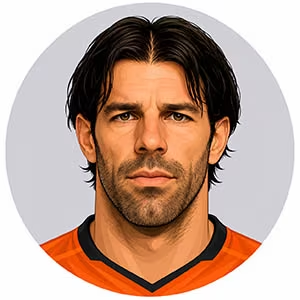
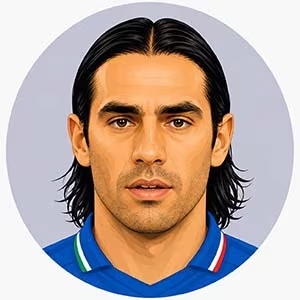
Netherlands - StrikerVan Basten, Marco
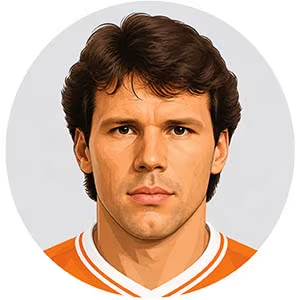
Munich, 25 June 1988, the fifty-fourth minute of a European Championship final. Arnold Mühren's cross arrived from the left, too high, too wide, and dropping behind the far post at an angle that offered nothing. Marco van Basten struck it first time on the volley from the byline, and it went in off the underside of the bar from a position where no shot should have been possible. It is the most technically improbable goal ever scored in a major final, and the most revealing thing about it is that he did not celebrate wildly — he jogged back with the expression of a man who had executed something he had already visualised.
Born in Utrecht in 1964, van Basten was the most complete centre-forward European football has produced. At 1.88m he combined a towering physical presence with the flexibility and footwork of a dancer: devastating in the air, immaculate in control with either foot under pressure, and capable of generating extraordinary power from angles that ought to have been unusable. He emerged at Ajax as Johan Cruyff's chosen successor, scoring 128 goals in 133 league matches and winning three Eredivisie titles, the 1987 Cup Winners' Cup and the European Golden Boot. Milan signed him in 1987, and in Arrigo Sacchi's high-pressing system he became something more than a finisher — an intelligent tactical pivot who dropped deep to link play, dragged centre-backs out of position, and drove into the box from distance. He won four Serie A titles, back-to-back European Cups in 1989 and 1990, two Intercontinental Cups, and three Ballons d'Or (1988, 1989, 1992). With the Netherlands he won 58 caps and 24 goals, and the 1988 European Championship, where he scored a hat-trick against England and then the volley in the final.
The end was catastrophic and disproportionate. A chronic right ankle problem, aggravated by repeated surgery and by the punishment Italian defenders were permitted to administer, made his career a sequence of interruptions from 1987 onward: he missed most of the 1987–88 and 1991–92 seasons, played the 1993 Champions League final in pain, and never played competitive football again after that match. He was twenty-eight. Beyond the injuries, his game had a narrower structural dependency than his talent suggested: he required service into good areas and a system that gave him the ball facing forward, and against deep blocks that denied him space to attack he could be reduced to aerial duels he did not always win alone.
Psychologically he was an icy perfectionist, playing with a cold, detached elegance that masked a ruthless competitive edge. He led through technical dominance and uncompromising standards, demanding absolute precision from himself and from teammates in build-up play, and he was openly critical of coaches when he disagreed — his disputes with Sacchi over a collective press he felt stifled individual creativity were public and unresolved. Within the dressing room he maintained a cool professional distance rather than expansive camaraderie, earning immense respect through output rather than warmth. His reaction to physical treatment was sharp and vocal: subjected to targeted, brutal tackling throughout his Italian years, he complained to officials, argued publicly for stricter protection of attacking players, and showed visible frustration when fouls went unpunished — one of the few things capable of breaking his composure. Big matches did not intimidate him and hostile crowds produced no measurable change; his demeanour in a final was identical to his demeanour in a league fixture. What the composure could not absorb was the ending itself. Forced to retire at twenty-eight, he withdrew almost completely: he stayed away from San Siro for years, cut contact with the club and with football, and admitted long afterwards that he had spent that period unable to accept what had happened. Away from the pitch he was private, family-oriented, and free of controversy, and he returned eventually as a coach with the same exacting, sometimes brittle intolerance for anything short of correct. Perfect, remote and cut down mid-sentence, van Basten remains the most complete striker the game has seen and the shortest prime any of them was given.