We use Google Analytics to understand how visitors use this site. Analytics cookies are only activated with your consent. For details, read our Privacy Policy.
Profile lensThe same player, read from a different angle.
Athletic82
Acceleration
89
Pace
85
Agility
90
Strength
73
Balance
77
Jumping
84
Stamina
82
Fitness
78
Technical87
Dribbling
87
Short Passing
83
Long Passing
78
Finishing
91
Shot Accuracy
91
Shot Power
79
Shooting Technique
93
Heading
82
Tackling
38
Crossing
71
Free Kick
70
Penalties
73
First Touch
91
Mental83
Composure
86
Aggression
80
Consistency
80
Creativity
86
Leadership
80
Work Rate
83
Tactical86
Vision
78
Off the Ball
92
Defensive Positioning
38
Teamwork
79
Anticipation
94
Marking
38
Player Traits
Attacking85
Crossing
71
Finishing
91
Heading Accuracy
82
Shot Accuracy
91
Off the Ball
92
Technique84
Dribbling
87
Free Kick
70
Short Passing
83
Long Passing
78
First Touch
91
Shot Technique
93
Movement85
Acceleration
89
Pace
85
Agility
90
Balance
77
Physicality79
Shot Power
79
Jumping
84
Stamina
82
Strength
73
Fitness
78
Defending38
Marking
38
Tackling
38
Def. Positioning
38
Mentality & Game Reading82
Aggression
80
Composure
86
Penalties
73
Vision
78
Leadership
80
Work Rate
83
Teamwork
79
Anticipation
94
Consistency
80
Creativity
86
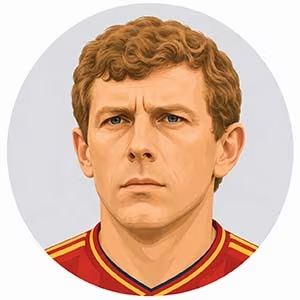
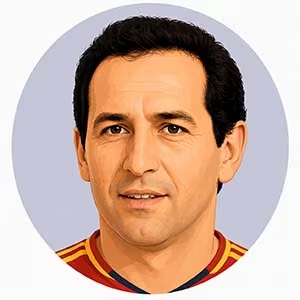
Spain - StrikerButragueño, Emilio
Emilio Butragueño
A newspaper headline in 1983 christened an entire golden generation of Real Madrid Castilla graduates before they had even hoisted a senior trophy, and the man at the very center of that cultural revolution was Emilio Butragueño Santos. Known universally as El Buitre (The Vulture), he stood as the cerebral apex of the Quinta del Buitre that dominated Spanish football in the late 1980s. Operating primarily as a second striker alongside the lethal Hugo Sánchez, Butragueño made time appear to freeze inside the penalty box: he did not overpower stoppers with raw speed or aerial strength, relying instead on sudden micro-pauses, sublime balance on the turn, and razor-sharp predatory rebounds off defensive mistakes. Across 463 matches for Real Madrid, he lifted six La Liga titles (including five consecutive crowns from 1986 to 1990), two Copas del Rey, two consecutive UEFA Cups (1985, 1986), and the 1990–91 Pichichi trophy with 19 league goals, earning two third-place finishes in the Ballon d'Or voting (1986, 1987). For Spain, his 69 caps and 26 goals were highlighted by an unforgettable four-goal demolition of Denmark in the round of sixteen at the 1986 World Cup in Querétaro.
Yet his hyper-refined craft featured sharp physical limitations. Butragueño was a lightweight artist who struggled whenever matches degenerated into chaotic, high-tempo aerial dogfights or heavy physical duels against bruising center-halves like Pietro Vierchowod. He offered negligible defensive pressing from the front, possessed an ordinary left foot, and his goal returns diminished considerably once opponents deployed ultra-compact low blocks that denied him the first two yards of turning space inside the eighteen-yard box, culminating in a quiet concluding club spell with Atlético Celaya in Mexico.
Gentlemanly, introspective, and completely devoid of malice, Butragueño approached elite football with the serene precision of an architect rather than the aggression of a warrior. He was an absolute gentleman on the pitch: across his entire career, he never received a single red card, refusing to retaliate against the cynical kicks, shirt-pulls, and violent hacks aimed at his ankles by desperate defenders. On the pitch, his body language was understated and calm, using sudden shifts of body weight rather than showy stepovers to dismantle defensive shape. Inside the Santiago Bernabéu dressing room, he was a quiet leader who commanded universal affection and authority alongside vocal figures like Míchel and Manolo Sanchís, setting an exemplary benchmark for professional conduct. Referees admired his spotless sportsmanship, while defenders found his unruffled demeanor and lightning-fast spatial instincts deeply unsettling, cementing an enduring legacy as one of the most elegant, intelligent, and influential penalty-box artists in Spanish football history.