We use Google Analytics to understand how visitors use this site. Analytics cookies are only activated with your consent. For details, read our Privacy Policy.
Profile lensThe same player, read from a different angle.
Athletic81
Acceleration
81
Pace
77
Agility
78
Strength
78
Balance
77
Jumping
82
Stamina
84
Fitness
87
Technical83
Dribbling
76
Short Passing
77
Long Passing
70
Finishing
93
Shot Accuracy
92
Shot Power
82
Shooting Technique
70
Heading
84
Tackling
38
Crossing
63
Free Kick
62
Penalties
77
First Touch
75
Mental83
Composure
87
Aggression
85
Consistency
80
Creativity
72
Leadership
81
Work Rate
84
Tactical84
Vision
71
Off the Ball
94
Defensive Positioning
39
Teamwork
77
Anticipation
89
Marking
38
Player Traits
Attacking85
Crossing
63
Finishing
93
Heading Accuracy
84
Shot Accuracy
92
Off the Ball
94
Technique72
Dribbling
76
Free Kick
62
Short Passing
77
Long Passing
70
First Touch
75
Shot Technique
70
Movement78
Acceleration
81
Pace
77
Agility
78
Balance
77
Physicality83
Shot Power
82
Jumping
82
Stamina
84
Strength
78
Fitness
87
Defending38
Marking
38
Tackling
38
Def. Positioning
39
Mentality & Game Reading80
Aggression
85
Composure
87
Penalties
77
Vision
71
Leadership
81
Work Rate
84
Teamwork
77
Anticipation
89
Consistency
80
Creativity
72
England - StrikerHunt, Roger
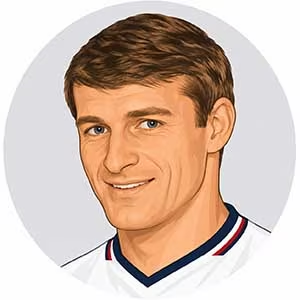
Before the 1966 World Cup final at Wembley kicked off, Alf Ramsey looked around the English dressing room and knew that his energetic, hard-running frontline depended entirely on the tireless industry of an unassuming forward from Golborne. Roger Hunt MBE—canonized across Merseyside as Sir Roger—was the relentless goalscoring engine of Bill Shankly’s original Liverpool revolution and the ultimate blue-collar forward of English post-war football. Operating as a direct center-forward or second striker, Hunt paired explosive short-range finishing inside the eighteen-yard box with limitless cardiovascular running, tracking back into midfield and pressing defenders relentlessly over ninety minutes. Across 492 appearances and 285 goals for Liverpool between 1958 and 1969, he remains the club’s all-time leading league goalscorer with 244 strikes, firing the Reds out of the Second Division to capture two First Division championships (1963–64, 1965–66) and the club’s historic, first-ever FA Cup in 1965. For England, across 34 caps and 18 goals, he played in all six matches of the 1966 World Cup, netting three goals in the group stage and starting the final alongside Geoff Hurst.
His direct, predator game, however, relied on high-energy service and physical momentum rather than individual dribbling wizardry. Hunt was not a silky, deep-lying orchestrator who could unlock compact low blocks through intricate individual dribbling; his game was built around speed into the channels, quick combination play, and first-time snatches inside the six-yard box. When isolated against deep, cynical continental defenses that eliminated running lanes behind the back four, his match involvement could fade into long phases of physical attrition.
Humble, deeply grounded, and completely devoid of modern vanity, Hunt approached professional football with the quiet dedication of a tradesman. He never demanded personal glory or media headlines, taking equal pride in creating space for Ian St John as in burying goals into the top corner. On the pitch, his presence was all honest graft: chasing down back-passes, throwing his body into flying challenges, and celebrating crucial goals with a simple raise of the arm to the Kop. Inside the Anfield and England dressing rooms, he was universally beloved for his modesty and unyielding competitive courage, cementing an immortal legacy as the founding goalscoring father of Liverpool’s modern empire.


 All Time LiverpoolClub