We use Google Analytics to understand how visitors use this site. Analytics cookies are only activated with your consent. For details, read our Privacy Policy.
Profile lensThe same player, read from a different angle.
Athletic81
Acceleration
87
Pace
82
Agility
86
Strength
71
Balance
78
Jumping
86
Stamina
82
Fitness
75
Technical85
Dribbling
84
Short Passing
77
Long Passing
75
Finishing
94
Shot Accuracy
96
Shot Power
77
Shooting Technique
88
Heading
81
Tackling
36
Crossing
69
Free Kick
68
Penalties
78
First Touch
79
Mental79
Composure
89
Aggression
70
Consistency
77
Creativity
73
Leadership
74
Work Rate
72
Tactical85
Vision
75
Off the Ball
95
Defensive Positioning
30
Teamwork
73
Anticipation
95
Marking
34
Player Traits
Attacking87
Crossing
69
Finishing
94
Heading Accuracy
81
Shot Accuracy
96
Off the Ball
95
Technique79
Dribbling
84
Free Kick
68
Short Passing
77
Long Passing
75
First Touch
79
Shot Technique
88
Movement83
Acceleration
87
Pace
82
Agility
86
Balance
78
Physicality78
Shot Power
77
Jumping
86
Stamina
82
Strength
71
Fitness
75
Defending33
Marking
34
Tackling
36
Def. Positioning
30
Mentality & Game Reading78
Aggression
70
Composure
89
Penalties
78
Vision
75
Leadership
74
Work Rate
72
Teamwork
73
Anticipation
95
Consistency
77
Creativity
73
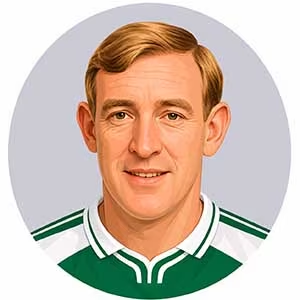
England - StrikerGreaves, Jimmy
No striker in the long, storied history of English football ever made the impossible art of goalscoring look as casual, effortless, and mathematically inevitable as the East End prodigy James Peter Greaves. Bursting through Chelsea’s youth ranks before brief spells at AC Milan, Tottenham Hotspur, West Ham United, and England, Greaves completely dismantled the myth that center-forwards needed to be battering rams who threw their heads at flying leather. Blessed with an astonishingly low center of gravity, cat-like balance on heavy mud pitches, and a lightning-fast five-meter burst of acceleration, Greaves approached finishing not with brute power, but with supreme, icy minimalism. His signature was the delicate stroke: receiving the ball on the half-turn, feinting the goalkeeper onto his backside with a subtle drop of the shoulder, and passing the ball with pinpoint accuracy into the bottom corner of the net as if rolling a marble across a snooker table. Scoring an all-time record 357 goals in the English top flight, 266 goals for Tottenham—where he won two FA Cups and the 1963 European Cup Winners' Cup—and 44 goals in just 57 caps for England, his numbers remain the gold standard of British penalty-box efficiency.
Psychologically, Greaves played with a carefree, joyous, and street-forged naturalism that masked an extraordinary, ice-cold detachment inside the penalty area. He possessed an innate ability to slow down time when everyone around him was panicking, entering a state of absolute, tranquil clarity the moment a scoring opportunity emerged. Inside the dressing room, he was a beloved, quick-witted cockney character whose infectious humor and lighthearted banter kept teammates relaxed, though he harbored an intense, private sensitivity beneath his cheerful exterior. When navigating the agonizing emotional trauma of losing his starting place to Geoff Hurst due to an untimely injury before the 1966 World Cup final, his dignity was profound; despite his inner heartbreak at missing the nation's finest hour, he celebrated his teammates' triumph with genuine sporting grace. Toward match officials and the ferocious, bone-crunching central defenders of the 1960s, Greaves maintained a nonchalant, gentlemanly distance: he absorbed brutal, cynical physical assaults without retaliating, never engaged in gamesmanship or diving, and simply let his supernatural finishing instincts deliver the ultimate, humiliating retribution on the scoreline, leaving an immortal legacy as the purest natural goalscorer England has ever produced.