We use Google Analytics to understand how visitors use this site. Analytics cookies are only activated with your consent. For details, read our Privacy Policy.
Profile lensThe same player, read from a different angle.
Athletic81
Acceleration
83
Pace
77
Agility
81
Strength
80
Balance
88
Jumping
75
Stamina
84
Fitness
80
Technical88
Dribbling
85
Short Passing
85
Long Passing
82
Finishing
95
Shot Accuracy
95
Shot Power
88
Shooting Technique
91
Heading
83
Tackling
49
Crossing
76
Free Kick
85
Penalties
85
First Touch
84
Mental82
Composure
86
Aggression
85
Consistency
81
Creativity
85
Leadership
77
Work Rate
83
Tactical87
Vision
81
Off the Ball
94
Defensive Positioning
38
Teamwork
77
Anticipation
93
Marking
43
Player Traits
Attacking89
Crossing
76
Finishing
95
Heading Accuracy
83
Shot Accuracy
95
Off the Ball
94
Technique85
Dribbling
85
Free Kick
85
Short Passing
85
Long Passing
82
First Touch
84
Shot Technique
91
Movement82
Acceleration
83
Pace
77
Agility
81
Balance
88
Physicality81
Shot Power
88
Jumping
75
Stamina
84
Strength
80
Fitness
80
Defending43
Marking
43
Tackling
49
Def. Positioning
38
Mentality & Game Reading83
Aggression
85
Composure
86
Penalties
85
Vision
81
Leadership
77
Work Rate
83
Teamwork
77
Anticipation
93
Consistency
81
Creativity
85
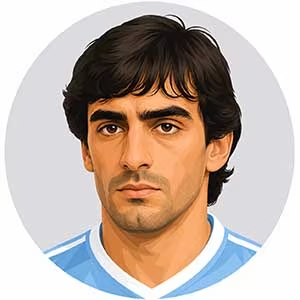
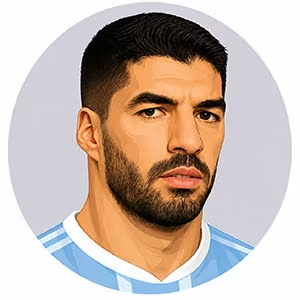
Uruguay - StrikerSuárez, Luis
Few athletes in sporting history have ever weaponized chaotic willpower quite like the snarling talisman from Salto. Luis Alberto Suárez Díaz carved out a legacy as the most relentlessly destructive, versatile center-forward of his generation, transitioning from Nacional to Ajax before reaching superhuman heights with Liverpool and FC Barcelona. Operating on the razor's edge of sporting legality, El Pistolero combined street-fighter physicality with breathtaking technical improvisation: nut-megging defenders in phone-booth spaces, hooking miraculous volleys off bouncing balls with zero backlift, and relentlessly pressing entire back fours into fatal panic. At Liverpool, his 31-goal haul in 2013–14 without a single penalty won him the European Golden Shoe, which he claimed again in 2015–16 at Barcelona with an astonishing 40 league goals. As the central engine of the legendary MSN trident alongside Lionel Messi and Neymar, he lifted the 2014–15 continental treble, four La Liga crowns, and later delivered a defiant, title-winning masterclass for Atlético Madrid in 2020–21. For Uruguay, across 143 caps and 69 goals, his folklore status is immortal: winning the 2011 Copa América as tournament MVP and executing the ultimate act of competitive martyrdom with his deliberate goal-line handball against Ghana in the 2010 World Cup quarter-final.
Yet Suárez’s volcanic fury was a double-edged blade that repeatedly crossed into disciplinary infamy. His career was marred by three separate biting incidents—culminating in the worldwide ban for his clash with Giorgio Chiellini at the 2014 World Cup—and persistent bouts of referee confrontation and simulation. From a technical standpoint, his linear top speed was modest, and as chronic knee degeneration mounted in his thirties, his turning radius slowed, rendering him less effective when forced to chase long balls in deep counter-attacking schemes without immediate combination support.
Unapologetic, feral, and fuelled by a win-at-all-costs obsession, Suárez played every single fixture as if his family’s survival depended on the final whistle. He fed off the visceral hatred of opposition crowds, transforming boos and hostility into pure attacking fuel. On the pitch, his body language was a storm of raw emotion: contesting every loose ball with ferocious commitment, gesticulating wildly, and using subtle hip checks and unglamorous contact to throw defenders off balance. Inside the dressing room, he was an intensely loyal, beloved warrior—forming an unbreakable brotherhood with Messi and serving as the emotional heartbeat of Óscar Tabárez’s Celeste. Opposing center-backs universally dreaded the psychological and physical war of marking him, leaving behind an immortal legacy as the definitive, unhinged genius of modern South American attacking football.


 All Time BarcelonaClub
 All Time UruguayNT
 All-Time 2010s2010s
 All-Time South AmericaSouth America