We use Google Analytics to understand how visitors use this site. Analytics cookies are only activated with your consent. For details, read our Privacy Policy.
Profile lensThe same player, read from a different angle.
Athletic80
Acceleration
86
Pace
79
Agility
88
Strength
70
Balance
87
Jumping
68
Stamina
88
Fitness
75
Technical90
Dribbling
95
Short Passing
94
Long Passing
85
Finishing
75
Shot Accuracy
80
Shot Power
77
Shooting Technique
79
Heading
62
Tackling
60
Crossing
84
Free Kick
75
Penalties
73
First Touch
98
Mental83
Composure
91
Aggression
66
Consistency
83
Creativity
93
Leadership
77
Work Rate
76
Tactical89
Vision
90
Off the Ball
87
Defensive Positioning
62
Teamwork
95
Anticipation
82
Marking
49
Player Traits
Attacking 78
Crossing
84
Finishing
75
Heading Accuracy
62
Shot Accuracy
80
Off the Ball
87
Technique 88
Dribbling
95
Free Kick
75
Short Passing
94
Long Passing
85
First Touch
98
Shot Technique
79
Movement 85
Acceleration
86
Pace
79
Agility
88
Balance
87
Physicality 76
Shot Power
77
Jumping
68
Stamina
88
Strength
70
Fitness
75
Defending 57
Marking
49
Tackling
60
Def. Positioning
62
Mentality & Game Reading 83
Aggression
66
Composure
91
Penalties
73
Vision
90
Leadership
77
Work Rate
76
Teamwork
95
Anticipation
82
Consistency
83
Creativity
93
Curated interpretation
Signature Moves
Role-defining patterns—not attributes, traits or Inner Game measures. Three ways Andrés Iniesta changes the meaning of the role around him.
01
Sleight of Space
He does not beat defenders with speed; he makes the space around them disappear and reappear exactly where he needs it.
02
Camouflage
The most extraordinary talent of his generation arrives in the least extraordinary body.
03
Loudest Silence
The player who asks to be seen the least decides the biggest moment Spanish football has ever reached.
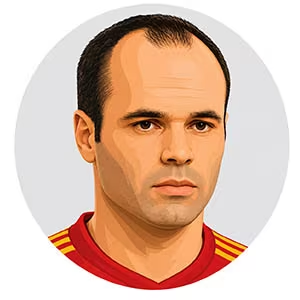
Spain - Attacking MidfielderIniesta, Andrés
At Stamford Bridge on 6 May 2009, Barcelona were seconds from elimination when Lionel Messi received the ball outside Chelsea’s penalty area and moved it towards Andrés Iniesta. Barcelona had produced almost no clean shooting opportunities all evening and were playing with ten men. Iniesta arrived at the edge of the box and struck first time with the outside of his right foot, sending the ball beyond Petr Čech and Barcelona into the Champions League final. Fifteen months later, in Johannesburg, another match had reached its final minutes when Cesc Fàbregas found him inside the Netherlands penalty area. Iniesta controlled, waited for the bouncing ball to settle and scored the goal that won Spain their first World Cup. The two actions were technically different but psychologically similar. Iniesta did not need to dominate the preceding match to remain available for its most consequential possession. Nor did pressure eliminate risk from his decision-making: one finish was struck first time from distance, the other required him to remain inside a crowded penalty area after 115 minutes. His defining response to extreme competitive pressure was not theatrical command but continued technical availability.
Iniesta was an interior midfielder whose game depended on manipulating space at extremely short range. His first touch, balance and rapid transfer of the ball between feet allowed him to receive under pressure in zones where most midfielders needed additional separation. The characteristic croqueta was not merely a dribbling ornament: shifting the ball instantly across his body allowed him to escape the direction of pressure while preserving forward momentum. He could accelerate over the first metres after beating an opponent, carry through midfield, combine at one touch and play final passes through compressed defensive lines. Under Pep Guardiola he functioned primarily as the advanced left interior but could move wider or higher when the structure required it; with Spain he similarly operated inside possession systems whose positional discipline created spaces for his improvisation. Across 674 competitive appearances for Barcelona he won nine league titles and four Champions Leagues, while 131 appearances for Spain included the 2008 and 2012 European Championships and the 2010 World Cup. His contribution cannot be represented adequately through goals and assists because much of his value occurred one action earlier: receiving under pressure, eliminating a defender and changing the geometry from which the decisive pass became possible.
There were nevertheless real limits. At 1.71 metres and without exceptional upper-body strength, Iniesta offered little aerial value and could be displaced when opponents successfully converted technical contests into static physical ones. He was elusive over the first metres rather than genuinely fast across long distances, and his defensive value came primarily from positioning, pressing coordination and ball retention rather than tackling volume or physical coverage. Persistent contact could disrupt his rhythm even when it did not provoke him emotionally. Availability was another important limitation: muscular injuries repeatedly interrupted seasons during his peak years, including 2008–09 and the months preceding the 2010 World Cup. As he aged and lost some initial acceleration, escaping the first defender became less automatic, reducing the advantage from which subsequent actions were created. His modest scoring numbers should not, however, be explained simply as excessive generosity or risk aversion. Iniesta was willing to attempt difficult penetrative actions but was not naturally a high-volume shooter or penalty-area occupier. His degradation therefore came more clearly through physical compression, reduced acceleration and interrupted fitness than through unwillingness to assume attacking responsibility.
Psychologically, Iniesta is best defined by **pressure-seeking availability without dominance-seeking**. The distinction matters because his restrained external manner can easily be mistaken for low emotional intensity. His own accounts contradict that inference: leaving Fuentealbilla for La Masia at twelve caused prolonged distress, and later periods of severe personal difficulty produced substantial internal suffering. Those private causes fall outside this profile’s editorial scope; the observable football distinction is that emotional load did not map cleanly onto avoidance of decisive responsibility. During the 2009 Champions League semi-final he remained available for the final attacking action despite Barcelona’s impending elimination; in the 2010 World Cup final he continued making forward runs deep into extra time and took the decisive finish himself. After scoring, his first deliberate public act was to reveal a tribute to his late friend Dani Jarque, showing that the emotional significance of the preceding period remained active rather than having been suppressed. His behaviour towards opponents and officials supplies a different form of evidence. Despite receiving repeated tactical fouls throughout his career, Iniesta was not characterised by retaliatory aggression or persistent referee confrontation; physical targeting did not reliably become interpersonal escalation. Leadership followed the same non-dominant pattern. He eventually became Barcelona captain, but teammates did not need to become subordinate to his personality for him to assume responsibility: his most visible form of leadership remained repeatedly offering himself for possession when losing the ball would be costly. Evidence does not justify calling him fearless or emotionally invariant. The stronger claim is almost the opposite: **fear, grief, pressure and vulnerability could remain present while his willingness to enter technically dangerous situations survived them**.