We use Google Analytics to understand how visitors use this site. Analytics cookies are only activated with your consent. For details, read our Privacy Policy.
Profile lensThe same player, read from a different angle.
Athletic81
Acceleration
87
Pace
82
Agility
85
Strength
76
Balance
83
Jumping
75
Stamina
83
Fitness
80
Technical92
Dribbling
95
Short Passing
96
Long Passing
94
Finishing
77
Shot Accuracy
82
Shot Power
84
Shooting Technique
90
Heading
75
Tackling
41
Crossing
91
Free Kick
84
Penalties
83
First Touch
95
Mental80
Composure
86
Aggression
69
Consistency
75
Creativity
94
Leadership
79
Work Rate
76
Tactical89
Vision
93
Off the Ball
85
Defensive Positioning
45
Teamwork
92
Anticipation
83
Marking
41
Player Traits
Attacking82
Crossing
91
Finishing
77
Heading Accuracy
75
Shot Accuracy
82
Off the Ball
85
Technique92
Dribbling
95
Free Kick
84
Short Passing
96
Long Passing
94
First Touch
95
Shot Technique
90
Movement84
Acceleration
87
Pace
82
Agility
85
Balance
83
Physicality80
Shot Power
84
Jumping
75
Stamina
83
Strength
76
Fitness
80
Defending42
Marking
41
Tackling
41
Def. Positioning
45
Mentality & Game Reading83
Aggression
69
Composure
86
Penalties
83
Vision
93
Leadership
79
Work Rate
76
Teamwork
92
Anticipation
83
Consistency
75
Creativity
94
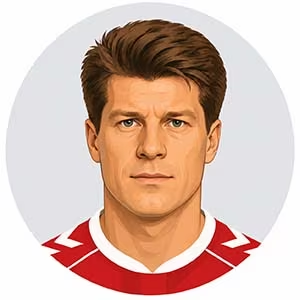
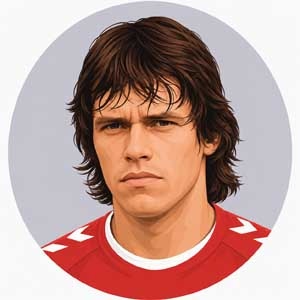
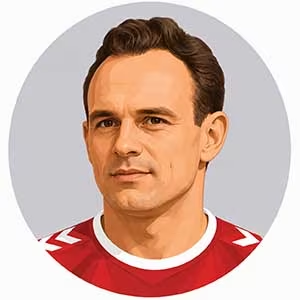
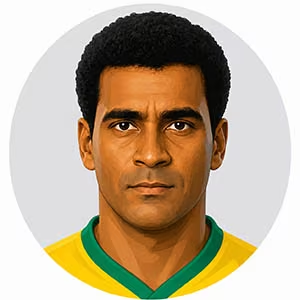
Denmark - Attacking MidfielderLaudrup, Michael
Watching Michael Laudrup orchestrate an attacking phase was akin to watching an illusionist perform tricks in broad daylight, where everyone in the stadium knew the sleight of hand was coming yet remained utterly powerless to stop it. The serene, cerebral conductor of Johan Cruyff’s Barcelona Dream Team and later the tactical catalyst behind Real Madrid’s mid-1990s resurgence, the Danish playmaker elevated the art of the assist into football's highest aesthetic form. Operating as an attacking midfielder, false nine, or drifting wide playmaker, Laudrup mastered the geometry of the pitch through his signature move: the croqueta—shifting the ball from one foot to the other in a single, fluid gliding motion to bypass lunging defenders—and his legendary no-look chipped through-balls that bypassed entire defensive lines into the path of runners like Romário and Hristo Stoichkov. Blessed with pristine balance, peripheral vision that spanned the entire pitch, and press-resistant ball control, he dictated the speed of European games with effortless elegance, claiming four consecutive La Liga crowns and the 1992 European Cup with Barça before crossing the Clásico divide to immediately lead Real Madrid to the 1995 league title, orchestrating historic 5-0 thrashings on both sides of the rivalry.
Mentally and emotionally, Laudrup was an aristocratic, deeply introverted perfectionist who approached the game through an intellectual and aesthetic filter rather than raw, blood-and-thunder aggression. On the pitch, he exercised a quiet, hypnotic authority, preferring to let the mathematical precision of his passing speak for his command rather than shouting at colleagues. Inside the dressing room, he was a polite, calm, and dignified professional who kept an arm's-length distance from theatrical media controversies, earning universal adoration from teammates for his supreme selflessness on the ball—famously preferring to supply an exquisite assist rather than take an easy shot himself. Under high-stakes pressure, his nervous system was exceptionally cool and detached, executing intricate passes in the tightest spaces of European finals with the calm detachment of a chess grandmaster, though his deep personal principles occasionally led to profound standoffs with authoritarian managers, most notably his fallout with Cruyff before the 1994 Athens final and his principled, temporary withdrawal from the Danish national team. Toward referees and opposition markers, Laudrup was the ultimate paragon of fair play: absorbing cynical fouls without diving, retaliation, or verbal dissent, floating above the physical violence of the era with immaculate sporting dignity.