We use Google Analytics to understand how visitors use this site. Analytics cookies are only activated with your consent. For details, read our Privacy Policy.
Profile lensThe same player, read from a different angle.
Athletic78
Acceleration
75
Pace
74
Agility
76
Strength
81
Balance
85
Jumping
73
Stamina
86
Fitness
76
Technical89
Dribbling
89
Short Passing
93
Long Passing
96
Finishing
77
Shot Accuracy
78
Shot Power
94
Shooting Technique
79
Heading
74
Tackling
60
Crossing
87
Free Kick
85
Penalties
85
First Touch
91
Mental84
Composure
89
Aggression
88
Consistency
77
Creativity
82
Leadership
87
Work Rate
82
Tactical83
Vision
93
Off the Ball
82
Defensive Positioning
63
Teamwork
86
Anticipation
77
Marking
54
Player Traits
Attacking80
Crossing
87
Finishing
77
Heading Accuracy
74
Shot Accuracy
78
Off the Ball
82
Technique89
Dribbling
89
Free Kick
85
Short Passing
93
Long Passing
96
First Touch
91
Shot Technique
79
Movement78
Acceleration
75
Pace
74
Agility
76
Balance
85
Physicality82
Shot Power
94
Jumping
73
Stamina
86
Strength
81
Fitness
76
Defending59
Marking
54
Tackling
60
Def. Positioning
63
Mentality & Game Reading85
Aggression
88
Composure
89
Penalties
85
Vision
93
Leadership
87
Work Rate
82
Teamwork
86
Anticipation
77
Consistency
77
Creativity
82
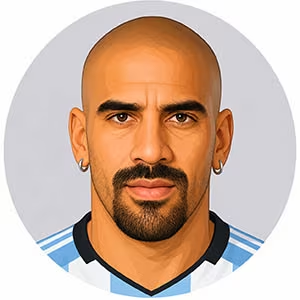
Argentina - Centre MidfielderVerón, Juan Sebastián
Few modern playmakers possessed the sheer ballistic range, diagonal velocity, and imperial arrogance of Juan Sebastián Verón, the Argentine Brujita who dictated European midfield tempos throughout the late 1990s and 2000s. Developed at Estudiantes and Boca Juniors before exploding in Italy with Sampdoria, Parma, and Lazio, Verón was the ultimate long-range orchestrator. While lacking dynamic short-burst speed or high-tempo pressing agility, he possessed exceptional balance, broad upper-body leverage, and a lethal right foot capable of spraying 60-yard passes with pinpoint accuracy onto a winger's boot. At Sven-Göran Eriksson's Lazio, he was the tactical fulcrum of the historic 1999–2000 Scudetto, UEFA Super Cup, and Coppa Italia triumphs, floating between lines, delivering lethal set pieces, and striking swerving shots from distance. However, his subsequent high-profile £28.1 million move to Manchester United in 2001 exposed his tactical flaws: the relentless, high-friction pace of the Premier League denied him the seconds on the half-turn he enjoyed in Italy, rendering his play erratic when swarmed by opposing midfields. After an indifferent spell with Chelsea and a restorative return to Italy with Inter Milan, he authored a triumphant late-career renaissance back home with Estudiantes, winning two Argentine titles and captaining the club to the 2009 Copa Libertadores.
Mentally and emotionally, Verón was a haughty, ultra-confident patrician who demanded total control over the footballing rhythm, playing best when the entire system deferred to his vision. He possessed a proud, occasionally prickly temperament; when a team's tactical identity suited his cadence, his leadership was commanding, authoritative, and fearless. Yet, when matches bypassed him—most painfully experienced during Argentina’s disastrous 2002 World Cup campaign, where his languid tempo against England drew intense, lasting public fury from home supporters—he could appear detached, stubborn, and unwilling to adapt his style to frenetic circumstances. Inside the dressing room, he was an alpha presence: direct, articulate, and fiercely protective of his status, capable of elevating younger players while clashing with managers who tried to turn him into a basic defensive workhorse. Toward match officials and aggressive markers, Verón was streetwise and unapologetically cynical, using clever tactical obstructions, heavy challenges, and biting verbal authority to protect his territory, leaving a complex legacy as one of the most gifted, polarizing, and technically supreme deep playmakers of his era.