We use Google Analytics to understand how visitors use this site. Analytics cookies are only activated with your consent. For details, read our Privacy Policy.
Profile lensThe same player, read from a different angle.
Athletic78
Acceleration
71
Pace
75
Agility
68
Strength
87
Balance
82
Jumping
77
Stamina
84
Fitness
80
Technical80
Dribbling
78
Short Passing
82
Long Passing
82
Finishing
74
Shot Accuracy
74
Shot Power
83
Shooting Technique
71
Heading
75
Tackling
74
Crossing
68
Free Kick
74
Penalties
72
First Touch
83
Mental78
Composure
78
Aggression
80
Consistency
78
Creativity
73
Leadership
80
Work Rate
75
Tactical78
Vision
80
Off the Ball
75
Defensive Positioning
68
Teamwork
84
Anticipation
74
Marking
66
Attacking73
Crossing
68
Finishing
74
Heading Accuracy
75
Shot Accuracy
74
Off the Ball
75
Technique78
Dribbling
78
Free Kick
74
Short Passing
82
Long Passing
82
First Touch
83
Shot Technique
71
Movement74
Acceleration
71
Pace
75
Agility
68
Balance
82
Physicality82
Shot Power
83
Jumping
77
Stamina
84
Strength
87
Fitness
80
Defending69
Marking
66
Tackling
74
Def. Positioning
68
Mentality & Game Reading77
Aggression
80
Composure
78
Penalties
72
Vision
80
Leadership
80
Work Rate
75
Teamwork
84
Anticipation
74
Consistency
78
Creativity
73
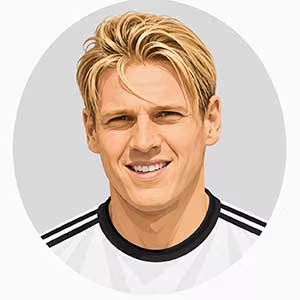
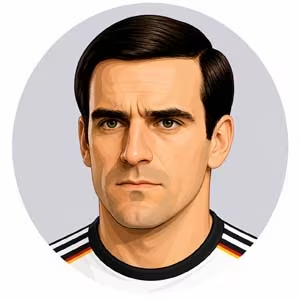
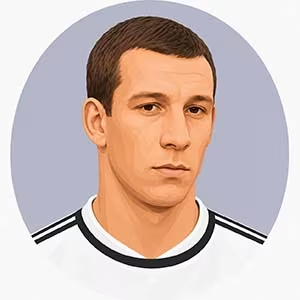
Germany - Centre MidfielderBorowski, Tim
Breaking the mold of the conventional German midfielder through an atypical combination of significant height, subtle close control, and arriving runs from deep, Tim Borowski was an indispensable tactical balance for Thomas Schaaf’s adventurous Werder Bremen during their mid-2000s peak. Developed entirely in Bremen’s youth system, Borowski offered a unique profile on the left or tip of Schaaf's dynamic midfield diamond. Rather than playing as a pure physical ball-winner or an agile dribbler, he excelled through spatial economy: using his extensive reach to protect the ball on the half-turn, sliding short vertical passes into feet, and timing his late arrivals at the edge of the box to unleash crisp, heavy strikes with his right foot. He played an integral role in Bremen’s historic 2003–04 Bundesliga and DFB-Pokal Double, followed by an exceptional 2005–06 season where he posted double digits in both goals and assists. On the international stage, he earned 33 caps for Germany, carving out a reputation as an ice-cold substitute at the 2006 World Cup—memorably flicking the headed assist for Miroslav Klose’s late equalizer against Argentina before converting a high-pressure penalty in the shootout. A subsequent move to Bayern Munich in 2008 exposed his limitations in lateral quickness and defensive transitions outside of Schaaf’s specific tactical framework, leading to an early return to the Weserstadion to close out his career.
Psychologically, Borowski was an understated, cerebral player whose performance levels were closely tied to structural clarity and the trust of his manager. He lacked the aggressive, vocal nature typical of German midfield generals, preferring to lead through tactical discipline and reliable ball retention rather than confrontational displays. Under extreme pressure, his emotional control was remarkable; stepping off the bench in high-stakes tournament matches, he showed zero nervous agitation, executing intricate combinations and stepping up in decisive penalty shootouts with pure mechanical focus. However, he struggled when relegated to the fringes, lacking the combative edge required to force his way into rigid, star-heavy environments like Munich. Inside the dressing room, he was a grounded, respected, and low-maintenance presence—appreciated by teammates for his dry humor, modesty, and commitment to the collective game plan. Toward referees and aggressive opponents, Borowski maintained an honorable, non-reactive attitude: avoiding theatrics, absorbing physical contact cleanly, and letting his technical delivery and sharp tactical timing define his identity on the pitch.