We use Google Analytics to understand how visitors use this site. Analytics cookies are only activated with your consent. For details, read our Privacy Policy.
Profile lensThe same player, read from a different angle.
Athletic87
Acceleration
86
Pace
84
Agility
83
Strength
85
Balance
88
Jumping
78
Stamina
93
Fitness
96
Technical87
Dribbling
86
Short Passing
87
Long Passing
90
Finishing
87
Shot Accuracy
85
Shot Power
93
Shooting Technique
84
Heading
75
Tackling
78
Crossing
86
Free Kick
85
Penalties
82
First Touch
85
Mental90
Composure
85
Aggression
90
Consistency
92
Creativity
82
Leadership
93
Work Rate
95
Tactical87
Vision
90
Off the Ball
87
Defensive Positioning
74
Teamwork
91
Anticipation
84
Marking
76
Player Traits
Attacking 84
Crossing
86
Finishing
87
Heading Accuracy
75
Shot Accuracy
85
Off the Ball
87
Technique 86
Dribbling
86
Free Kick
85
Short Passing
87
Long Passing
90
First Touch
85
Shot Technique
84
Movement 85
Acceleration
86
Pace
84
Agility
83
Balance
88
Physicality 89
Shot Power
93
Jumping
78
Stamina
93
Strength
85
Fitness
96
Defending 76
Marking
76
Tackling
78
Def. Positioning
74
Mentality & Game Reading 88
Aggression
90
Composure
85
Penalties
82
Vision
90
Leadership
93
Work Rate
95
Teamwork
91
Anticipation
84
Consistency
92
Creativity
82
Curated interpretation
Signature Moves
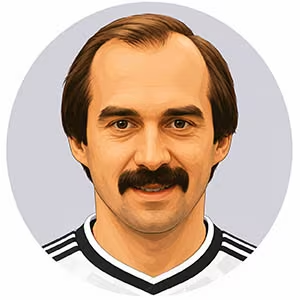
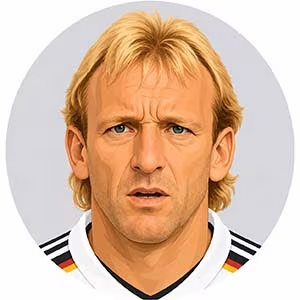
Role-defining patterns—not attributes, traits or Inner Game measures. Three ways Lothar Matthäus changes the meaning of the role around him.
01
No Decline Clause
Two decades pass, and the level simply never drops.
02
Shapeshifter
Four different positions, never a weaker version of himself in any of them.
03
The Final Word
The armband he wears in 1990 is function, not ceremony.
Germany - Centre MidfielderMatthäus, Lothar
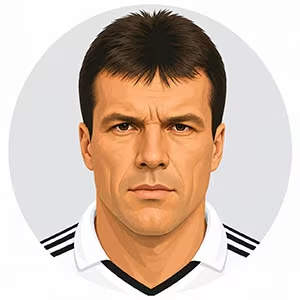
At Milan’s San Siro on 24 June 1990, West Germany were struggling to break down Czechoslovakia in a World Cup quarter-final when Jürgen Klinsmann was fouled inside the penalty area. Lothar Matthäus took the ball. Four years earlier, against Mexico, he had declined to participate in the quarter-final shoot-out because he had changed boots during the match and no longer trusted the pair he was wearing. In Milan there was no comparable hesitation: as captain and designated penalty taker, he drove the ball beyond Jan Stejskal and scored the only goal. It was his fourth of the tournament. By then Matthäus was operating at the centre of almost every German phase—recovering possession, carrying through midfield, switching play and arriving near goal. The contrast between 1986 and 1990 is useful because it prevents simplistic mythology. Matthäus did not possess an abstract refusal ever to retreat from responsibility; he could make a situational judgement that a specific action was unreliable. When he believed the conditions were his to control, however, responsibility tended to expand around him.
At his peak Matthäus was an extraordinarily complete central midfielder. Compact, powerful and explosive over distance, he could win possession through aggressive tackling and immediately convert the recovery into forward progression. His acceleration allowed him to carry directly through midfield, while powerful shooting with either foot forced opponents to defend him long before he reached the penalty area. He could also distribute over distance and alter the point of attack, making him much more than a ball-winning runner. At Internazionale, particularly under Giovanni Trapattoni, those qualities converged into a box-to-box role that culminated in the 1988–89 Serie A title and his extraordinary 1990 season. Later, after serious injury and declining mobility, he moved permanently behind midfield and became a libero for Bayern and Germany. The transition preserved his passing, anticipation and command while reducing the repeated running demanded of the younger player. His record ultimately reached 150 German internationals across five World Cups, with the 1990 World Cup, Ballon d’Or and subsequent FIFA World Player award marking the peak of his individual authority.
Completeness did not mean absence of structural weaknesses. The younger Matthäus’s aggressive verticality could pull him towards the action and leave space if the surrounding midfield did not compensate. His desire to influence multiple phases could occasionally become overextension: carrying, tackling, shooting and organising were all strengths, but attempting to solve too many problems personally could reduce positional restraint. Serious injuries eventually removed some of the explosive mobility that made the box-to-box version exceptional. The libero conversion was therefore genuine reconstruction rather than proof that ageing had not affected him. His later defensive role also exposed different vulnerabilities: he could organise and anticipate superbly but was no longer ideally equipped for repeated open-field races against fast forwards. There was a psychological analogue. Matthäus’s tendency to enlarge his responsibility could become counterproductive when another powerful authority occupied the same space. The problem was not pressure itself; his record in major tournaments contradicts that. The degradation condition was more specific: overlapping claims to control could turn functional assertiveness into interpersonal friction.
Psychologically, Matthäus is best defined by **authority expansion under competitive stress**. He did not merely accept captaincy as ceremonial status. In the 1990 World Cup he operated as tactical reference, penalty taker and highly visible organiser, while Franz Beckenbauer trusted him with substantial responsibility for controlling matches from midfield. Yet his relationship with authority was not uniformly submissive. Later conflicts with Jürgen Klinsmann at Bayern became particularly revealing because both players possessed senior status and competing influence; their hostility was sufficiently open that it affected the atmosphere around the team. Matthäus also developed a reputation for publicly evaluating teammates and football decisions rather than keeping disagreement private. This should not be flattened into emotional instability. He could perform exceptionally while confrontational, and high competitive pressure often increased rather than reduced his involvement. Nor was self-belief equivalent to indiscriminate risk: the 1986 shoot-out episode shows him refusing a prestigious responsibility when he believed his equipment made execution unreliable. His leadership was therefore neither simple courage nor simple dominance. The consistent behaviour was an impulse to **increase personal control when he believed the competitive problem required intervention**. That could produce extraordinary tournament authority when the hierarchy accepted it and friction when another player or coach claimed the same decision-making territory. Evidence for systematic degradation after his own mistakes or individual provocation is less secure and should remain open. Matthäus’s contradiction is stronger without embellishment: **pressure invited him inward towards responsibility, but the more responsibility he occupied, the greater the possibility that leadership would become territorial conflict**.