We use Google Analytics to understand how visitors use this site. Analytics cookies are only activated with your consent. For details, read our Privacy Policy.
Profile lensThe same player, read from a different angle.
Athletic81
Acceleration
73
Pace
78
Agility
73
Strength
90
Balance
82
Jumping
86
Stamina
89
Fitness
78
Technical85
Dribbling
82
Short Passing
86
Long Passing
86
Finishing
86
Shot Accuracy
82
Shot Power
93
Shooting Technique
81
Heading
93
Tackling
63
Crossing
82
Free Kick
80
Penalties
89
First Touch
86
Mental87
Composure
88
Aggression
87
Consistency
87
Creativity
74
Leadership
88
Work Rate
85
Tactical83
Vision
87
Off the Ball
86
Defensive Positioning
58
Teamwork
88
Anticipation
80
Marking
48
Player Traits
Attacking86
Crossing
82
Finishing
86
Heading Accuracy
93
Shot Accuracy
82
Off the Ball
86
Technique84
Dribbling
82
Free Kick
80
Short Passing
86
Long Passing
86
First Touch
86
Shot Technique
81
Movement77
Acceleration
73
Pace
78
Agility
73
Balance
82
Physicality87
Shot Power
93
Jumping
86
Stamina
89
Strength
90
Fitness
78
Defending56
Marking
48
Tackling
63
Def. Positioning
58
Mentality & Game Reading85
Aggression
87
Composure
88
Penalties
89
Vision
87
Leadership
88
Work Rate
85
Teamwork
88
Anticipation
80
Consistency
87
Creativity
74
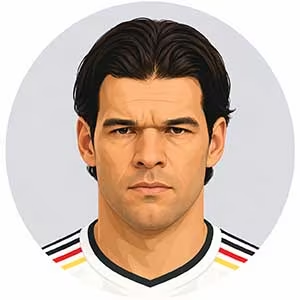
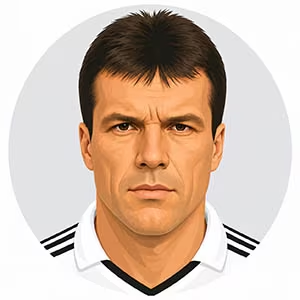
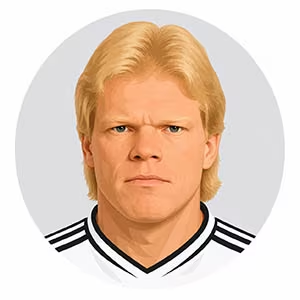
Germany - Centre MidfielderBallack, Michael
Michael Ballack defined the complete, dominant modern box-to-box central midfielder across European football throughout the 2000s. Emerging from Chemnitzer FC and winning a sensational, shock Bundesliga title under Otto Rehhagel at 1. FC Kaiserslautern in 1998, he developed into a devastating goalscoring talisman at Bayer Leverkusen, Bayern Munich, and Chelsea. Standing six-foot-two with an imperious aerial presence, broad physical power, and an explosive shooting repertoire off either boot, Ballack was an irresistible vertical force: crashing into the penalty box with perfectly timed third-man runs, burying headers over towering center-backs, and striking clean, thunderous drives from thirty yards. At Bayern, he swept three domestic doubles (2003, 2005, 2006) and was named German Footballer of the Year three times, later claiming the 2009–10 Premier League title and three FA Cups at Stamford Bridge. Across 98 caps and 42 goals for Germany, his international zenith arrived at the 2002 World Cup, where he almost single-handedly dragged a limited squad to the final—famously sacrificing his own participation in Yokohama by committing a professional foul against South Korea to preserve a 1–0 lead seconds after scoring the winner.
Yet for all his completeness, Ballack’s career was haunted by systemic tactical vulnerabilities and an iconic string of second-place finishes. His turning circle in tight central zones could be heavy against aggressive pressing swarms, and his linear sprint speed over large defensive distances left him vulnerable in open-field transitions. Tactically, his tendency to surge forward into the eighteen-yard box demanded an ultra-disciplined defensive anchor behind him to prevent midfield exposure. These constraints became painfully prominent during Leverkusen’s 2001–02 runner-up treble heartbreak and Chelsea’s 2008 Champions League final defeat in Moscow.
Stoic, demanding, and governed by an unforgiving standard of personal responsibility, Ballack led through sheer presence and competitive grit. He was not an emotional cheerleader; his authority was rooted in leading from the front when the pressure was suffocating. On the pitch, his body language was resolute and upright: he absorbed bruising tackles without rolling on the turf, stepped up to smash high-stakes penalties into the corner, and demanded tactical accountability from teammates with direct, no-nonsense gestures. Inside the German national team and Chelsea dressing rooms, he was an authoritative leader whose uncompromising personality occasionally caused friction with younger elements, but whose competitive backbone was unquestioned by managers from Rudi Völler to Carlo Ancelotti. Match officials found him a commanding presence who knew how to use his physical frame within the limits of the rules, leaving an enduring legacy as one of the most prolific, complete, and imposing central midfielders in German football history.