We use Google Analytics to understand how visitors use this site. Analytics cookies are only activated with your consent. For details, read our Privacy Policy.
Profile lensThe same player, read from a different angle.
Athletic80
Acceleration
68
Pace
71
Agility
75
Strength
93
Balance
92
Jumping
82
Stamina
66
Fitness
91
Technical47
Dribbling
55
Short Passing
63
Long Passing
64
Shot Accuracy
50
Shot Power
86
Shooting Technique
48
Heading
54
Free Kick
43
Penalties
47
First Touch
52
Mental86
Composure
84
Consistency
87
Leadership
93
Goalkeeping91
Reflexes
96
Positioning
92
Handling
90
Kicking
86
Goalkeeping91
Reflexes
96
Positioning
92
Handling
90
Kicking
86
Attacking52
Heading Accuracy
54
Shot Accuracy
50
Technique54
Dribbling
55
Free Kick
43
Short Passing
63
Long Passing
64
First Touch
52
Shot Technique
48
Physicality84
Shot Power
86
Jumping
82
Stamina
66
Strength
93
Fitness
91
Movement77
Acceleration
68
Pace
71
Agility
75
Balance
92
Mentality & Game Reading78
Composure
84
Penalties
47
Leadership
93
Consistency
87
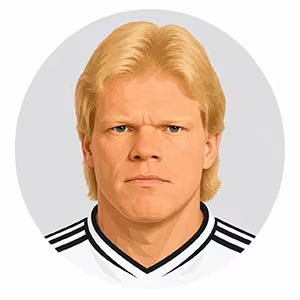
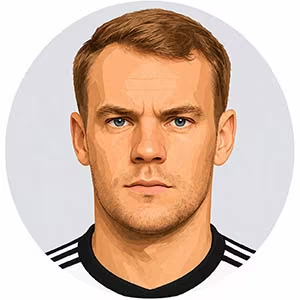
Germany - GoalkeeperKahn, Oliver
Oliver Kahn did not enter a match trying to make the goalmouth feel neutral. He widened his stance, projected his body towards the attacker and communicated with a volume and physical intensity that made his presence impossible to ignore. In one-on-one situations he could remain upright until the forward committed and then explode across the remaining angle, using shoulders, arms and legs to turn himself into a moving barrier. The same physicality appeared after saves: clenched fists, shouting, confrontational gestures towards teammates or opponents. Yet treating all of this as a single permanent state misses the evolution of his career. The goalkeeper who became notorious for emotional excess in the 1990s was not psychologically identical to the captain who led Bayern through the 2001 Champions League or the veteran who accepted losing Germany’s number-one position before the 2006 World Cup.
Technically, Kahn was an explosive shot-stopper whose compact, powerful build generated exceptional movement over short distances. His reactions were particularly strong against close-range shots and deflections, while aggressive angle reduction made him formidable when attackers broke through centrally. He possessed strong hands and could redirect powerful shots away from immediate danger, and his concentration allowed him to remain decisive after long periods without involvement. Bayern’s 2001 Champions League victory demonstrated another specialty: penalties. Kahn saved three Valencia kicks in the final shoot-out after Bayern had lost the 1999 final to two stoppage-time goals. At the 2002 World Cup he produced a succession of decisive saves as Germany reached the final while conceding only once before facing Brazil. His distribution was less sophisticated than that of later possession-oriented goalkeepers, but describing him as offering zero sweeping value is too extreme. Kahn could leave his area when required; what he was not was a goalkeeper whose primary tactical value came from operating permanently as an additional outfield player.
There were real limitations. Kahn’s technique with the ball at his feet was functional rather than creative, making him less naturally suited to structures requiring continuous short construction under pressure. His aggressive commitment could also become counterproductive if the timing was wrong: a goalkeeper trying to dominate an action physically has fewer recovery options once he has committed his body. Cross management was generally forceful but not flawless, particularly when traffic complicated his route towards the ball. More importantly, emotional intensity itself could become a performance cost. Kahn accumulated episodes in which confrontation ceased to serve the next save: charging opponents, grabbing players and the notorious 1999 incident in which he appeared to bite Heiko Herrlich’s neck during an altercation. These behaviours cannot be reclassified as useful intimidation simply because they belonged to a great goalkeeper. They consumed attention and created disciplinary risk. The 2002 World Cup final supplies another necessary boundary to mythology: after an extraordinary tournament, Kahn failed to hold Rivaldo’s shot and Ronaldo scored from the rebound. Elite pressure performance did not make catastrophic technical error impossible.
Psychologically, Kahn is best defined by **arousal calibration learned through excess**. His early and peak-career behaviour demonstrates genuinely high emotional aggression: frustration could become shouting, physical confrontation and occasionally bizarre retaliatory behaviour. But Kahn later reflected explicitly on the psychological demands of goalkeeping and on learning to channel rather than merely maximise intensity. The most revealing evidence came before the 2006 World Cup. Jürgen Klinsmann chose Jens Lehmann as Germany’s starting goalkeeper after a prolonged and highly public competition. Kahn was deeply disappointed and initially needed time to process the decision, but chose to remain in the squad rather than withdraw. Before the quarter-final shoot-out against Argentina, he approached Lehmann, shook his hand and offered encouragement; Germany advanced. Kahn then played the third-place match. The behaviour is striking because a younger version of his competitive identity had often treated rivalry as confrontation. Here, loss of the most important status available to him did not become sabotage, public rupture or refusal to contribute. Evidence therefore supports genuine development rather than timeless “mental strength”. His intensity remained visible, but the relationship with it changed. **Kahn’s competitive evolution was not from anger to calm; it was from assuming maximum arousal was always useful towards recognising that intensity had to remain below the point where it stopped serving the task.**