We use Google Analytics to understand how visitors use this site. Analytics cookies are only activated with your consent. For details, read our Privacy Policy.
Profile lensThe same player, read from a different angle.
Athletic81
Acceleration
75
Pace
71
Agility
83
Strength
90
Balance
77
Jumping
87
Stamina
68
Fitness
93
Technical48
Dribbling
60
Short Passing
63
Long Passing
66
Shot Accuracy
45
Shot Power
85
Shooting Technique
43
Heading
43
Free Kick
45
Penalties
30
First Touch
60
Mental90
Composure
90
Consistency
90
Leadership
91
Goalkeeping94
Reflexes
97
Positioning
98
Handling
92
Kicking
88
Goalkeeping94
Reflexes
97
Positioning
98
Handling
92
Kicking
88
Attacking44
Heading Accuracy
43
Shot Accuracy
45
Technique56
Dribbling
60
Free Kick
45
Short Passing
63
Long Passing
66
First Touch
60
Shot Technique
43
Physicality85
Shot Power
85
Jumping
87
Stamina
68
Strength
90
Fitness
93
Movement77
Acceleration
75
Pace
71
Agility
83
Balance
77
Mentality & Game Reading75
Composure
90
Penalties
30
Leadership
91
Consistency
90
Curated interpretation
Signature Moves
Role-defining patterns—not attributes, traits or Inner Game measures. Three ways Gianluigi Buffon changes the meaning of the role around him.
01
Second Skin
He organises a defence the way a conductor organises an orchestra.
02
Anchored
He stays in Serie B when leaving would have been easy.
03
Unarmored
He lets people see him feel it, in a position built on hiding that.
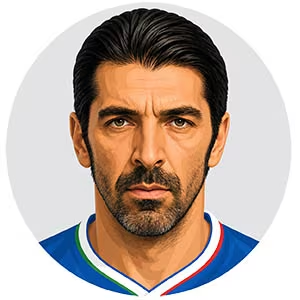
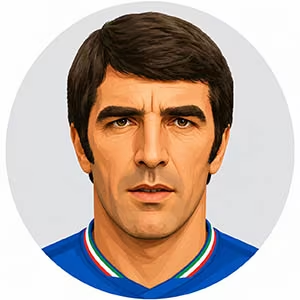
Italy - GoalkeeperBuffon, Gianluigi
Madrid, 3 April 2018, the ninety-third minute of a Champions League quarter-final. Juventus had overturned three goals in the Bernabéu, the tie was level, and Michael Oliver gave Real Madrid a penalty. Gianluigi Buffon — forty years old, in the last months of a twenty-three-year career, one match from a semi-final of the trophy he had never won — went at the referee with such fury that he was sent off, and continued arguing from the tunnel afterwards in language that made the front pages for a week. It was undignified, self-destructive and entirely characteristic. Everything Buffon ever did on a football pitch, he did with the volume turned all the way up.
Born in Carrara in 1978 into a family of athletes, Buffon debuted for Parma at seventeen against Milan and did not concede. He spent six seasons there, winning the UEFA Cup, the Coppa Italia and the European Super Cup in 1999 before joining Juventus in 2001 for a fee that remains the highest ever paid for a goalkeeper in real terms. His technique rarely depended on theatrical dives: he built everything on positional geometry and on reading a striker's hips a fraction before the shot, which made world-class saves look procedural. Tall and powerful with explosive short-step adjustments, he dominated low shot-stopping and smothered ground-level danger without spilling rebounds. Across seventeen seasons in Turin he made 685 appearances and won ten Serie A titles, five Coppe Italia and five Supercoppe, reaching three Champions League finals and losing all three. For Italy he collected 176 caps across five World Cups, captained the side for a decade, and won the 2006 World Cup conceding two goals in seven matches — one an own goal, one a penalty.
The flaws were persistent and well known to opponents. Buffon was hesitant on high aerial claims from set pieces throughout his career, preferring to stay on his line rather than commit, which left his centre-backs to defend crosses alone. His skill set was traditional and hands-first, and he was visibly uncomfortable playing out from the back in the sweeper-keeper era that arrived in his mid-thirties, producing occasional high-profile errors under sustained pressing. He also suffered serious back and shoulder injuries in his early Juventus years that cost him substantial time, and his concentration could lapse in matches with long periods of inactivity.
Psychologically he was an intoxicating, charismatic energy source who infected his backline with courage in the largest moments — the 2006 World Cup, where his authority held together a defence under enormous external pressure, remains the clearest example. He talked constantly, organised loudly, and led with a warmth and physical demonstrativeness that made him beloved in every dressing room he entered, far closer to Italian football's emotional tradition than to the cool professionalism of his contemporaries. That same volatility curdled regularly. He argued with referees to the point of self-harm, reacted to defeat with raw, impulsive outbursts he later regretted, and his conduct in the highest-tension matches periodically shattered the dignified figure he otherwise cut. The most revealing decision of his career came in 2006, when Juventus were relegated to Serie B weeks after he had won the World Cup: he stayed, played a season in the second division at twenty-eight in the prime of his career, and treated it as an obligation rather than a sacrifice. He also spoke publicly, years later and unusually for an Italian sportsman of his generation, about a difficult period in 2003 when he sought professional help and briefly lost his appetite for the game — an admission he made deliberately, to make the subject discussable for others. Away from the pitch he was gregarious, culturally curious, politically outspoken enough to attract criticism, and permanently present. Loud, loyal and emotionally uncontainable, Buffon played until he was forty-five because stopping would have required a calm he never possessed.