We use Google Analytics to understand how visitors use this site. Analytics cookies are only activated with your consent. For details, read our Privacy Policy.
Profile lensThe same player, read from a different angle.
Athletic78
Acceleration
79
Pace
73
Agility
84
Strength
78
Balance
74
Jumping
92
Stamina
65
Fitness
82
Technical45
Dribbling
59
Short Passing
58
Long Passing
56
Shot Accuracy
44
Shot Power
80
Shooting Technique
44
Heading
45
Free Kick
46
Penalties
44
First Touch
62
Mental81
Composure
82
Consistency
80
Leadership
82
Goalkeeping90
Reflexes
97
Positioning
89
Handling
87
Kicking
86
Goalkeeping90
Reflexes
97
Positioning
89
Handling
87
Kicking
86
Attacking45
Heading Accuracy
45
Shot Accuracy
44
Technique54
Dribbling
59
Free Kick
46
Short Passing
58
Long Passing
56
First Touch
62
Shot Technique
44
Physicality79
Shot Power
80
Jumping
92
Stamina
65
Strength
78
Fitness
82
Movement78
Acceleration
79
Pace
73
Agility
84
Balance
74
Mentality & Game Reading72
Composure
82
Penalties
44
Leadership
82
Consistency
80
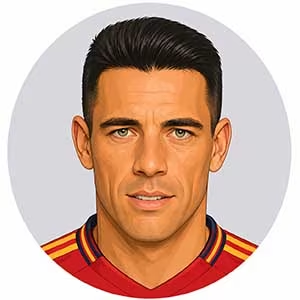
Spain - GoalkeeperBuyo, Paco
Buyo had begun football as an outfield player, and traces of that athletic background remained visible in goal. At approximately 1.79 metres he lacked the dimensions increasingly preferred for elite goalkeepers, compensating with explosive movement, agility and aggressive occupation of his area. Real Madrid itself identifies agility as his defining physical quality and records that he became first choice immediately after arriving from Sevilla in 1986, remaining the reference goalkeeper through the dominant domestic cycle of the Quinta del Buitre. His game was based on reactions rather than imposing reach: rapid lateral movement, strong reflexes, committed dives and the ability to close attackers quickly when defensive lines were breached. He was comfortable defending farther from his line than a purely reactive shot-stopper, an important property for a Madrid side that often pushed opponents backwards. His authority over defensive organisation was also explicit in his later technical explanations: discussing free kicks, he insisted that positioning the wall belonged to the goalkeeper and that the exposed side of goal became the keeper’s responsibility. Six league titles and sustained selection under different coaches testify to the effectiveness of that package, although seven senior caps for Spain show that domestic permanence did not translate into equivalent international status.
The same construction created identifiable failure conditions. Height was not merely an aesthetic objection: at 1.79 metres Buyo had less natural aerial coverage than larger goalkeepers and needed timing, movement and commitment to compensate. Fabio Capello made that limitation institutional in 1996, judging both Buyo and Santiago Cañizares too small and demanding the 1.90-metre Bodo Illgner instead. More broadly, Buyo’s proactive style could convert decisiveness into exposure. Coming quickly from goal shortened angles when correctly read but reduced recovery possibilities after a mistaken judgement; attempts to claim or intervene rather than remain passive consequently carried variance. His reflexes allowed spectacular recovery saves, but spectacular recovery should not be mistaken for technical cleanliness on every action. Nor was his distribution a defining creative weapon in the later sense of the goalkeeper as an additional build-up player. Age eventually removed some of the explosiveness on which his compensatory game depended. In 1995–96 he still made 31 league appearances, but Capello’s arrival changed the selection criteria abruptly: Illgner was recruited specifically for his physical dimensions, Cañizares became the reserve and Buyo moved outside the match squad. This was performance degradation through ageing combined with tactical-institutional preference, not evidence that pressure itself made him unreliable.
Buyo’s most discriminating psychological feature is confrontational territoriality without equivalent collapse under conflict. His goalkeeping projected ownership: he treated the penalty area, defensive organisation and decisions surrounding his position as matters over which the goalkeeper should exercise authority. That assertiveness existed inside a highly competitive personality and should not be flattened into generic “leadership”. The important distinction is between readiness for friction and what happened to his football afterwards. Buyo could become involved in disputes, respond visibly to opponents and inhabit the emotional temperature of matches rather than detach himself from it; this was not the same phenomenon as physical bravery when attacking a loose ball, and neither should automatically be scored as loss of composure. The evidence from his final season adds another contradiction. Capello effectively rejected the goalkeeper who had occupied Madrid’s goal for a decade, recruited Illgner because he wanted greater size and eventually omitted Buyo entirely. Buyo did not pretend indifference: contemporary reporting identified him among the senior players critical of their relegation under Capello. Yet his immediate public response to the most personally pointed element—the claim that he was too short—was humour. After Illgner arrived, Buyo climbed onto a stool in front of president Lorenzo Sanz and asked whether he was now tall enough for Capello. When excluded from the squad for the first time in ten seasons, he packed his equipment and trained with the other discarded players. That does not establish passive acceptance of authority; the reported criticism argues against it. It shows instead that status threat generated resistance without documented disciplinary withdrawal. Evidence is insufficient to score his response to teammates’ mistakes or sustained hostile crowds confidently, and his relatively combative match presence must not be converted automatically into referee instability. Buyo therefore occupies a useful psychological distinction: emotionally and territorially assertive, capable of confrontation and sensitive to challenges to his standing, yet with much weaker evidence that those reactions systematically degraded his subsequent performance.


 All Time Real MadridClub