We use Google Analytics to understand how visitors use this site. Analytics cookies are only activated with your consent. For details, read our Privacy Policy.
Profile lensThe same player, read from a different angle.
Athletic76
Acceleration
66
Pace
68
Agility
72
Strength
87
Balance
77
Jumping
82
Stamina
65
Fitness
94
Technical45
Dribbling
52
Short Passing
54
Long Passing
55
Shot Accuracy
44
Shot Power
84
Shooting Technique
42
Heading
55
Free Kick
48
Penalties
47
First Touch
53
Mental91
Composure
90
Consistency
93
Leadership
90
Goalkeeping90
Reflexes
88
Positioning
95
Handling
92
Kicking
86
Goalkeeping90
Reflexes
88
Positioning
95
Handling
92
Kicking
86
Attacking50
Heading Accuracy
55
Shot Accuracy
44
Technique51
Dribbling
52
Free Kick
48
Short Passing
54
Long Passing
55
First Touch
53
Shot Technique
42
Physicality82
Shot Power
84
Jumping
82
Stamina
65
Strength
87
Fitness
94
Movement71
Acceleration
66
Pace
68
Agility
72
Balance
77
Mentality & Game Reading80
Composure
90
Penalties
47
Leadership
90
Consistency
93
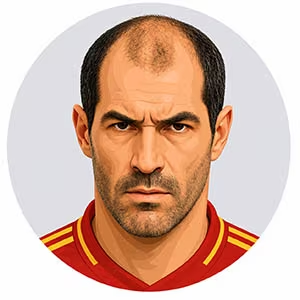
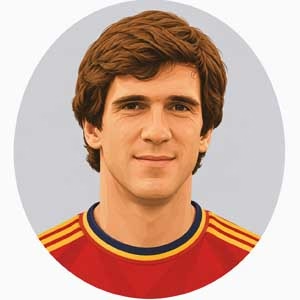
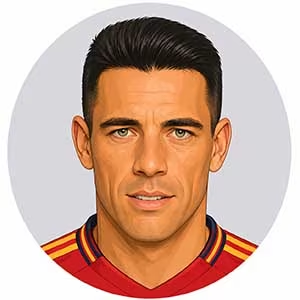
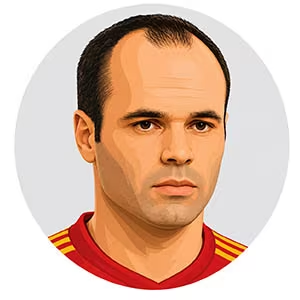
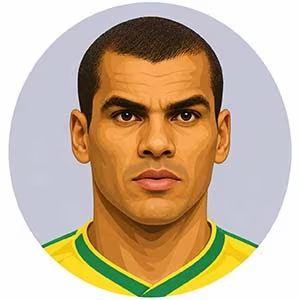
Spain - GoalkeeperZubizarreta, Andoni
Total sobriety, positional geometry, and a remarkably low-risk technical philosophy turned Andoni Zubizarreta Urreta into the most durable defensive pillar in Spanish football across the late 1980s and 1990s. Developed in the Basque heartland with Alavés and Athletic Club—where he anchored Javier Clemente’s aggressive, direct side to back-to-back La Liga titles in 1983 and 1984—Zubizarreta became the trusted custodian of Johan Cruyff’s revolutionary "Dream Team" at Barcelona from 1986 to 1994. Standing at six-foot-two, he was never a spectacular, acrobatic diver; his primary skill lay in cutting down angles early through disciplined footwork, smothering low drives, and catching cleanly to deny secondary rebounds. While he struggled with the radical demands of Cruyff’s sweeper-keeper philosophy due to limited technical fluency with his feet, his penalty-box command and shot-stopping reliability anchored Barcelona to four consecutive league crowns and the 1992 European Cup at Wembley. He closed his club career with four dependable seasons at Valencia, ultimately racking up 622 La Liga appearances (the all-time record for decades). For Spain, he earned 126 caps across four World Cups (1986 to 1998), though his international legacy was painfully tarnished in his final tournament when a catastrophic handling blunder against Nigeria in Nantes contributed to an early group-stage exit.
Psychologically, Zubizarreta was an intellectual, stoic, and deeply introspective leader who treated the goalkeeping craft as a solemn civic duty. He avoided personal vanity, eccentric antics, and emotional outbursts, serving as a tranquil, reassuring influence behind Barcelona’s ultra-offensive, often exposed three-man defensive line. His mental toughness was repeatedly tested by tactical friction with Cruyff, who openly criticized his limitations with the back-pass rule, yet Zubizarreta absorbed the pressure with dignity, working relentlessly in training to adapt rather than venting to the press. In the dressing room, he was an articulate, calm captain—a natural diplomat who balanced Basque pragmatism with the volatile egos of stars like Hristo Stoichkov and Romário. When the crushing trauma of the 1998 Nigeria mistake effectively ended his career on a tragic note, he faced the intense media storm without excuses, offering honest accountability in post-match interviews. Toward referees and opposing strikers, Zubizarreta was an absolute model of old-school sportsmanship: he never engaged in gamesmanship, avoided theatrical simulation, and commanded universal respect across Spanish stadiums as an honest, hardworking monument of the sport.