We use Google Analytics to understand how visitors use this site. Analytics cookies are only activated with your consent. For details, read our Privacy Policy.
Profile lensThe same player, read from a different angle.
Athletic72
Acceleration
65
Pace
63
Agility
72
Strength
80
Balance
79
Jumping
74
Stamina
60
Fitness
85
Technical37
Dribbling
49
Short Passing
52
Long Passing
52
Shot Accuracy
44
Shot Power
72
Shooting Technique
44
Heading
45
Free Kick
46
Penalties
0
First Touch
50
Mental85
Composure
88
Consistency
80
Leadership
86
Goalkeeping91
Reflexes
95
Positioning
95
Handling
87
Kicking
85
Goalkeeping91
Reflexes
95
Positioning
95
Handling
87
Kicking
85
Attacking45
Heading Accuracy
45
Shot Accuracy
44
Technique49
Dribbling
49
Free Kick
46
Short Passing
52
Long Passing
52
First Touch
50
Shot Technique
44
Physicality74
Shot Power
72
Jumping
74
Stamina
60
Strength
80
Fitness
85
Movement70
Acceleration
65
Pace
63
Agility
72
Balance
79
Mentality & Game Reading64
Composure
88
Penalties
0
Leadership
86
Consistency
80
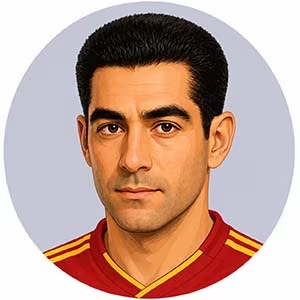
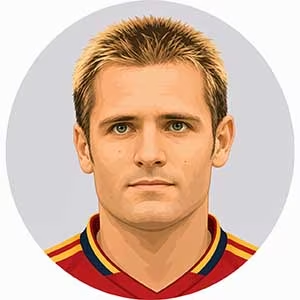
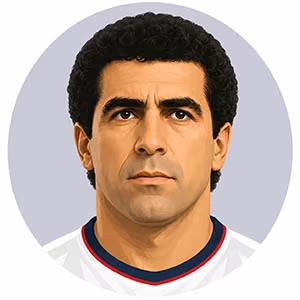
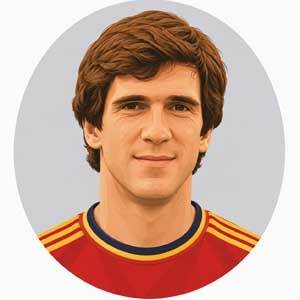
Spain - GoalkeeperArconada, Luis
Kneeling on the grass of the Parc des Princes with his head buried in his gloves as Michel Platini’s free-kick trickled under his torso remains one of the most agonizing snapshots in European tournament history, yet it represents a cruelly distorted footnote to an otherwise untouchable monument of Basque goalkeeping. Luis Miguel Arconada Etxarri—hailed simply across the peninsula as El Pulpo (The Octopus) for his uncanny ability to snare impossible shots—was the feline, acrobatic foundation of Spanish football’s early-1980s transition: a custodian whose lightning reflexes, commanding penalty-box presence, and revolutionary leg-block saves made him a national myth.
Arconada was an explosive shot-stopper who turned the six-yard box into his exclusive dominion. Standing just under six feet tall, he compensated for modest height with an extraordinary vertical leap, razor-sharp lateral recovery, and a signature reflex technique using his feet to deflect low, driven drives on the goal line. A lifelong one-club titan, he spent fifteen seasons as the undisputed soul and captain of Real Sociedad between 1974 and 1989 across 551 official matches. Under Alberto Ormaetxea, he was the defensive wall that propelled the San Sebastián side to back-to-back La Liga championships (1980–81, 1981–82), the 1982 Supercopa de España, the 1986–87 Copa del Rey, and the semi-finals of the 1982–83 European Cup, winning the Zamora Trophy for three consecutive seasons (1980, 1981, 1982). For Spain, across 68 caps (many as captain), he was the heroic, penalty-saving spearhead of the squad across two World Cups (1978, 1982) and two European Championships (1980, 1984), carrying La Roja to the Euro '84 final through a string of masterclasses before the tragic Paris mistake.
His hyper-athletic, reflex-heavy style, however, operated within specific mechanical parameters. Arconada was an instinctual line-goalkeeper and cross-puncher rather than a modern, ball-playing sweeper-keeper who stepped thirty yards out of his area to initiate passing sequences with his feet. On swinging, heavily congested corners in wet winter conditions, his aggressive decision to punch under heavy physical contact occasionally created chaotic second-ball scrambles around the edge of his penalty area. Furthermore, the immense psychological shadow cast by his 1984 final error, coupled with a catastrophic anterior cruciate ligament injury in 1985, abruptly curtailed his international longevity.
Proud, fiercely independent, and carrying the quiet, unyielding stoicism of his Guipuzcoan roots, Arconada was an intimidating, aristocratic leader who commanded unconditional reverence from his defenders. He was immune to stadium whistles and political pressure, famously wearing his distinct, unbranded white socks and plain jerseys regardless of commercial mandates. On the pitch, his presence radiated pure, coiled intensity: staring down approaching strikers in one-on-one isolations, barking sharp positional corrections with icy authority, and pulling off physics-defying reflex saves without performative theatricality. Inside the Atotxa and Spanish dressing rooms, his moral authority was absolute—an untouchable patriarch whose technical heroism, tragic fallibility, and immense personal courage cemented an enduring legacy as one of the most iconic, revered goalkeepers the Iberian game has ever produced.


 All Time SpainNT