We use Google Analytics to understand how visitors use this site. Analytics cookies are only activated with your consent. For details, read our Privacy Policy.
Profile lensThe same player, read from a different angle.
Athletic78
Acceleration
69
Pace
70
Agility
74
Strength
85
Balance
80
Jumping
85
Stamina
62
Fitness
95
Technical43
Dribbling
48
Short Passing
56
Long Passing
55
Shot Accuracy
44
Shot Power
82
Shooting Technique
43
Heading
45
Free Kick
48
Penalties
44
First Touch
55
Mental92
Composure
91
Consistency
94
Leadership
86
Goalkeeping91
Reflexes
92
Positioning
95
Handling
89
Kicking
87
Goalkeeping91
Reflexes
92
Positioning
95
Handling
89
Kicking
87
Attacking45
Heading Accuracy
45
Shot Accuracy
44
Technique51
Dribbling
48
Free Kick
48
Short Passing
56
Long Passing
55
First Touch
55
Shot Technique
43
Physicality82
Shot Power
82
Jumping
85
Stamina
62
Strength
85
Fitness
95
Movement73
Acceleration
69
Pace
70
Agility
74
Balance
80
Mentality & Game Reading79
Composure
91
Penalties
44
Leadership
86
Consistency
94
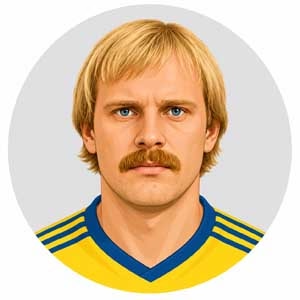
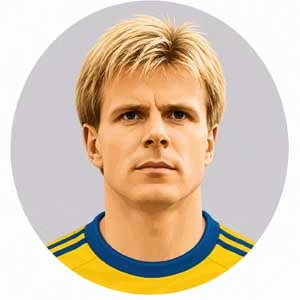
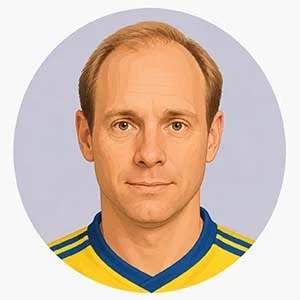
Sweden - GoalkeeperRavelli, Thomas
A fiery, expressive demeanor between the posts, extraordinary lateral elasticity, and high-pressure penalty-saving ability turned Thomas Ravelli into the defining Nordic goalkeeping icon of the 1980s and 1990s. Emerging from Östers IF—where he won two Allsvenskan titles (1980, 1981)—the Vimmerby-born shot-stopper cemented his domestic dominance across nearly a decade with IFK Göteborg, securing six more Swedish league championships and reaching the UEFA Champions League group stages. Standing six-foot-one with quick reflexes, a strong vertical leap, and remarkable agility on low skidding drives, Ravelli excelled in one-on-one standoffs: he stayed on his feet until the absolute final fraction of a second, using his reach and wide spread to narrow angles effectively. His career reached its global peak at the 1994 World Cup in the United States: pulling off miraculous saves throughout the tournament, his iconic shootout denial of Romania's Miodrag Belodedici in the quarter-finals propelled Sweden to a historic third-place bronze medal. With 143 caps for Sweden across nearly two decades, he stood for years as the country’s most-capped international player.
Tactically and technically, however, Ravelli’s eccentric style carried notable vulnerabilities. His handling on high aerial crosses in crowded boxes could be erratic, often preferring to punch or flap at the ball rather than securing a clean catch under heavy contact. Furthermore, his distribution with the ball at his feet was strictly conventional for the pre-back-pass era, looking uncomfortable when pressed into hurried clearances, while his emotional volatility on the pitch occasionally led to rash decisions and spatial misjudgments on set pieces.
Combative, hyper-expressive, and thrives on psychological friction, Ravelli treated the penalty area as a dramatic arena where he sought to dominate opponents through mind games and theatrical intensity. He never hid his emotions: a missed clearance or a defensive lapse would trigger animated shouting matches with his defenders, yet he channeled that same adrenaline into match-winning saves seconds later. On the pitch, his competitive motor was relentless; he lived to unsettle penalty-takers through sudden movements, intense eye contact, and vocal chatter on the goal line. Inside the Swedish national team and IFK Göteborg dressing rooms, he was an energetic, emotional talisman—intensely vocal, fiercely competitive, and capable of rallying the squad through sheer passion during grueling knockout fixtures. When opposing forwards tried to bump him or obstruct his vision on corner kicks, Ravelli responded with fiery physical resistance and immediate verbal pushback. Referees found him an exhausting, highly vocal presence who constantly questioned calls, while opponents universally feared his ability to turn shootouts into psychological traps, leaving an enduring legacy as one of the most charismatic, clutch, and unforgettable tournament goalkeepers of modern Swedish football.

 All Time SwedenNT