We use Google Analytics to understand how visitors use this site. Analytics cookies are only activated with your consent. For details, read our Privacy Policy.
Profile lensThe same player, read from a different angle.
Athletic78
Acceleration
69
Pace
68
Agility
82
Strength
88
Balance
78
Jumping
86
Stamina
66
Fitness
85
Technical43
Dribbling
51
Short Passing
54
Long Passing
56
Shot Accuracy
44
Shot Power
84
Shooting Technique
43
Heading
46
Free Kick
45
Penalties
44
First Touch
53
Mental88
Composure
89
Consistency
86
Leadership
86
Goalkeeping92
Reflexes
96
Positioning
94
Handling
92
Kicking
87
Goalkeeping92
Reflexes
96
Positioning
94
Handling
92
Kicking
87
Attacking45
Heading Accuracy
46
Shot Accuracy
44
Technique50
Dribbling
51
Free Kick
45
Short Passing
54
Long Passing
56
First Touch
53
Shot Technique
43
Physicality82
Shot Power
84
Jumping
86
Stamina
66
Strength
88
Fitness
85
Movement74
Acceleration
69
Pace
68
Agility
82
Balance
78
Mentality & Game Reading76
Composure
89
Penalties
44
Leadership
86
Consistency
86
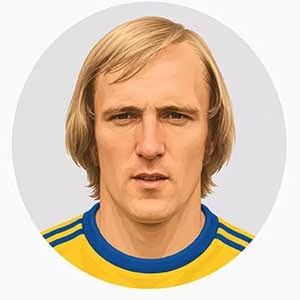
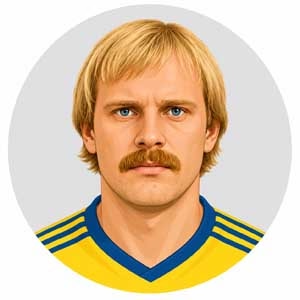
Sweden - GoalkeeperHellström, Ronnie
The floodlit drama of the 1974 World Cup in West Germany turned an agile, mustachioed Swede from Malmö into a global sensation, outperforming Sepp Maier and Dino Zoff to be widely recognized as the premier shot-stopper of the tournament. Ronnie Carl Hellström was the elastic, reflex-driven pioneer who revolutionized Swedish goalkeeping through breathtaking horizontal spring, razor-sharp reaction speed on close-range volleys, and innovative counter-attacking distribution via long, pinpoint underarm throws. Emerging at Hammarby IF—where he won the Swedish Guldbollen in 1971 and 1978—he spent a legendary decade in the Bundesliga anchoring 1. FC Kaiserslautern across 266 league appearances, becoming an untouchable cult icon at the Betzenberg and guiding the club to two DFB-Pokal finals and the 1982 UEFA Cup semi-finals. For Sweden, across 77 caps between 1968 and 1980, he competed across three World Cups (1970, 1974, 1978), earning a historic top-six finish in the Ballon d'Or voting in both 1974 and 1978—an extraordinary individual milestone for a goalkeeper in that era.
Hellström’s high-energy, proactive approach operated within clear physical boundaries. Standing just under six feet tall, he lacked the modern aerial bulk required to dominate congested six-yard boxes through pure height, forcing him to rely on impeccable timing, punching clearances, and physical bravery when challenged by bruising European target men on high set pieces. Furthermore, in the twilight of his career at Kaiserslautern, recurring back stiffness and muscular strains slightly diminished his explosive recovery speed on second-phase rebounds.
Charismatic, warm, and possessing an infectious, joyful love for the sport, Hellström played with the radiant freedom of a natural entertainer. He was deeply loved across Germany and Sweden for his unpretentious personality: bantering with rival forwards, signing autographs for hours outside the stadium, and displaying immense moral courage—famously joining protests alongside the Mothers of the Plaza de Mayo during the 1978 World Cup in Argentina despite intense political pressure. On the pitch, his presence was electric and brave: leaping into clusters of boots without self-preservation and bouncing back to his feet with an easy smile. Inside the Kaiserslautern and Swedish dressing rooms, he was an untouchable patriarch whose tactical intuition and sportsmanship earned the profound respect of legends like Franz Beckenbauer and Johan Cruyff, leaving behind an immortal legacy as the greatest, most beloved Swedish goalkeeper of the 20th century.


 All Time SwedenNT