We use Google Analytics to understand how visitors use this site. Analytics cookies are only activated with your consent. For details, read our Privacy Policy.
Profile lensThe same player, read from a different angle.
Athletic74
Acceleration
63
Pace
66
Agility
73
Strength
87
Balance
76
Jumping
82
Stamina
68
Fitness
80
Technical42
Dribbling
47
Short Passing
52
Long Passing
59
Shot Accuracy
42
Shot Power
82
Shooting Technique
42
Heading
44
Free Kick
41
Penalties
44
First Touch
55
Mental85
Composure
86
Consistency
83
Leadership
83
Goalkeeping87
Reflexes
86
Positioning
86
Handling
88
Kicking
86
Goalkeeping87
Reflexes
86
Positioning
86
Handling
88
Kicking
86
Attacking43
Heading Accuracy
44
Shot Accuracy
42
Technique49
Dribbling
47
Free Kick
41
Short Passing
52
Long Passing
59
First Touch
55
Shot Technique
42
Physicality80
Shot Power
82
Jumping
82
Stamina
68
Strength
87
Fitness
80
Movement70
Acceleration
63
Pace
66
Agility
73
Balance
76
Mentality & Game Reading74
Composure
86
Penalties
44
Leadership
83
Consistency
83
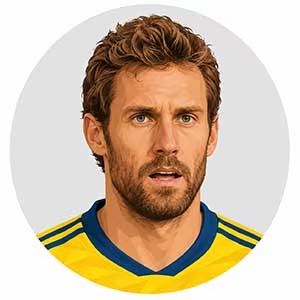
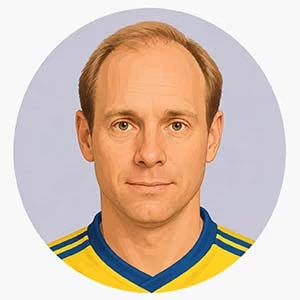
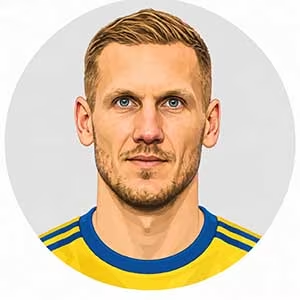
Sweden - GoalkeeperIsaksson, Andreas
A staggering triple-save against the Netherlands in 2004 announced to European football that Sweden had uncovered the rightful heir to Thomas Ravelli’s international mantle. Andreas Isaksson was the towering, six-foot-six shot-stopping pillar who anchored the Swedish national team across an extraordinary decade and a half of major tournaments. Operating with immense wingspan, exceptional ground-level reach on low drives, and a calm, positional economy that rarely required desperate theatrics, Isaksson dominated his goalmouth through reach and angle reduction. Forged at Trelleborg and Djurgården—where he claimed back-to-back Allsvenskan titles in 2002 and 2003—he established his European pedigree across stints with Rennes, Manchester City, PSV Eindhoven (lifting the 2008 Johan Cruyff Shield), and Kasımpaşa. For Sweden, across 133 caps between 2002 and 2016 (third-most in national history), he served as the undisputed starting goalkeeper across two World Cups (2002, 2006) and four consecutive European Championships (2004, 2008, 2012, 2016), famously keeping clean sheets in hostile knockout environments.
His towering frame, however, brought inevitable mechanical limitations. Isaksson was an orthodox, goal-line custodian rather than an adventurous sweeper-keeper; his lateral mobility outside the penalty box was deliberate and heavy, and his distribution with his feet under intense forward pressing was strictly pragmatic, often resorting to long, high-risk clearances downfield. Furthermore, his early years in the Premier League at Manchester City were repeatedly disrupted by ankle and knee ailments that occasionally compromised his lateral sharpness against skidding, low shots.
Monastic, soft-spoken, and completely immune to the vanity of modern football stardom, Isaksson approached goalkeeping with understated Scandinavian stoicism. He never engaged in hysterical screaming matches with his center-backs or played to the cameras, resetting his defensive block through quiet, focused hand signals. On the pitch, his body language was steady and reassuring, standing tall to demoralize opposing forwards in one-on-one standoffs through sheer physical presence. Inside the Swedish and PSV locker rooms, he was an indispensable elder statesman—a quiet professional whose reliability in penalty shootouts and tournament pressure earned the deep reverence of captains like Zlatan Ibrahimović and Olof Mellberg, cementing an enduring legacy as one of the most durable and consistent international goalkeepers in modern Nordic football history.