We use Google Analytics to understand how visitors use this site. Analytics cookies are only activated with your consent. For details, read our Privacy Policy.
Profile lensThe same player, read from a different angle.
Athletic84
Acceleration
83
Pace
78
Agility
77
Strength
84
Balance
82
Jumping
85
Stamina
88
Fitness
92
Technical79
Dribbling
76
Short Passing
77
Long Passing
80
Finishing
66
Shot Accuracy
66
Shot Power
84
Shooting Technique
74
Heading
81
Tackling
87
Crossing
77
Free Kick
65
Penalties
64
First Touch
79
Mental88
Composure
84
Aggression
88
Consistency
89
Creativity
68
Leadership
89
Work Rate
96
Tactical80
Vision
74
Off the Ball
72
Defensive Positioning
79
Teamwork
83
Anticipation
83
Marking
87
Player Traits
Attacking72
Crossing
77
Finishing
66
Heading Accuracy
81
Shot Accuracy
66
Off the Ball
72
Technique75
Dribbling
76
Free Kick
65
Short Passing
77
Long Passing
80
First Touch
79
Shot Technique
74
Movement80
Acceleration
83
Pace
78
Agility
77
Balance
82
Physicality87
Shot Power
84
Jumping
85
Stamina
88
Strength
84
Fitness
92
Defending84
Marking
87
Tackling
87
Def. Positioning
79
Mentality & Game Reading82
Aggression
88
Composure
84
Penalties
64
Vision
74
Leadership
89
Work Rate
96
Teamwork
83
Anticipation
83
Consistency
89
Creativity
68
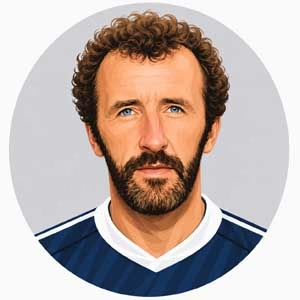
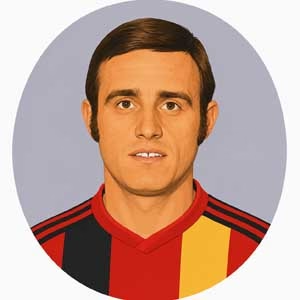
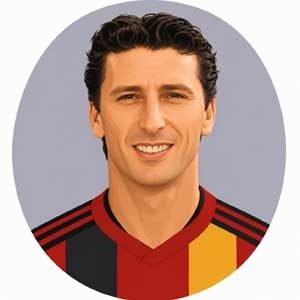
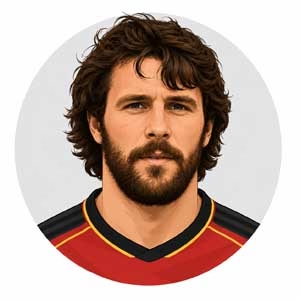
Belgium - Right BackGerets, Eric
There is a photograph of Eric Gerets that circulated for years in Belgium: shirt untucked, hair plastered to his forehead, arm outstretched, screaming at a teammate roughly forty metres away while the ball is still in play at the other end of the pitch. It captures the essential fact about him. Gerets was a right-back who governed a football match by refusing, for ninety minutes, to allow anyone near him to relax.
Born in Rekem in 1954 and nicknamed De Leeuw van Vlaanderen — the Lion of Flanders — he was the defining Belgian defender of his generation and one of the most complete full-backs in European football between 1975 and 1992. He was not a great athlete by modern standards, standing 1.76m with respectable but unremarkable pace, and he compensated with positional intelligence, ferocious competitive stamina, and an aggression in the duel that arrived early and left a mark. He defended narrow, tucked in to protect the centre-backs, and attacked in disciplined bursts rather than as a constant outlet, which made him valuable in systems that could not afford an exposed flank. He began at Standard Liège, where he won two Belgian titles and reached the 1982 Cup Winners' Cup final, then moved to Milan, briefly to MVV Maastricht, and finally to PSV Eindhoven, where the last chapter of his career became the best of it: three consecutive Eredivisie titles and the 1988 European Cup, won as captain of a side that also completed the treble that season. For Belgium he collected 86 caps across four World Cups and two European Championships, captaining the team to fourth place at Mexico 1986 and playing in the 1980 European Championship final. He carried, and never fully escaped, the shadow of the Standard Liège bribery scandal of 1982, which brought a suspension and remained attached to his name long after he had rebuilt his career in the Netherlands.
His weaknesses were structural rather than temperamental. Gerets was vulnerable to genuinely quick, direct wingers in isolated one-against-one situations, particularly in open space behind him, and his instinct to step forward into the duel could be exploited by opponents who played early balls into the channel he had just vacated. He committed fouls at a high rate and accumulated cards for persistent infringement and dissent, and in matches where his side was already reduced or already booked, that habit became a liability the coach had to manage rather than trust.
He was, above all, an organizer who led through volume and confrontation. Gerets talked without pause — instructing, correcting, demanding a step up from the defensive line, and turning immediately on any teammate who had switched off — and he did it with a bluntness that made him respected rather than beloved inside the dressing room. He argued with referees over every marginal decision, treated an opponent's provocation as an invitation rather than a threat, and visibly raised his intensity in hostile stadiums and against superior opposition, playing his best football when the occasion was largest. Younger players described him as a difficult teammate to satisfy and an indispensable one to have, since his standards were applied to himself first and abandoned for nobody. The 1982 scandal marked him permanently, and the response was a decade of relentless professionalism that answered the accusation without ever addressing it directly. Away from the pitch he was disciplined, family-oriented and unglamorous, a man with no interest in nightlife who spent his career preparing obsessively and later carried the same authoritarian intensity into management across Belgium, the Netherlands, Turkey, Morocco and the Gulf. Combative, unsentimental and permanently switched on, Gerets was the rare defender whose personality was itself a tactical instrument.


 All Time BelgiumNT