We use Google Analytics to understand how visitors use this site. Analytics cookies are only activated with your consent. For details, read our Privacy Policy.
Profile lensThe same player, read from a different angle.
Athletic84
Acceleration
83
Pace
82
Agility
80
Strength
76
Balance
82
Jumping
85
Stamina
91
Fitness
93
Technical76
Dribbling
71
Short Passing
75
Long Passing
79
Finishing
54
Shot Accuracy
62
Shot Power
82
Shooting Technique
67
Heading
80
Tackling
85
Crossing
76
Free Kick
65
Penalties
60
First Touch
75
Mental88
Composure
85
Aggression
78
Consistency
92
Creativity
66
Leadership
87
Work Rate
91
Tactical80
Vision
74
Off the Ball
65
Defensive Positioning
83
Teamwork
86
Anticipation
84
Marking
86
Player Traits
Attacking67
Crossing
76
Finishing
54
Heading Accuracy
80
Shot Accuracy
62
Off the Ball
65
Technique72
Dribbling
71
Free Kick
65
Short Passing
75
Long Passing
79
First Touch
75
Shot Technique
67
Movement82
Acceleration
83
Pace
82
Agility
80
Balance
82
Physicality85
Shot Power
82
Jumping
85
Stamina
91
Strength
76
Fitness
93
Defending85
Marking
86
Tackling
85
Def. Positioning
83
Mentality & Game Reading80
Aggression
78
Composure
85
Penalties
60
Vision
74
Leadership
87
Work Rate
91
Teamwork
86
Anticipation
84
Consistency
92
Creativity
66
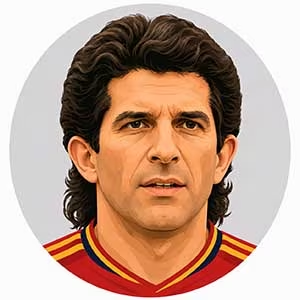
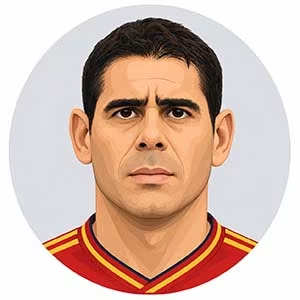
Spain - Right BackChendo
Diego Armando Maradona was famously neutralized at the Santiago Bernabéu on September 16, 1987, not by a legion of tactical sweepers, but by a tireless local right-back who marked him with such surgical, legal tenacity that he famously executed a clean nutmeg on the Argentine maestro along the touchline. Miguel Porlán Noguera—known universally by his childhood moniker Chendo—was the blue-collar, unyielding defensive anchor of Real Madrid’s legendary Quinta del Buitre era. Stationed on the right side of defense across seventeen seasons, the Totana-born full-back was an uncompromising one-on-one stopper: using a low center of gravity, flawless sliding recovery timing, and relentless cardiovascular endurance to shut down Europe’s most flamboyant wingers. Across 497 official matches for Los Blancos between 1982 and 1998, he collected seven La Liga championships, two Copas del Rey, back-to-back UEFA Cups (1985, 1986), and closed his playing career by lifting the elusive Séptima—the 1997–98 UEFA Champions League in Amsterdam. For Spain, across 26 caps, he was the starting right-back across two World Cups (1986 in Mexico and 1990 in Italy).
Yet Chendo’s profile was rooted strictly in classical, defense-first orthodoxy. He offered virtually nothing in terms of dynamic, modern overlapping attacking play: his crossing from deep wide angles was functional rather than threatening, his technical dribbling in the final third was basic, and his presence inside the opponent's eighteen-yard box was almost non-existent (scoring just three goals in his entire career).
Stoic, humble, and fiercely loyal to the white shirt, Chendo was the ultimate anti-celebrity footballer. While teammates like Emilio Butragueño and Míchel dominated magazine covers, Chendo took pride in the unglamorous, bruising dirty work required to secure clean sheets. On the pitch, his presence was understated and fearless: absorbing heavy physical collisions without rolling on the turf, executing clean ball-and-all tackles, and refusing to engage in verbal provocation. Inside the Chamartín locker room, he was an indispensable, universally beloved cultural bedrock whose selfless professionalism set the moral tone for the squad, later serving the club for decades as its iconic match-day delegate. Opposing wingers universally dreaded the exhausting physical battle of facing him over ninety minutes, leaving behind an immortal legacy as the definitive, honest defender of Real Madrid’s modern history.