



We use Google Analytics to understand how visitors use this site. Analytics cookies are only activated with your consent. For details, read our Privacy Policy.
Profile lensThe same player, read from a different angle.
Athletic82
Acceleration
84
Pace
80
Agility
83
Strength
85
Balance
90
Jumping
77
Stamina
77
Fitness
77
Technical92
Dribbling
92
Short Passing
91
Long Passing
88
Finishing
97
Shot Accuracy
98
Shot Power
93
Shooting Technique
93
Heading
75
Tackling
48
Crossing
83
Free Kick
82
Penalties
87
First Touch
94
Mental88
Composure
88
Aggression
77
Consistency
86
Creativity
92
Leadership
94
Work Rate
80
Tactical87
Vision
90
Off the Ball
93
Defensive Positioning
37
Teamwork
83
Anticipation
85
Marking
33
Player Traits
Attacking 89
Crossing
83
Finishing
97
Heading Accuracy
75
Shot Accuracy
98
Off the Ball
93
Technique 90
Dribbling
92
Free Kick
82
Short Passing
91
Long Passing
88
First Touch
94
Shot Technique
93
Movement 84
Acceleration
84
Pace
80
Agility
83
Balance
90
Physicality 82
Shot Power
93
Jumping
77
Stamina
77
Strength
85
Fitness
77
Defending 39
Marking
33
Tackling
48
Def. Positioning
37
Mentality & Game Reading 86
Aggression
77
Composure
88
Penalties
87
Vision
90
Leadership
94
Work Rate
80
Teamwork
83
Anticipation
85
Consistency
86
Creativity
92
Curated interpretation
Signature Moves
Role-defining patterns—not attributes, traits or Inner Game measures. Three ways Ferenc Puskás changes the meaning of the role around him.
01
Heavy Body, Light Touch
A seemingly unathletic frame carries exquisite technique, exceptional coordination and an improbably delicate touch.
02
Left-Footed Law
His left foot becomes a law of the game in its own right: historic power, precision and naturalness.
03
No Second Chances
When the opening appears, he tends to turn it into a goal immediately—the mentality of an absolute finisher.
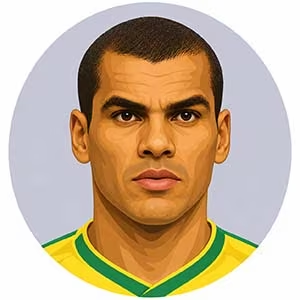
Hungary - ForwardPuskás, Ferenc
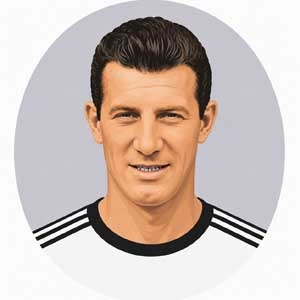
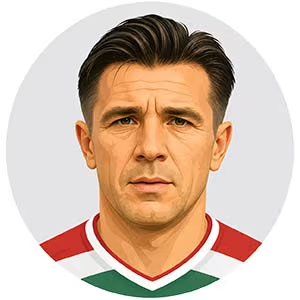
Born in Kispest in 1927, Puskás was a pure left-footer of extraordinary technical range: he barely used his right foot at all, and never needed to. He was not fast, not strong in the air, and visibly out of shape by the standards of any era, and none of it mattered, because his left foot could pass, shoot, dribble and disguise with a precision nobody could contain. He operated as an inside-forward and attacking midfielder, dropping to construct and arriving to finish, and his shooting from distance was among the most powerful the game had seen. He scored 358 goals in 350 matches for Budapest Honvéd, won five Hungarian titles, and was the leader and top scorer of the Golden Team — Olympic champions in 1952, unbeaten for four years, and losers of the 1954 World Cup final to West Germany while carrying an injury he had insisted on playing through. He was 31, out of match condition, and had been suspended by FIFA for eighteen months following the 1956 revolution — which stranded the Honvéd squad abroad on tour and turned him into an exile — when Real Madrid signed him. He then scored 243 goals in 262 matches, won five La Liga titles, three European Cups, and the 1960 Intercontinental Cup, including four goals in the 7–3 demolition of Eintracht Frankfurt at Hampden Park. He played until 38. Across 85 internationals for Hungary he scored 84 goals, and he later added four caps for Spain.
His physical profile was a permanent limitation that only his technique concealed. Puskás had no pace, no aerial presence, and no defensive contribution whatsoever, and his conditioning was a running problem throughout his career — he arrived in Madrid so heavy that the club initially doubted the signing, and he had to be reduced to playing weight before his debut. He was one-footed to an extreme degree that intelligent defenders could exploit by showing him onto his right, and in matches that became physical and fast rather than technical he could be marginalised. His whole late career depended on playing in a team that gave him the ball in advanced positions and asked nothing else of him.
He was a natural, unmistakable leader with an outsized personality to match. Puskás captained Hungary as a young man with total authority, held the rank of major in the army — hence the nickname the Galloping Major — and used that standing to protect and negotiate for his teammates, in a political system where such protection genuinely mattered. He was voluble, funny, endlessly sociable, and entirely without pretension: he made friends immediately in Spain, learned the language quickly, joked with opponents and referees, and was famous for a warmth that survived exile, a change of country and a change of language. On the pitch he was competitive but not aggressive — he fouled rarely, retaliated almost never, and argued with officials without malice — and he responded to heavy marking by trying to solve it technically rather than by escalating. He was generous in a way that was unusual for a scorer of his volume, and his partnership with Di Stéfano at Madrid worked precisely because he deferred to a more domineering personality without ever losing his own standing; he famously handed Di Stéfano a goal that would have won him a scoring title. Away from football he was expansive and disorganised, fond of food and company, and he lived nearly forty years in exile from Hungary before returning to a hero's welcome after the fall of communism. Round, joyful and technically untouchable, Puskás won everything twice, in two countries, in two languages, and made all of it look like a good time.